Essential oils · Earthy family
Vetiver essential oil
Chrysopogon zizanioides
Hương bài · Poaceae
Dry earth and roots, with a thin layer of smoke. This is the heaviest oil in its group, and the smell barely changes all day.
The scent lives underground, not in the leaves. Harvest age affects oil yield and composition, so how long the roots were grown is a question worth asking the seller.
Many Vietnamese people know this plant from the bundles of hương bài burned at Lunar New Year long before they hear the name vetiver. The same root, two names.
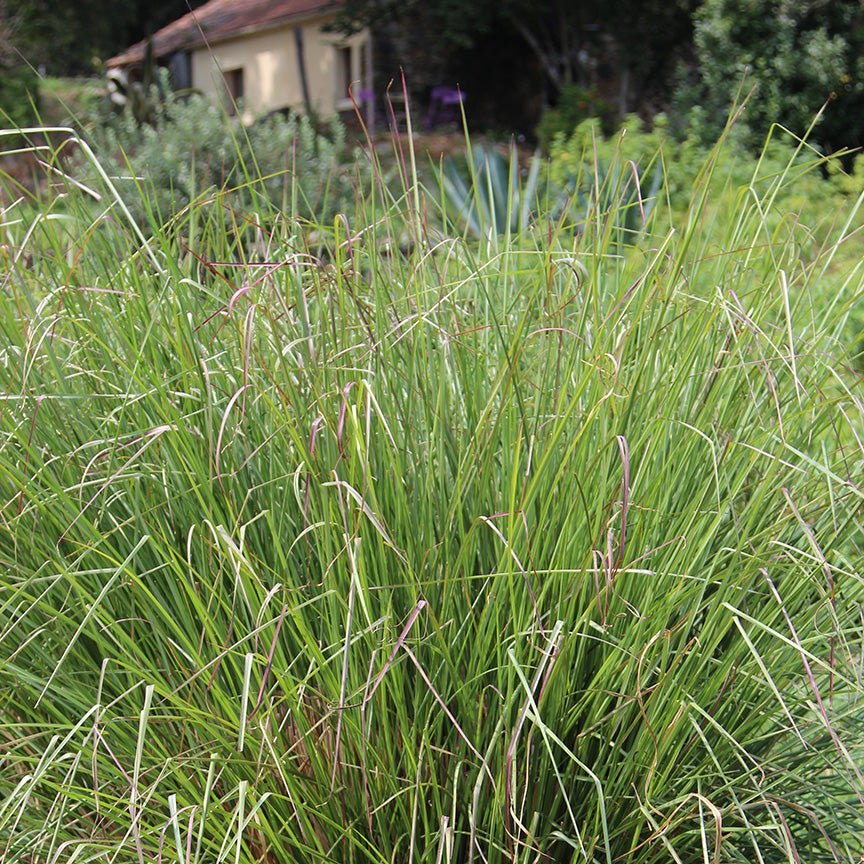
- Plant part
- Roots
- Vietnamese name
- Hương bài
- Scent family
- Earthy
- Plant family
- Poaceae
- Lots published
- —
 Roots
Composition profile
The published composition from the article, read as structure: 4 compounds adding up to about 32 % of the sample. Figures are printed as the source gives them — one sample, not a species average.
| Compound | Level | Class | Note |
|---|---|---|---|
| Khusimol | 3.4–13.7 % | — | — |
| Vetiselinenol | 1.3–7.8 % | — | — |
| α-Vetivone | 2.5–6.3 % | Ketones | Base |
| β-Vetispirene | 1.6–4.5 % | — | — |
By chemical class
- Unclassified26.0 %
- Ketones6.3 %
By note
- Base6.3 %
- Unclassified26.0 %
Group totals use the upper bound of each range and only the compounds the article lists; bars are relative to the identified total.
The compound behind the smell of vetiver
Vetiver oil is one of the most complex essential oils known to perfumery, made up of hundreds of sesquiterpenes and their derivatives. The major groups, such as α-vetivone, have long been known. Yet for decades nobody could say which compound actually makes people recognise “this is vetiver”.
In 2021 a study in Angewandte Chemie gave the answer: (+)-2-epi-ziza-6(13)en-3-one. The authors synthesised it in eleven steps and then evaluated it by smell. Its odour threshold is 29 picograms per litre of air, that is, 29 trillionths of a gram.
With a threshold that low, the compound only needs to be present at trace level to dominate the smell. It is the clearest example of something the article on trace compounds discusses: the tallest peak on a chromatogram is not necessarily the compound that decides the smell. A vetiver analysis therefore tells you a lot about origin and distillation, but rarely answers the question “does it smell good?”
Composition: many compounds, none dominant
| Compound | Nine origins (2006) | Reunion, 3 oils (2017) |
|---|---|---|
| Khusimol | 3.4–13.7% | 0.6–8.9% |
| Vetiselinenol | 1.3–7.8% | – |
| α-Vetivone | 2.5–6.3% | 8.4–13.3% |
| β-Vetivone | – | 2.2–3.7% |
| β-Vetispirene | 1.6–4.5% | – |
The 2006 study analysed commercial oils from Brazil, China, Haiti, India, Java, Madagascar, Mexico, Reunion and El Salvador, identified about 110 compounds, and found no significant differences in composition between origins. The Reunion column is three commercial oils in a 2017 review. A dash means it was not reported. In these samples even the largest compound reaches only about 14% of the oil; the Haitian vetiver page has figures for one specific lot.
Why the oil is thick and slow to distil
The oil sits in the roots, and most of it is heavy, high-boiling molecules. Steam has to pass through the root mass for much longer than with leaves to carry them out. The oil that results is thick, amber to brown, and pours slowly, like honey.
Because it evaporates so slowly, vetiver usually sits in the base of a perfume, keeping the upper layers from fading too quickly. The 2021 authors also wrote that the compound with the 29-picogram threshold is what gives the particular “aura” vetiver lends to a blend.
One plant, several names
The current scientific name is Chrysopogon zizanioides. Older literature, and many labels today, still give Vetiveria zizanioides; both names refer to the same species. In India the plant and its oil are also called khus. The international standard for the oil is ISO 4716:2013, confirmed in 2024.
Besides oil, vetiver is planted in dense rows to hold soil on embankments and slopes, because its roots grow straight down rather than spreading sideways. Since 1987 the World Bank has promoted vetiver hedgerows against erosion. In rows planted for that purpose the roots are left in the ground, not dug up for distillation.
Reading the label
Because it is expensive and complex, vetiver is often cut with cheaper oils of an earthy, woody character. Two things are worth asking the seller:
- Where the roots were grown and at what age they were harvested. Harvest age affects oil yield: a CSIR-CIMAP (India) trial recorded oil content of 1.30% at 8 months, 2.65% at 12 months and 1.85% at 14 months.
- The analysis of the lot. It does not prove the smell is beautiful, but it helps rule out lots stretched with other oils.
Sources
- Ouyang et al. (2021). The Smelling Principle of Vetiver Oil, Unveiled by Chemical Synthesis. Angewandte Chemie International Edition 60(11), 5666–5672. doi:10.1002/anie.202014609
- ISO 4716:2013. Oil of vetiver (Vetiveria zizanioides (L.) Nash), confirmed 2024.
- Champagnat P., Figueredo G., Chalchat J.-C., Carnat A.-P., Bessiere J.-M. (2006). A Study on the Composition of Commercial Vetiveria zizanioides Oils from Different Geographical Origins. Journal of Essential Oil Research 18(4), 416–422. doi:10.1080/10412905.2006.9699129
- Burger P., Landreau A., Watson M. et al. (2017). Vetiver Essential Oil in Cosmetics: What Is New? Medicines 4(2), 41. doi:10.3390/medicines4020041
- World Bank (1990). Vetiver Grass: The Hedge against Erosion, 3rd edition.
- CSIR-CIMAP. Vetiver harvest-age trial, document on vetiver.org.
Buy Vetiver
Vetiver oil: no lot has been brought in yet, so it is not on sale. Message us if you need it.
In the scent dictionary: Vetiver root — a description of the smell, the compounds behind it, and how to smell it for yourself.
Further reading
Close to Vetiver
Same plant family: Poaceae East Indian lemongrass · Java citronella · Lemongrass · Palmarosa
Also from the roots Angelica root · Haitian vetiver
Same method: direct steam distillation Cajeput · Clove basil · Copaiba · Fokienia · Holy basil (tulsi) · Rosemary ct camphor · Rosemary ct verbenone · Tarragon
Quick answers
What does vetiver essential oil smell like?
Dry earth and roots, with a thin layer of smoke. This is the heaviest oil in its group, and the smell barely changes all day.
What is the botanical name of vetiver oil?
The plant is Chrysopogon zizanioides, in the Poaceae family. In Vietnamese it is called hương bài.
How is vetiver oil produced?
From the roots of the plant, by direct steam distillation. See the method for what that does to the oil.
What are the main compounds of vetiver oil?
From the composition data on this page, the oil is led by α-Vetivone. Proportions vary with origin, harvest and method; a lot analysis is the only answer for a given bottle.
Last updated