Essential oils · Medicinal family
Ravintsara ct 1,8-cineole essential oil
Cinnamomum camphora ct. 1,8-cineole
Ravintsara · Lauraceae
Cool, clean, airy, close to eucalyptus but softer and sweeter. It lacks the harsh edge of blue gum eucalyptus.
The main compound is 1,8-cineole. What is remarkable is that the tree it comes from is the camphor tree itself, Cinnamomum camphora. Grown in Madagascar, its leaves contain almost no camphor and are rich in cineole instead, so the same species gives an oil entirely different from Asian camphor.
The name is a trap too. Ravintsara is often confused with ravensara, a completely different tree also from Madagascar, and the two names were used interchangeably for years. The botanical name and chemotype on this page are what untangle the confusion.
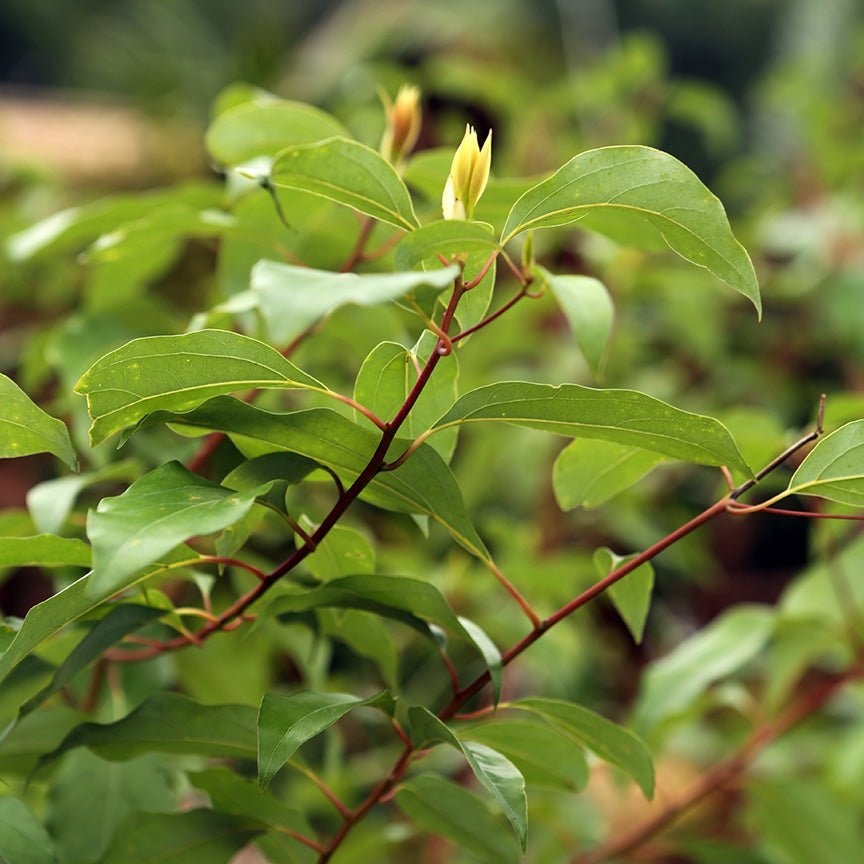
- Plant part
- Leaves
- Chemotype
- ct. 1,8-cineole
- Vietnamese name
- Ravintsara
- Scent family
- Medicinal
- Plant family
- Lauraceae
- Lots published
- —
 Leaves
Composition profile
The published composition from the article, read as structure: 1 compounds adding up to about 0 % of the sample. Figures are printed as the source gives them — one sample, not a species average.
| Compound | Level | Class | Note |
|---|---|---|---|
| 1,8-Cineole | — | Oxides | Top |
By chemical class
By note
Group totals use the upper bound of each range and only the compounds the article lists; bars are relative to the identified total.
Put it beside another oil in the Compare tool Which other oils are rich in 1,8-Cineole?
Ravintsara and ravensara: two trees, one muddled name
Madagascar produces two essential oils with almost identical names, and for years they were used interchangeably on labels, in books and online:
| Name | Species | What it is |
|---|---|---|
| Ravintsara | Cinnamomum camphora | The camphor tree grown in Madagascar, with leaves rich in 1,8-cineole |
| Ravensara | Ravensara aromatica | A tree native to Madagascar, in a different genus |
In 2010 Robert Tisserand, one of the longest-standing authors in the essential oil field, wrote that many books had described the characteristics of ravintsara while calling it ravensara. The two words are also often misspelled (ravinsara, ravensare and so on), which makes it even harder for readers to tell which is meant.
This page is ravintsara, that is, Cinnamomum camphora chemotype 1,8-cineole. It is the same species as camphor and ho wood, chemotype linalool, as the article on chemotypes explains.
True ravensara has four chemotypes
Confusing the two trees is not only a matter of names. A 2006 study in Flavour and Fragrance Journal analysed the leaf oil of 28 formally identified Ravensara aromatica trees and sorted them into four chemotypes:
| Chemotype | Main compounds |
|---|---|
| Methyl chavicol | Over 90% |
| Methyl eugenol | 74–82% |
| α-Terpinene and limonene | 25–28% and 15–22% |
| Sabinene, linalool, terpinen-4-ol | 25–34%, 7–21%, 6–12% |
The first two types are rich in methyl chavicol (estragole) and methyl eugenol, two compounds closely monitored in cosmetics and food, for which IFRA sets limits. According to Tisserand, ravensara bark oil also contains 90–95% estragole.
In other words, a bottle labelled “ravensara” could be cineole-rich ravintsara, but it could also be an oil that is almost entirely estragole. With ravensara, the name on the label is not enough; only the lot analysis says what it is.
Ravintsara and “ho leaf”
Tisserand also pointed out that ravintsara is essentially the same species and chemotype as Chinese ho leaf oil, chemotype cineole. The same tree, grown in different places, sold under two trade names. The questions to ask the seller are therefore where the leaves come from, and how much 1,8-cineole the analysis shows.
Safe use
Being rich in 1,8-cineole, ravintsara should not be used near the face of young children. Always dilute before use on skin, and see the page on children and pregnancy.
Sources
- Andrianoelisoa H.S., Menut C., Collas de Chatelperron P. et al. (2006). Intraspecific chemical variability and highlighting of chemotypes of leaf essential oils from Ravensara aromatica Sonnerat, a tree endemic to Madagascar. Flavour and Fragrance Journal 21, 833–838. doi:10.1002/ffj.1735
- Tisserand R. (2010). Ravensara rant. roberttisserand.com. roberttisserand.com
Buy Ravintsara ct 1,8-cineole
Ravintsara ct 1,8-cineole oil: no lot has been brought in yet, so it is not on sale. Message us if you need it.
Where you may already have smelled it
According to the text above, this oil is rich in 1,8-cineole. It is also the leading compound in the scenes below from the scent dictionary. Smelling one of those scenes again is a way to get to know it without opening a bottle. A shared compound does not mean the oil smells exactly like the scene.
Further reading
Close to Ravintsara ct 1,8-cineole
Same plant family: Lauraceae Camphor ct camphor · Cassia bark · Ceylon cinnamon · Cinnamon leaf · Ho wood · Rosewood
Also from the leaves Balsam fir · Lemon eucalyptus · Lemongrass · Norway pine · Palmarosa · Perilla · Rosalina · Saro
Same method: direct steam distillation Amomum · Clove bud · Eucalyptus dives · Galangal · Palo santo · Rosalina · Saro · White fir
Quick answers
What does ravintsara ct 1,8-cineole essential oil smell like?
Cool, clean, airy, close to eucalyptus but softer and sweeter. It lacks the harsh edge of blue gum eucalyptus.
What is the botanical name of ravintsara ct 1,8-cineole oil?
The plant is Cinnamomum camphora, in the Lauraceae family; this oil is the 1,8-cineole chemotype. In Vietnamese it is called ravintsara.
How is ravintsara ct 1,8-cineole oil produced?
From the leaves of the plant, by direct steam distillation. See the method for what that does to the oil.
What are the main compounds of ravintsara ct 1,8-cineole oil?
From the composition data on this page, the oil is led by 1,8-Cineole. Proportions vary with origin, harvest and method; a lot analysis is the only answer for a given bottle.
Last updated