Cassia bark essential oil
Cinnamomum loureiroi
Vỏ quế Trà My · Lauraceae
Sweet and hot, almost a taste before you taste it. Compared with Ceylon cinnamon it is stronger, straighter and much hotter.
That heat is not purely smell but the trigeminal nerve, the same system that tells you chilli is hot and mint is cold. When you smell cinnamon, you are using two senses at once.
The bark oil is almost all cinnamaldehyde, the compound behind that sweetness and heat, but how much it contains changes with the age of the tree. Leaf oil is a different product, so the label should state the plant part.
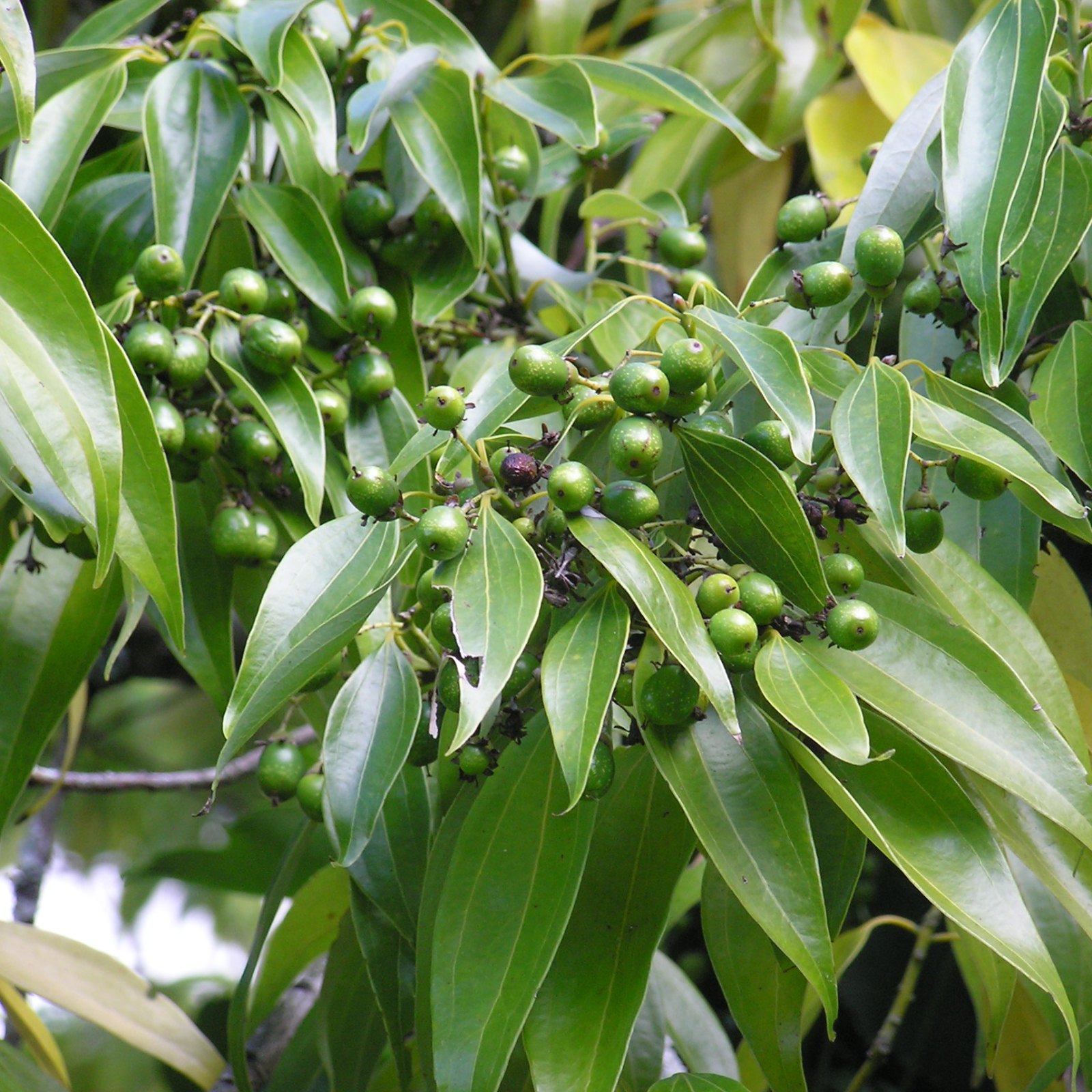
- Plant part
- Bark
- Vietnamese name
- Vỏ quế Trà My
- Scent family
- Spicy
- Plant family
- Lauraceae
- Lots published
- —
 Bark
Composition profile
The published composition from the article, read as structure: 1 compounds adding up to about 93 % of the sample. Figures are printed as the source gives them — one sample, not a species average.
| Compound | Level | Class | Note |
|---|---|---|---|
| Cinnamaldehyde EU | 50.2–92.9 % | Aldehydes | Base |
By chemical class
- Aldehydes92.9 %
By note
- Base92.9 %
Group totals use the upper bound of each range and only the compounds the article lists; bars are relative to the identified total.
Put it beside another oil in the Compare tool Which other oils are rich in Cinnamaldehyde?
Tra My cassia, Chinese cassia and Ceylon cinnamon
Three different species are sold under the one Vietnamese word quế:
- Tra My cassia, Cinnamomum loureiroi, grows in the mountains of Quang Nam and Quang Ngai. Internationally it is called Saigon cinnamon or Vietnamese cinnamon.
- Chinese cassia, Cinnamomum cassia, is Chinese cinnamon, also grown widely in Yen Bai. This is what the trade calls cassia.
- Ceylon cinnamon, Cinnamomum verum, from Sri Lanka, also called true cinnamon.
Tra My cassia and Chinese cassia belong to the same cassia group: thick bark, sweet and hot. Ceylon cinnamon has thin bark rolled in many layers, with a lighter smell and a floral touch.
In practice the line between the two cassia-group species is not always clear. Most of the studies of Vietnamese cinnamon bark oil we could read, including a sample from Quang Ngai, name the species as C. cassia. When reading a figure for “Vietnamese cinnamon”, check which species the authors name.
Composition of the bark oil
We have not read any peer-reviewed study of C. loureiroi bark oil grown at Tra My. The table combines C. loureiroi bark oil grown in China with Vietnamese bark oils labelled C. cassia, all hydrodistilled:
| Bark oil sample | Yield | Cinnamaldehyde |
|---|---|---|
| C. loureiroi, Guangdong, trees aged 6–15 (2021) | 4.52–5.48% (trees aged 12–15) | 50.2–92.9% |
| C. cassia, Quang Ngai (2025) | 2.60% | about 94% |
| C. cassia, Kon Tum (2025) | 1.51% | 96.07% |
| C. cassia, Yen Bai (2025) | 1.32% | 94.72% |
| C. cassia, Yen Bai (2024) | 3.38% | 93.3% |
The 2021 study took 10 bark samples at Maoming (Guangdong) from trees aged 6 to 15 years: trans-cinnamaldehyde peaked in trees aged 10–12, while α-copaene ranged from 0.5% to 21.3% and peaked in trees aged 13–15. The 2024 Yen Bai sample also had cinnamyl acetate 2.49% and α-copaene 0.99%. For the 2025 Quang Ngai sample, the abstract gives 94.06% and the results 94.69%, so the table says “about 94%”.
Reading the table
Cassia-group bark oil is almost all cinnamaldehyde: over 90% in every Vietnamese sample above. The Chinese C. loureiroi samples show that tree age can make cinnamaldehyde vary very widely, with the rest then mostly sesquiterpenes such as α-copaene. So with Tra My cassia oil, the lot analysis tells you more than the name of the growing area.
Leaf oil depends on the species. For Ceylon cinnamon, cinnamon leaf oil leans towards eugenol, so it smells closer to clove. For C. loureiroi, a 2021 preprint that has not been peer reviewed (14-year-old trees in Guangdong) gives the leaf oil as still containing 63.20% cinnamaldehyde, with cinnamyl acetate 27.52%. Even so, bark oil and leaf oil are two different products, so the label should state the plant part.
Cinnamaldehyde and IFRA
Cinnamaldehyde is a strong skin sensitiser. The IFRA Standard for cinnamaldehyde (Amendment 49, 2020) sets maximum concentrations in the finished product, for example:
- 0.25% in fine fragrance (category 4);
- 0.064% in body lotion (category 5A).
The standard refers to a separate annex on contributions from other sources, such as essential oils. If the cinnamaldehyde in a bark oil is counted against this limit, then for an oil with about 90% cinnamaldehyde, the 0.064% limit corresponds to only about 0.07% oil in a body lotion. That is why cinnamon bark oil must always be diluted heavily. The dilution page says more about diluting.
Coumarin is a question about the spice
Many people search for the difference between Tra My cassia and Ceylon cinnamon because they have read about coumarin. The German Federal Institute for Risk Assessment (BfR) reports that cassia cinnamon contains on average about 3,000 mg of coumarin per kg, with some samples reaching about 10,000 mg/kg, while Ceylon cinnamon contains only very low amounts. A 2020 review in Foods compiles figures for cinnamon bark: an authenticated sample of Tra My cassia contained about 6,970 mg/kg, a Vietnamese commercial bark about 1,060 mg/kg, and authenticated Ceylon cinnamon only about 17 mg/kg. The tolerable daily intake the BfR uses is 0.1 mg of coumarin per kg of body weight.
Those figures concern cinnamon powder and sticks used in food. The essential oil sold here is not for eating or drinking, so with the oil, what matters is cinnamaldehyde on the skin, not coumarin in the diet. These are two separate concerns, and folding them into one sentence such as “Tra My cassia is more toxic” gets both wrong.
Sources
- Li Y., Tan B., Cen Z. et al. (2021). The variation in essential oils composition, phenolic acids and flavonoids is correlated with changes in antioxidant activity during Cinnamomum loureirii bark growth. Arabian Journal of Chemistry 14(8), 103249. doi:10.1016/j.arabjc.2021.103249
- Comparison of chemical profile and antibacterial activity of Cinnamomum cassia bark essential oil from three different Vietnamese provinces (2025). Indian Journal of Agricultural Research 59(7), 1060–1067. doi:10.18805/IJARe.AF-923
- Study on the production and composition of essential oil from Cinnamomum cassia bark in Yen Bai province of Vietnam (2024). Tropical Journal of Natural Product Research 8(4), 6807–6813. doi:10.26538/tjnpr/v8i4.9
- Xing H., Hu Y., Yang L. et al. (2021). Fumigation activity of essential oil of Cinnamomum loureirii against red imported fire ant (Solenopsis invicta) workers. Research Square preprint, not peer reviewed. doi:10.21203/rs.3.rs-450369/v1
- BfR (German Federal Institute for Risk Assessment). Frequently asked questions on coumarin in cinnamon and other foods. bfr.bund.de
- Loncar et al. (2020). Coumarins in Food and Methods of Their Determination. Foods 9(5), 645. doi:10.3390/foods9050645
- IFRA Standard: Cinnamic aldehyde, Amendment 49 (2020).
Buy Cassia bark
Cassia bark oil: no lot has been brought in yet, so it is not on sale. Message us if you need it.
In the scent dictionary: Cassia cinnamon bark — a description of the smell, the compounds behind it, and how to smell it for yourself.
Further reading
Close to Cassia bark
Same plant family: Lauraceae Camphor ct camphor · Cinnamon leaf · Ho wood · Indian bay leaf · May chang · Rosewood
Also from the bark Ceylon cinnamon · Chinese cassia
Same method: direct steam distillation Angelica root · Ceylon cinnamon · Clary sage · Clove bud · Elemi · Kanuka · Moroccan blue chamomile · Wintergreen
Quick answers
What does cassia bark essential oil smell like?
Sweet and hot, almost a taste before you taste it. Compared with Ceylon cinnamon it is stronger, straighter and much hotter.
What is the botanical name of cassia bark oil?
The plant is Cinnamomum loureiroi, in the Lauraceae family. In Vietnamese it is called vỏ quế trà my.
How is cassia bark oil produced?
From the bark of the plant, by direct steam distillation. See the method for what that does to the oil.
What are the main compounds of cassia bark oil?
From the composition data on this page, the oil is led by Cinnamaldehyde. Proportions vary with origin, harvest and method; a lot analysis is the only answer for a given bottle.
Is there anything to watch out for with cassia bark oil?
Rich in cinnamaldehyde — a strong skin sensitiser. IFRA sets a concentration limit for skin products; blending stronger than that limit is asking for a reaction.
Last updated