Clove bud essential oil
Syzygium aromaticum
Đinh hương · Myrtaceae
Spicy, sweet, hot, almost a taste. Strong and direct, with no hidden layers to guess at.
About four-fifths of the bottle is eugenol, so clove is almost the smell of that compound itself. Eugenol is also found in cinnamon leaf and holy basil, which is why the three are often described with the same word although they come from three different plants.
Many people recognise this smell from the dentist before they recognise it from the kitchen, because eugenol is used in traditional dental materials. Oil distilled from the buds is the roundest; oil from leaves and stems is harsher, and labels do not always say which.
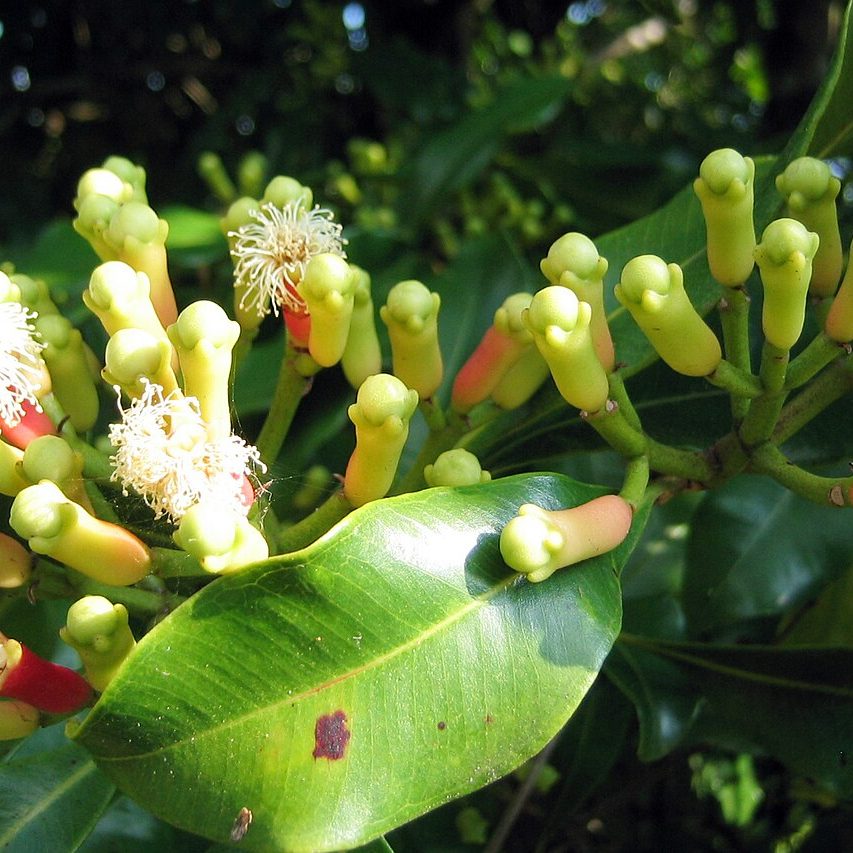
- Plant part
- Flowers
- Vietnamese name
- Đinh hương
- Scent family
- Spicy
- Plant family
- Myrtaceae
- Lots published
- —
 Flowers
Composition profile
The published composition from the article, read as structure: 2 compounds adding up to about 87 % of the sample. Figures are printed as the source gives them — one sample, not a species average.
| Compound | Level | Class | Note |
|---|---|---|---|
| Eugenol EU | 72.08–80.71 % | Phenols | Base |
| β-Caryophyllene EU | 2.76–6.38 % | Sesquiterpenes | Base |
By chemical class
- Phenols80.7 %
- Sesquiterpenes6.4 %
By note
- Base87.1 %
Group totals use the upper bound of each range and only the compounds the article lists; bars are relative to the identified total.
Compare with the 2 chemically closest oils Which other oils are rich in Eugenol?
Bud, leaf or stem
The clove tree (Syzygium aromaticum) gives three oils from three parts, and they are not alike:
- Bud oil is distilled from the dried flower buds, the cloves used in the kitchen. Besides eugenol, bud oil has a substantial share of eugenyl acetate, which makes it rounder and sweeter.
- Leaf oil is distilled from the leaves, almost only eugenol and β-caryophyllene, harsher and drier.
- Stem oil has the highest eugenol of the three and almost no eugenyl acetate.
Composition: bud, leaf and stem
A 2014 study analysed 121 commercial oils from Madagascar, Indonesia and Zanzibar:
| Part, origin | Eugenol | Eugenyl acetate | β-Caryophyllene |
|---|---|---|---|
| Bud, Madagascar | 72.08–80.71% | 11.68–21.32% | 2.76–6.38% |
| Bud, Indonesia | 77.32–82.36% | 8.61–10.55% | 5.34–8.64% |
| Leaf, Madagascar | 80.87–83.58% | 0.29–1.45% | 11.65–15.02% |
| Leaf, Indonesia | 75.04–77.54% | 0–0.06% | 17.04–19.53% |
| Stem, Madagascar | 91.81–96.65% | 0.37–2.53% | 1.66–4.48% |
| Stem, Zanzibar | 87.52–89.47% | 0.55–0.88% | 7.19–9.70% |
The specification the European Food Safety Authority (EFSA) uses for bud oil, based on ISO 3142, is eugenol 67–85%, eugenyl acetate 5–15% and β-caryophyllene 2–16%; seven batches of bud oil in the EFSA assessment had 0.039–0.128% methyl eugenol.
The table shows the clearest marker: in this study, bud oil had about 8–21% eugenyl acetate, while leaf and stem oils have under 2.5%. So a bottle labelled “bud oil” with almost no eugenyl acetate points to leaf oil, stem oil or a blend. Leaf oil, for its part, is much higher in β-caryophyllene.
This page describes bud oil. When buying, look for the word bud, leaf or stem on the label. A label that says only “clove oil” without naming the part is worth asking the seller about.
Eugenol and the skin
Eugenol is a skin sensitiser and irritates mucous membranes. IFRA restricts eugenol because of dermal sensitisation and systemic toxicity (Amendment 51, 2023), for example to 2.5% in fine fragrance (category 4) and 0.64% in creams (category 5A). In the EU, eugenol has long had to be named on cosmetic labels as an allergen, and since Regulation (EU) 2023/1545 clove oils must also be labelled above 0.001% in leave-on products. That is why clove oil must always be heavily diluted for skin use, and why neat oil should not be put on the gums. The dilution page gives the figures.
Clove and dentistry
Many people know the smell of clove from the dentist’s. A 1964 report by the US National Bureau of Standards (NBS) notes that oil of cloves had been used to treat dental caries since the 16th century; since the oil contains about 83% eugenol, eugenol came to be used in its place in dental preparations. Zinc oxide–eugenol cement is still used for temporary fillings and bases.
Same compound, different plants
Eugenol is also the main compound in cinnamon leaf oil and is abundant in clove basil. These three oils are therefore often substituted for one another or blended together. On a GC/MS report they differ in the compounds that come with the eugenol: clove bud oil has eugenyl acetate, while cinnamon leaf and clove basil each have their own set of minor compounds.
Sources
- Razafimamonjison G. et al. (2014). Bud, leaf and stem essential oil composition of Syzygium aromaticum from Madagascar, Indonesia and Zanzibar. International Journal of Basic and Applied Sciences 3(3), 224–233. doi:10.14419/ijbas.v3i3.2473
- EFSA FEEDAP Panel (2023). EFSA Journal 21(7), 8183. doi:10.2903/j.efsa.2023.8183
- ISO 3142:1997. Oil of clove buds.
- IFRA Standard: Eugenol, Amendment 51 (2023).
- Regulation (EU) 2023/1545 on the labelling of fragrance allergens.
- Brauer G.M. (1964). A Review of Zinc Oxide-Eugenol Type Filling Materials and Cements. NBS Report 8647, National Bureau of Standards.
Buy Clove bud
Clove bud oil: no lot has been brought in yet, so it is not on sale. Message us if you need it.
In the scent dictionary: Clove — a description of the smell, the compounds behind it, and how to smell it for yourself.
Where you may already have smelled it
According to the analyses cited above, this oil contains up to 80.7 % eugenol. It is also the leading compound in the scenes below from the scent dictionary. Smelling one of those scenes again is a way to get to know it without opening a bottle. A shared compound does not mean the oil smells exactly like the scene.
Chemically close
The oils whose published composition is closest to this one, compared across every compound we could read. Close in composition does not mean the scent is identical or that one can replace the other.
- Cinnamon leaf Cinnamomum verum shared: Eugenol, β-Caryophyllene · closeness 1.00 · compare
- Clove basil Ocimum gratissimum shared: Eugenol, β-Caryophyllene · closeness 1.00 · compare
Further reading
Close to Clove bud
Same plant family: Myrtaceae Eucalyptus dives · Eucalyptus globulus · Eucalyptus radiata · Fragonia · Kunzea · Lemon eucalyptus · Manuka
Also from the flowers Blue tansy · German chamomile · Helichrysum · Hops · Immortelle Madagascar · Lavandin · Roman chamomile · Tuberose
Same method: direct steam distillation Angelica root · Bee balm · Blue cypress · Blue tansy · Coriander seed · Ho wood · Lavandin · White fir
Quick answers
What does clove bud essential oil smell like?
Spicy, sweet, hot, almost a taste. Strong and direct, with no hidden layers to guess at.
What is the botanical name of clove bud oil?
The plant is Syzygium aromaticum, in the Myrtaceae family. In Vietnamese it is called đinh hương.
How is clove bud oil produced?
From the flowers of the plant, by direct steam distillation. See the method for what that does to the oil.
What are the main compounds of clove bud oil?
From the composition data on this page, the oil is led by Eugenol and β-Caryophyllene. Proportions vary with origin, harvest and method; a lot analysis is the only answer for a given bottle.
Is there anything to watch out for with clove bud oil?
Rich in eugenol — sensitises the skin and irritates mucous membranes. Dilute very well before applying.
Last updated