Moroccan blue chamomile essential oil
Ormenis multicaulis
Hoa cúc Maroc · Asteraceae
Sweet herbs, slightly balsamic and a little like ripe fruit. It is warm and round, without the apple note of Roman chamomile.
Although often called “Moroccan chamomile”, Ormenis multicaulis (also listed as Cladanthus mixtus) is neither Roman nor German chamomile. Its composition differs from both and varies widely by region: some samples are rich in santolina alcohol, some in 1,8-cineole and α-pinene, some in farnesene or nerolidol.
The three oils sold as “chamomile” are three species in different genera. Setting them side by side is the quickest way to see how little the word “chamomile” tells you.
- Plant part
- Flowers
- Vietnamese name
- Hoa cúc Maroc
- Scent family
- Green
- Plant family
- Asteraceae
- Lots published
- —
 Flowers
What Moroccan chamomile is
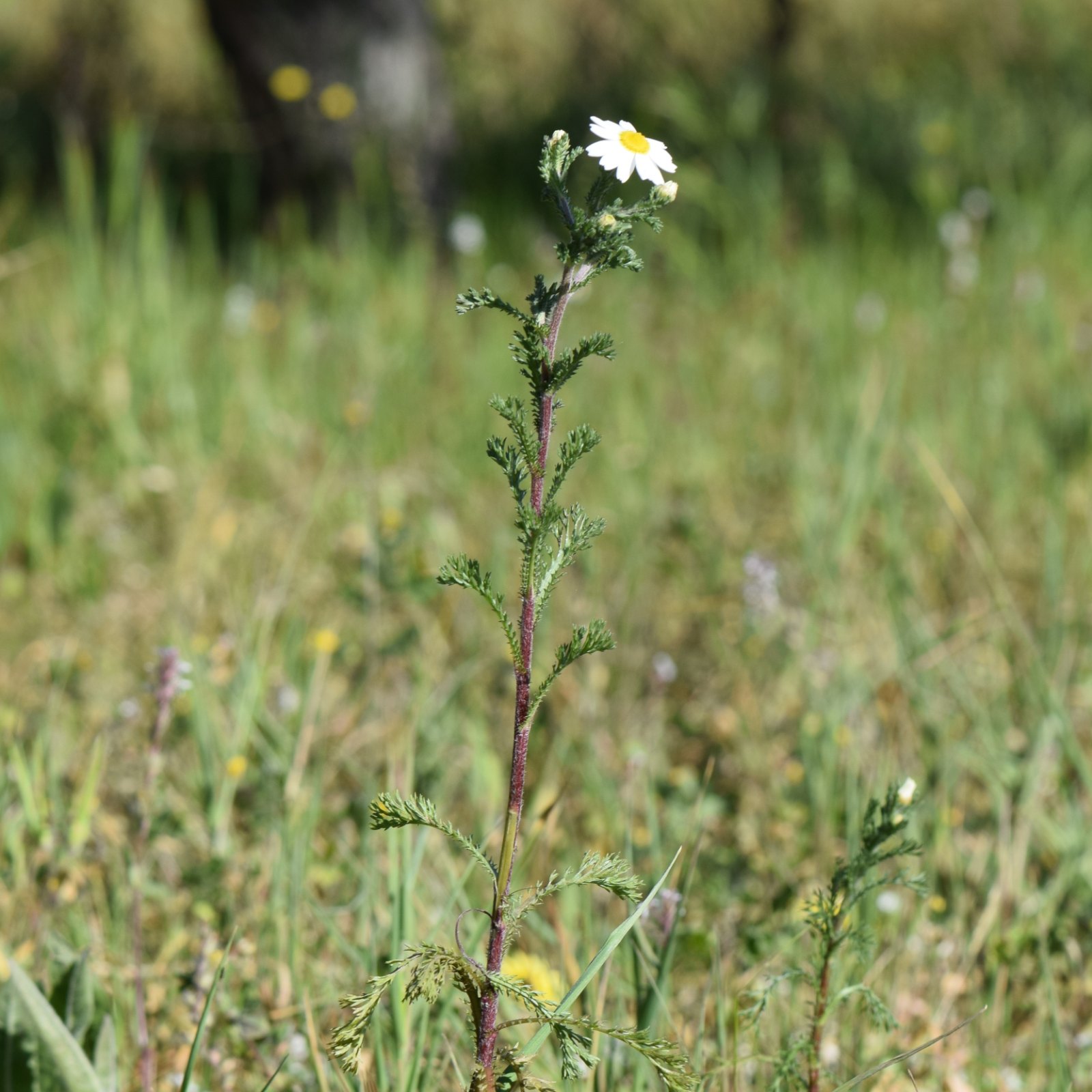
Moroccan chamomile is the oil distilled from the flowering tops of Cladanthus mixtus, also known as Ormenis mixta and Ormenis multicaulis, a daisy that grows wild in Morocco. Despite the name, it is neither Roman chamomile (Chamaemelum nobile) nor German chamomile (Matricaria chamomilla), but a species of a different genus.
Composition: very wide variation
A 2023 study reviewed the literature and divided the published oils into two groups. The first has one dominant compound, which depending on the sample is:
- santolina alcohol 24.1–66.0%;
- camphor 17.8–33.0%;
- 2-methyl-2-trans-butenyl methacrylate 32.0–35.2%;
- (E)-β-farnesene 35.5–50.3%;
- (E)-nerolidol 44.1%.
The second has several compounds at similar levels, mainly α-pinene, myrcene, 1,8-cineole, camphor, santolina alcohol, germacrene D or (E)-β-farnesene.
Some individual samples:
| Sample | Main compounds |
|---|---|
| Souk Had, north-west Morocco (2023) | 1,8-cineole 20.8%; α-pinene 16.1%; limonene 3.6% |
| Sidi Slimane, north-west Morocco (2023) | (E)-nerolidol 13.9%; α-pinene 4.6%; germacrene D 4.0%; santolina alcohol 3.4% |
| Bouznika (2014, 40 samples) | 2-methyl-2-trans-butenyl methacrylate 32.8–35.2%; ar-curcumene 13–14% |
| Oujda (2014) | trans-β-farnesene 35.5–50.3% |
| One commercial oil | germacrene D 11.46%; 1,8-cineole 10.28%; cis-methyl isoeugenol 9.04% |
The two 2023 samples were aerial parts, hydrodistilled for 2 hours, with a yield of only 0.10%. The Bouznika samples yielded 0.3–0.8%.
Reading the table
There is no single “Moroccan chamomile smell”. Depending on where it is picked, the oil can lean towards santolina alcohol, towards cineole and pinene, towards farnesene or nerolidol, or towards a methacrylate ester. One French supplier’s specification for the commercial oil allows santolina alcohol anywhere from 2% to 24%, which shows that even the traded oil varies widely.
Blue or not
This oil is sometimes sold as “blue chamomile”. A 2013 study of wild oils from 9 sites reported that most were blue and three were yellow; a 2016 review records one sample from Chefchaouen with 5.0% chamazulene, the same blue compound as in German chamomile. But supplier specifications describe the commercial oil as dark yellow to greenish brown. The blue colour is therefore not a fixed feature of this oil.
Its smell
It is usually described as sweet and herbaceous, slightly balsamic, with a ripe-fruit note. A batch rich in cineole and pinene is cooler and more resinous; one rich in farnesene or nerolidol is softer and woodier.
Safety
The oil can contain pinene, camphor and limonene, which are on the EU list of fragrance allergens that must be named on cosmetic labels. We have not found an IFRA standard specific to this oil. Always dilute before use on skin.
Sources
- El Hafidi S., Bakhy K., Ouhssine M., Benzakour A., Casanova J., Paoli M., Tomi F. (2023). Compounds 3(2), 365–375. doi:10.3390/compounds3020028
- Elouaddari A. et al. (2013). Flavour and Fragrance Journal 28(6), 360–366. doi:10.1002/ffj.3146
- Elouaddari A. et al. (2014). Natural Product Communications 9(1). doi:10.1177/1934578X1400900137
- Ouedrhiri W. et al. (2018). Environmental Science and Pollution Research 25(30), 29860–29867. doi:10.1007/s11356-017-9739-1
- Tadrent W., Kabouche A., Touzani R., Kabouche Z. (2016). Journal of Materials and Environmental Science 7(4), 1229–1235.
- Compagnie des Sens. Moroccan chamomile oil specification (retail document).
- Regulation (EU) 2023/1545 on the labelling of fragrance allergens.
Buy Moroccan blue chamomile
Moroccan blue chamomile oil: no lot has been brought in yet, so it is not on sale. Message us if you need it.
Further reading
Close to Moroccan blue chamomile
Same plant family: Asteraceae Blue tansy · Davana · Mugwort · Roman chamomile · Tagetes · Tarragon
Also from the flowers German chamomile · Jasmine sambac · Lavandin · Lavender · Rose absolute · Rose otto · Tagetes · Tuberose
Same method: direct steam distillation Frankincense · Green myrtle · Honey myrtle · Lavandin · Peppermint · Rose otto · Tagetes · Thuja
Quick answers
What does Moroccan blue chamomile essential oil smell like?
Sweet herbs, slightly balsamic and a little like ripe fruit. It is warm and round, without the apple note of Roman chamomile.
What is the botanical name of Moroccan blue chamomile oil?
The plant is Ormenis multicaulis, in the Asteraceae family. In Vietnamese it is called hoa cúc maroc.
How is Moroccan blue chamomile oil produced?
From the flowers of the plant, by direct steam distillation. See the method for what that does to the oil.
Last updated