Essential oils · Woody & Resinous family
Kanuka essential oil
Kunzea ericoides
Kānuka · Myrtaceae
Fresh, lightly piney, slightly lemony and clean. It is brighter and much simpler than manuka.
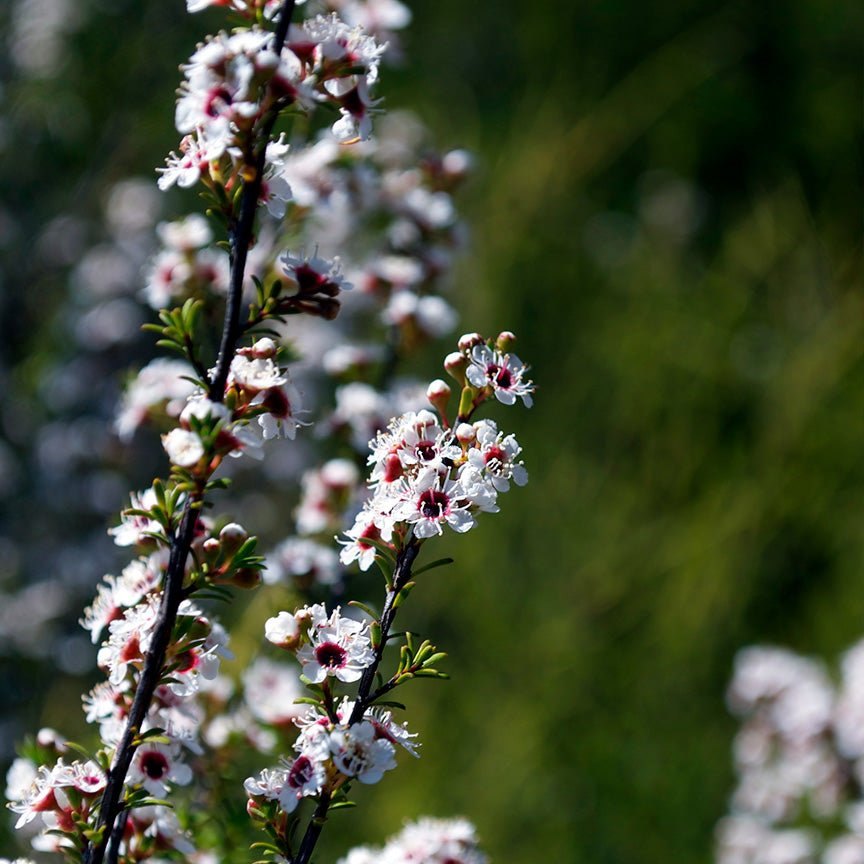
Kanuka (Kunzea ericoides) is a close relative of manuka in New Zealand; the two look alike and were once placed in the same genus. But kanuka oil is usually rich in α-pinene and has almost none of manuka’s characteristic triketones.
Because the two look so alike in the field, kanuka leaves can end up in a manuka distillation. The triketone level in the analysis is how to tell them apart.
- Plant part
- Leaves
- Vietnamese name
- Kānuka
- Scent family
- Woody & Resinous
- Plant family
- Myrtaceae
- Lots published
- —
 Leaves
Composition profile
The published composition from the article, read as structure: 4 compounds adding up to about 94 % of the sample. Figures are printed as the source gives them — one sample, not a species average.
| Compound | Level | Class | Note |
|---|---|---|---|
| α-Pinene EU | 35–59 % | Monoterpenes | Top |
| p-Cymene | 0.1–19 % | Monoterpenes | Top |
| Viridiflorol | 2–9 % | — | — |
| 1,8-Cineole | 0.1–7 % | Oxides | Top |
By chemical class
- Monoterpenes78.0 %
- Unclassified9.0 %
- Oxides7.0 %
By note
- Top85.0 %
- Unclassified9.0 %
Group totals use the upper bound of each range and only the compounds the article lists; bars are relative to the identified total.
Compare with the 2 chemically closest oils Which other oils are rich in α-Pinene?
Kanuka and manuka: two similar trees, two different oils
Kanuka and manuka grow side by side in New Zealand. Both are in the myrtle family, with small white flowers and short, needle-like leaves, and they are hard to tell apart at a glance. Their oils, though, belong to different worlds: kanuka is a light monoterpene oil, manuka a heavy sesquiterpene oil with triketones.
Kanuka has long been called Kunzea ericoides. A 2014 taxonomic revision split New Zealand kanuka into 10 endemic Kunzea species, and recent studies use K. robusta for North Island kanuka.
Composition
| Compound | Value | Sample |
|---|---|---|
| α-Pinene | 35–59% | 11 kanuka oils (2023) |
| p-Cymene | 0.1–19% | same study |
| 1,8-Cineole | 0.1–7% | same study |
| Viridiflorol | 2–9% | same study |
| α-Pinene | over 50% | commercial kanuka oil (1999) |
The 2023 study also identified the α-pinene in kanuka oil as the (+)-enantiomer.
Its smell: bright and simple
With around half its weight as α-pinene, kanuka opens with fresh, clean pine resin, close to Scots pine. p-Cymene, when abundant, adds a dry, slightly spicy note like herbs drying in the sun. Viridiflorol is the light woody part that lingers longest. A p-cymene range from 0.1% to 19% means two bottles of kanuka can differ noticeably.
Telling it apart from manuka
According to the 1999 study, commercial manuka oil is at least 60% sesquiterpene hydrocarbons, while kanuka is dominated by α-pinene. In commercial manuka oil, density correlates closely with triketone content. That makes density a simple test that helps tell the two oils apart.
On an analysis, a manuka oil with unusually high α-pinene and low triketones is a reason to question the supplier.
Safety
Oils rich in α-pinene oxidise quickly in air, and oxidised oil irritates skin more easily. Keep tightly closed and cool, and dilute before use on skin.
Sources
- Lewe N., Young M., Vorster J. et al. (2023). Comparison of chemical profiles of Kanuka (Kunzea robusta de Lange & Toelken, Myrtaceae) essential oils. Phytochemistry Letters 56, 50–56. doi:10.1016/j.phytol.2023.06.006
- Porter N.G., Wilkins A.L. (1999). Chemical, physical and antimicrobial properties of essential oils of Leptospermum scoparium and Kunzea ericoides. Phytochemistry 50(3), 407–415. doi:10.1016/S0031-9422(98)00548-2
Buy Kanuka
Kanuka oil: no lot has been brought in yet, so it is not on sale. Message us if you need it.
Where you may already have smelled it
According to the analyses cited above, this oil contains up to 59 % α-pinene. It is also the leading compound in the scenes below from the scent dictionary. Smelling one of those scenes again is a way to get to know it without opening a bottle. A shared compound does not mean the oil smells exactly like the scene.
Chemically close
The oils whose published composition is closest to this one, compared across every compound we could read. Close in composition does not mean the scent is identical or that one can replace the other.
- Frankincense sacra Boswellia sacra shared: α-Pinene · closeness 0.93 · compare
- Kunzea Kunzea ambigua shared: α-Pinene, 1,8-Cineole · closeness 0.93 · compare
- Pinyon pine Pinus edulis shared: α-Pinene · closeness 0.92 · compare
Further reading
Close to Kanuka
Same plant family: Myrtaceae Baeckea · Cajeput · Clove bud · Green myrtle · Guava leaf · Manuka · Red myrtle
Also from the leaves Balsam fir · Geranium · Lemongrass · Petitgrain · Siberian fir · Utah juniper · White fir · White pine
Same method: direct steam distillation Balsam fir · Camphor ct camphor · Cassia bark · Ceylon cinnamon · Elemi · Siberian fir · Thuja · White fir
Quick answers
What does kanuka essential oil smell like?
Fresh, lightly piney, slightly lemony and clean. It is brighter and much simpler than manuka.
What is the botanical name of kanuka oil?
The plant is Kunzea ericoides, in the Myrtaceae family. In Vietnamese it is called kānuka.
How is kanuka oil produced?
From the leaves of the plant, by direct steam distillation. See the method for what that does to the oil.
What are the main compounds of kanuka oil?
From the composition data on this page, the oil is led by α-Pinene, p-Cymene and 1,8-Cineole. Proportions vary with origin, harvest and method; a lot analysis is the only answer for a given bottle.
Last updated