Essential oils · Woody & Resinous family
Ho wood essential oil
Cinnamomum camphora ct. linalool
Gỗ long não ct. linalool · Lauraceae
Flowers and soft, clean wood, lightly sweet. It is close to lavender in its floral part without the herbal layer, and closer to rosewood than to anything else.
This is camphor wood chemotype linalool, also called ho wood: the same species, Cinnamomum camphora, as camphor and ravintsara, but the tree accumulates linalool instead of camphor or cineole. Linalool usually makes up most of the oil.
Three bottles with the same species name, three entirely different smells.
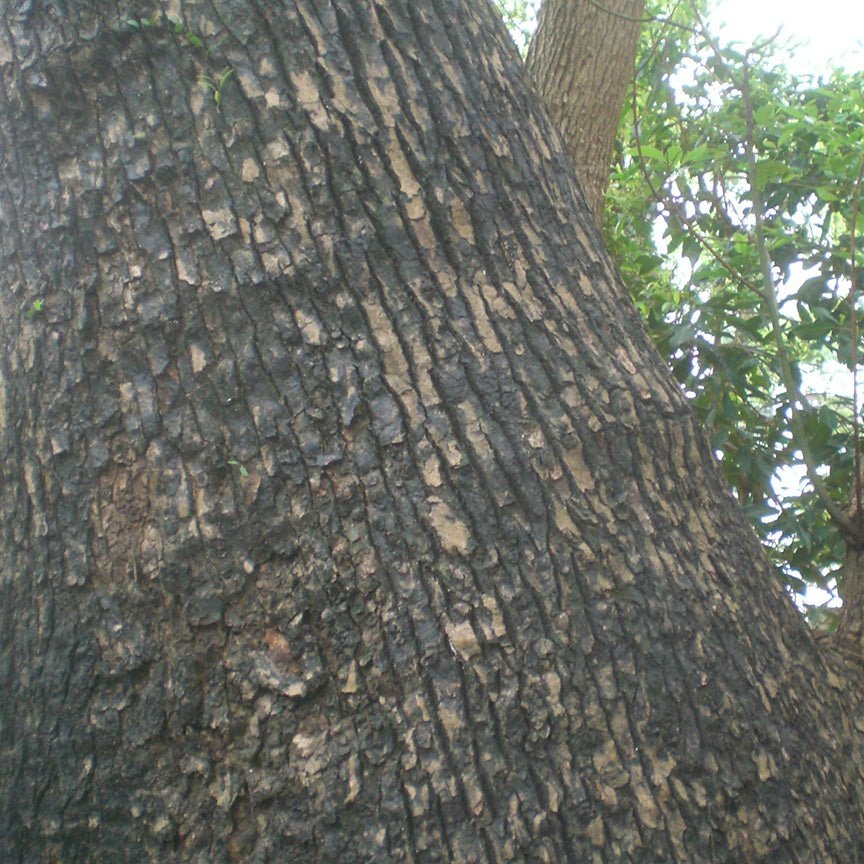
- Plant part
- Wood
- Chemotype
- ct. linalool
- Vietnamese name
- Gỗ long não ct. linalool
- Scent family
- Woody & Resinous
- Plant family
- Lauraceae
- Lots published
- —
 Wood
Composition profile
The published composition from the article, read as structure: 1 compounds adding up to about 96 % of the sample. Figures are printed as the source gives them — one sample, not a species average.
| Compound | Level | Class | Note |
|---|---|---|---|
| Linalool EU | 91.1–96.47 % | Alcohols | Middle |
By chemical class
- Alcohols96.5 %
By note
- Middle96.5 %
Group totals use the upper bound of each range and only the compounds the article lists; bars are relative to the identified total.
Put it beside another oil in the Compare tool Which other oils are rich in Linalool?
One species, many oils
The camphor tree (Cinnamomum camphora) is the clearest example of one species giving quite different oils. A 2023 study analysed leaf oil from 974 trees in 13 Chinese provinces and found several chemotypes:
| Type | Main compound, range | Mean leaf-oil yield |
|---|---|---|
| Linalool | linalool 11.23–96.45% | 1.55% |
| Cineole | 1,8-cineole 11.63–65.33% | 1.64% |
| Camphor | camphor 13.89–87.69% | below 1% |
| Nerolidol | trans-nerolidol 15.24–88.66% | 0.22% |
There are also rare types: one tree rich in borneol (52.22%), a few rich in methyl eugenol (up to 87.71%) or methyl isoeugenol. This page covers the linalool type; the camphor page covers the camphor type.
The linalool type: almost one compound
In typical linalool trees, the leaf oil is almost nothing but linalool:
- A leaf sample from Jinxi, Jiangxi, China (2022): linalool 96.47%, camphor not detected.
- A study of C. camphora var. linaloolifera in Vietnam (1993): leaf oil with 91.1% linalool.
So the smell is that of nearly pure linalool: floral, soft wood, clean, close to the floral part of lavender but without the herbal layer.
Leaf or wood?
The trade name “ho wood” refers to the wood oil, “ho leaf” to the leaf oil. We have not read a study comparing wood and leaf oils of the linalool type specifically, and most published data on this type are for leaf oil.
For the camphor type, the difference between plant parts has been measured. A 2021 study in Nepal found leaf oil with 93.1% camphor (yield 2.67%), while wood oil from the same tree had only 53.2% camphor, with about 19.9% 1,8-cineole and 3.2% safrole (yield 1.0%); root oil had as much as 57.6% safrole. In Vietnam, a survey of camphor wood oil from Gia Lai (2010) also found camphor to be the main component.
So for a bottle of “ho wood”, ask for the analysis: how much linalool, how much camphor, and whether there is any safrole.
Safety
Linalool must be labelled above a threshold under EU cosmetics rules, and oxidised linalool sensitises skin more readily, so keep the bottle tightly closed and cool. If the oil contains significant camphor, do not use it near the faces of young children (see children and pregnancy). Always dilute before use on skin.
Sources
- Zhang T., Zheng Y., Fu C. et al. (2023). Chemical Variation and Environmental Influence on Essential Oil of Cinnamomum camphora. Molecules 28(3), 973. doi:10.3390/molecules28030973
- Wan N., Li Y., Huang X.Y. et al. (2022). A comparative evaluation of chemical composition and antimicrobial activities of essential oils extracted from different chemotypes of Cinnamomum camphora (L.) Presl. Grasas y Aceites 73(1), e441. doi:10.3989/gya.1014202
- Poudel D.K., Rokaya A., Ojha P.K. et al. (2021). The Chemical Profiling of Essential Oils from Different Tissues of Cinnamomum camphora L. and Their Antimicrobial Activities. Molecules 26(17), 5132. doi:10.3390/molecules26175132
- The Essential Oil of Cinnamomum camphora (L.) Sieb. var. linaloolifera from Vietnam (1993). Journal of Essential Oil Research 5(4), 451–453. doi:10.1080/10412905.1993.9698258
- Khảo sát tinh dầu gỗ long não [A survey of camphor wood essential oil], Cinnamomum camphora (L.) Nees et Eberm. (2010). Tap chi Khoa hoc DHSP TP.HCM (24).
Buy Ho wood
Ho wood oil: no lot has been brought in yet, so it is not on sale. Message us if you need it.
In the scent dictionary: Camphor wood — a description of the smell, the compounds behind it, and how to smell it for yourself.
Where you may already have smelled it
According to the analyses cited above, this oil contains up to 96.5 % linalool. It is also the leading compound in the scenes below from the scent dictionary. Smelling one of those scenes again is a way to get to know it without opening a bottle. A shared compound does not mean the oil smells exactly like the scene.
Further reading
Close to Ho wood
Same plant family: Lauraceae Bay laurel · Camphor ct camphor · Ceylon cinnamon · Cinnamon leaf · May chang · Ravintsara ct 1,8-cineole
Also from the wood Atlas cedarwood · Camphor ct camphor · Cupressus · Fokienia · Palo santo · Sandalwood
Same method: direct steam distillation Clary sage · Coriander seed · Ginger · Immortelle Madagascar · Manuka · Palo santo · Siberian fir · Wild ginger
Quick answers
What does ho wood essential oil smell like?
Flowers and soft, clean wood, lightly sweet. It is close to lavender in its floral part without the herbal layer, and closer to rosewood than to anything else.
What is the botanical name of ho wood oil?
The plant is Cinnamomum camphora, in the Lauraceae family; this oil is the linalool chemotype. In Vietnamese it is called gỗ long não ct. linalool.
How is ho wood oil produced?
From the wood of the plant, by direct steam distillation. See the method for what that does to the oil.
What are the main compounds of ho wood oil?
From the composition data on this page, the oil is led by Linalool. Proportions vary with origin, harvest and method; a lot analysis is the only answer for a given bottle.
Last updated