Essential oils · Woody & Resinous family
Rosewood essential oil
Aniba rosaeodora
Gỗ hồng · Lauraceae
Flowers and soft, clean wood, slightly sweet, with a very light spice. It is close to ho wood but warmer and woodier.
The floral part is linalool, which makes up most of the oil. The wood and thin spice come from the minor compounds, and these change depending on whether the oil is distilled from trunk, twigs or leaves.
Because supply is limited by CITES, the smell of real rosewood is increasingly rare. Many people know it only through its substitutes.
- Plant part
- Wood
- Vietnamese name
- Gỗ hồng
- Scent family
- Woody & Resinous
- Plant family
- Lauraceae
- Lots published
- —
 Wood
Composition profile
The published composition from the article, read as structure: 4 compounds adding up to about 89 % of the sample. Figures are printed as the source gives them — one sample, not a species average.
| Compound | Level | Class | Note |
|---|---|---|---|
| Linalool EU | 79.7–85.5 % | Alcohols | Middle |
| trans-Linalool oxide (furanoid) | 0.8–1.7 % | — | — |
| cis-Linalool oxide (furanoid) | 0.7–1.6 % | — | — |
| Benzyl benzoate | 0.1–0.5 % | — | — |
By chemical class
- Alcohols85.5 %
- Unclassified3.8 %
By note
- Middle85.5 %
- Unclassified3.8 %
Group totals use the upper bound of each range and only the compounds the article lists; bars are relative to the identified total.
Compare with the 2 chemically closest oils Which other oils are rich in Linalool?
An Amazonian tree on the CITES list
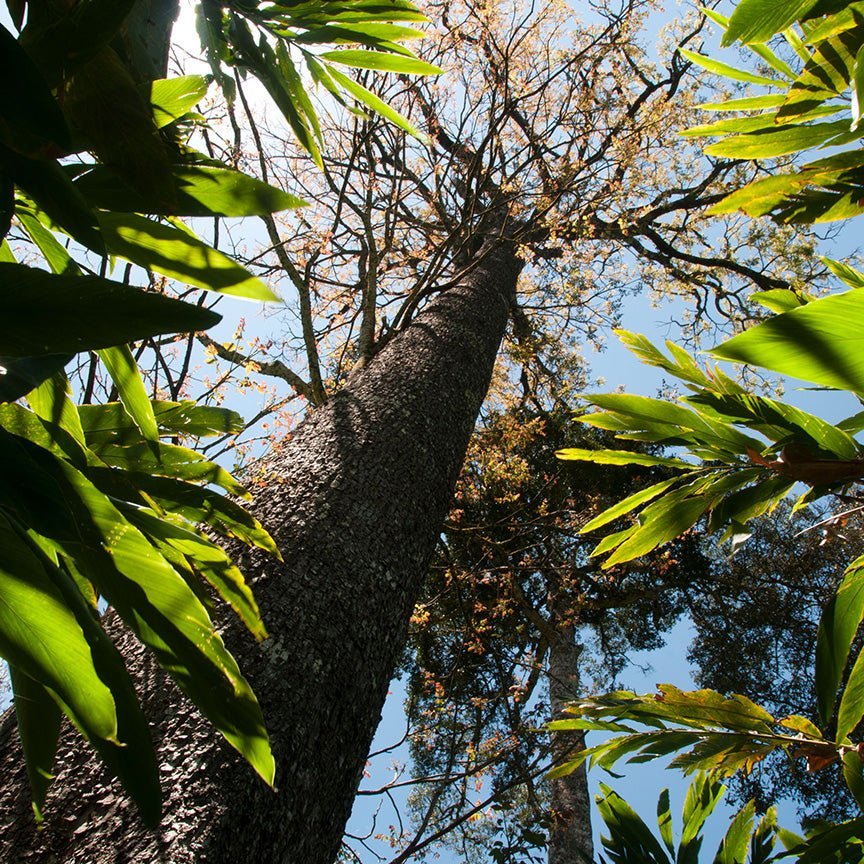
Rosewood (Aniba rosaeodora) is a large tree of the Amazon rainforest, mainly in Brazil. Rosewood oil is rich in linalool, and in the twentieth century it was one of perfumery’s main sources of natural linalool.
The old way of harvesting left serious consequences. According to the Amazon Cooperation Treaty Organization (OTCA), the oil used to be distilled from the trunk, which meant felling the whole tree. Since July 2010, Aniba rosaeodora has been listed in Appendix II of CITES. Trade and export of the oil are permitted only from authorised management areas.
Today the oil is distilled from leaves and branches instead of the trunk. Processors and small producers cultivate the tree, and local communities take part in replanting.
Composition: leaf oil and wood oil
A 2007 study in Quimica Nova distilled the leaves and the wood of the same five trees separately: one tree planted in 1946 in Belem and four trees of four morphological types at Novo Airao (Amazonas). The table gives the range across the five trees:
| Compound | Leaf oil | Wood oil |
|---|---|---|
| Linalool | 79.7–85.5% | 75.3–84.8% |
| trans-Linalool oxide (furanoid) | 0.8–1.7% | 0.7–2.6% |
| cis-Linalool oxide (furanoid) | 0.7–1.6% | 0.5–2.7% |
| α-Terpineol | trace–0.1% | 0.7–5.6% |
| Benzyl benzoate | 0.1–0.5% | 0.6–3.7% |
Oil yield was 2.4–3.1% for leaves and 1.8–3.4% for wood (hydrodistillation, Clevenger apparatus). The same study sampled the leaves of one tree every month for a year: linalool ranged from 68.0% (March) to 96.1% (December).
A 2013 study distilled leaves and fine branches at industrial scale (a 1,500-litre still, 6 hours, average yield 0.75%) from trees aged 4, 10 and 20 years at Maues: linalool was 82.2%, 90.5% and 87.1% respectively, and α-terpineol 3.60%, 1.11% and 1.21%.
Reading the table
Leaf oil and wood oil carry almost the same amount of linalool. The difference lies in the minor part: wood oil has clearly more α-terpineol and benzyl benzoate, the compounds that give the woody, thicker sweetness underneath. So today’s leaf-and-branch oil may be brighter and thinner than the wood oil described in older books, even though its main compound is still linalool. The plant part decides that minor part.
Linalool exists as two enantiomers with slightly different smells. A 2018 study of 54 leaf and branch oils from natural populations in the Central Amazon found (R)-(−)-linalool to (S)-(+)-linalool ratios from 5:95 to 44:56, with a statistically significant difference between leaf and branch oils. According to the authors, (R)-linalool is woody, floral and lavender-like, and (S)-linalool sweet, herbal and slightly citrus.
Checking authenticity
Rosewood oil is expensive and its supply is limited, so it is often adulterated. OTCA lists the usual forms: mixing with other essential oils, natural or synthetic; adding other plant products; or substituting the source plant during extraction.
In 2022 a Brazilian team from the Forest Products Laboratory of the Brazilian Forest Service, the Institute of Chemistry at the University of Brasilia, the National Institute for Amazon Research (INPA) and Universidade Paulista published a method for authenticating rosewood oil with a handheld near-infrared spectrometer. The method needs no sample preparation and achieved 98% efficiency on 130 authentic and commercial oils from several Brazilian states.
There is an international standard for this oil, ISO 3761:2005 (oil of rosewood, Brazilian type). We have not read its limits, so we do not give them here; when buying, ask whether the seller’s analysis has been checked against this standard.
Rosewood and ho wood
Because rosewood is restricted, perfumery long ago turned to other sources of linalool, including ho wood, chemotype linalool, and synthetic linalool. The smell is not identical, but close enough to substitute in many formulas. A bottle labelled “rosewood” at an unusually low price is worth questioning: does it have a CITES permit, and what is the source plant really?
Safety
Linalool is on the EU list of fragrance allergens that must be named on cosmetic labels. Linalool oxidises in air, and its oxidation products sensitise skin more readily, so store the oil tightly closed in a cool, dark place, and always dilute before use on skin.
Sources
- Maia J.G.S., Andrade E.H.A., Couto H.A.R., da Silva A.C.M., Marx F., Henke C. (2007). Plant sources of Amazon rosewood oil. Quimica Nova 30(8), 1906–1910.
- Fidelis C.H.V., Sampaio P.T.B., Krainovic P.M., Augusto F., Barata L.E.S. (2013). Correlation between maturity of tree and GC×GC–qMS chemical profiles of essential oil from leaves of Aniba rosaeodora Ducke. Microchemical Journal 109, 73–77. doi:10.1016/j.microc.2012.03.034
- Lara C.S., Barata L.E.S., Sampaio P.T.B., Eberlin M.N., Fidelis C.H.V. (2018). Linalool enantiomeric distribution in rosewood-reminiscent populations in Central Amazon. Journal of Essential Oil Research 30(6), 464–469. doi:10.1080/10412905.2018.1492464
- Amazon Cooperation Treaty Organization (OTCA) (2022). Technique enables to evaluate rosewood oil purity, a product valued by the perfume and cosmetics industry. Bioamazon Newsletter no. 17. otca.org
- ISO 3761:2005. Oil of rosewood, Brazilian type.
- Regulation (EU) 2023/1545 on the labelling of fragrance allergens.
Buy Rosewood
Rosewood oil: no lot has been brought in yet, so it is not on sale. Message us if you need it.
Where you may already have smelled it
According to the analyses cited above, this oil contains up to 85.5 % linalool. It is also the leading compound in the scenes below from the scent dictionary. Smelling one of those scenes again is a way to get to know it without opening a bottle. A shared compound does not mean the oil smells exactly like the scene.
Chemically close
The oils whose published composition is closest to this one, compared across every compound we could read. Close in composition does not mean the scent is identical or that one can replace the other.
- Champaca Magnolia × alba shared: Linalool · closeness 1.00 · compare
- Pomelo blossom Citrus maxima shared: Linalool · closeness 0.99 · compare
- Coriander seed Coriandrum sativum shared: Linalool · closeness 0.98 · compare
Further reading
Close to Rosewood
Same plant family: Lauraceae Bay laurel · Camphor ct camphor · Chinese cassia · Cinnamon leaf · Ho wood · May chang
Also from the wood Agarwood · Camphor ct camphor · Cupressus · Ho wood · Palo santo · Virginian cedarwood
Same method: direct steam distillation Balsam fir · Chinese cassia · Ginger · Ho wood · May chang · Palo santo · Wild ginger · Wintergreen
Quick answers
What does rosewood essential oil smell like?
Flowers and soft, clean wood, slightly sweet, with a very light spice. It is close to ho wood but warmer and woodier.
What is the botanical name of rosewood oil?
The plant is Aniba rosaeodora, in the Lauraceae family. In Vietnamese it is called gỗ hồng.
How is rosewood oil produced?
From the wood of the plant, by direct steam distillation. See the method for what that does to the oil.
What are the main compounds of rosewood oil?
From the composition data on this page, the oil is led by Linalool. Proportions vary with origin, harvest and method; a lot analysis is the only answer for a given bottle.
Last updated