Thyme ct linalool essential oil
Thymus vulgaris ct. linalool
Cỏ xạ hương ct. linalool · Lamiaceae
Soft herbs, slightly floral, with a thyme character but none of the hot spice. It is gentle, almost sweet.
The softness is linalool, which makes up most of the oil, with linalyl acetate. This type is not rich in thymol, the phenol behind the heat of ordinary thyme.
Setting it beside the thymol type is the quickest way to understand chemotypes: one species, two quite different oils.
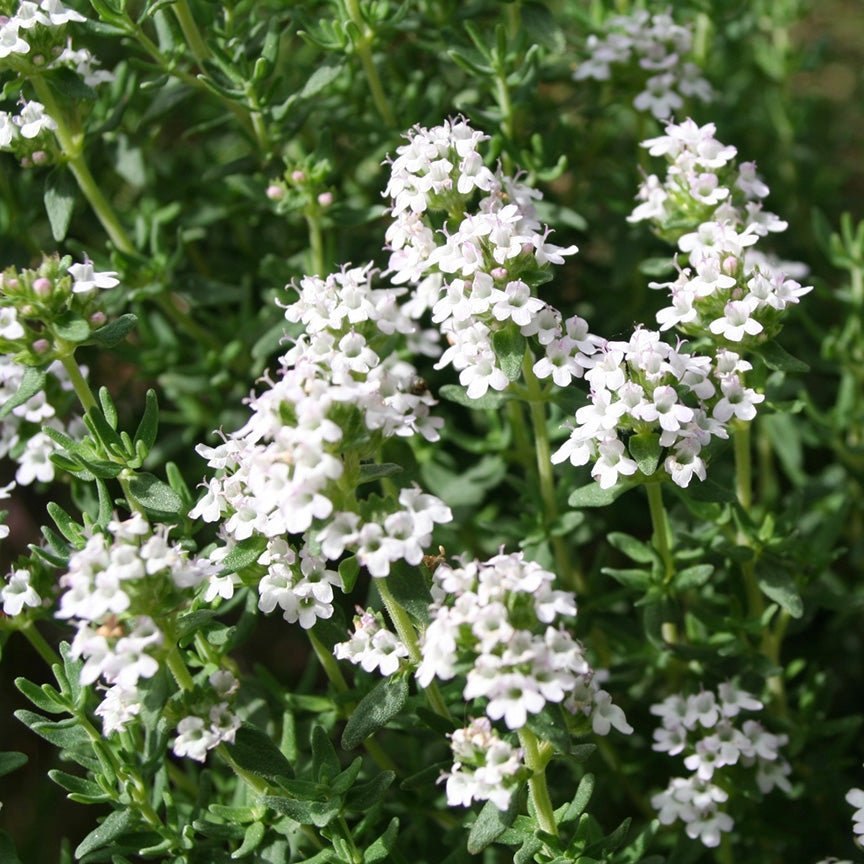
- Plant part
- Whole plant
- Chemotype
- ct. linalool
- Vietnamese name
- Cỏ xạ hương ct. linalool
- Scent family
- Green
- Plant family
- Lamiaceae
- Lots published
- —
 Whole plant
Composition profile
The published composition from the article, read as structure: 1 compounds adding up to about 76 % of the sample. Figures are printed as the source gives them — one sample, not a species average.
| Compound | Level | Class | Note |
|---|---|---|---|
| Linalool EU | 76.2 % | Alcohols | Middle |
By chemical class
- Alcohols76.2 %
By note
- Middle76.2 %
Group totals use the upper bound of each range and only the compounds the article lists; bars are relative to the identified total.
Put it beside another oil in the Compare tool Which other oils are rich in Linalool?
Thyme has many kinds of oil
Thyme (Thymus vulgaris) is the textbook example of chemotypes. According to a 2016 study in Foods, the established chemotypes include linalool, borneol, geraniol, sabinene hydrate, thymol and carvacrol, plus a number of mixed types. When the authors ran a cluster analysis on their four oils together with 81 published compositions, the data fell into 20 groups.
The four samples were aerial parts collected in France and Serbia (May 2015), air-dried and then steam-distilled for 3 hours:
| Origin | Chemotype | Main compounds |
|---|---|---|
| Nyons, France | Linalool | Linalool 76.2%, linalyl acetate 14.3% |
| Jablanicki, Serbia | Geraniol | Geraniol 59.8%, geranyl acetate 16.7% |
| Pomoravje, Serbia | Sabinene hydrate | cis-Sabinene hydrate 30.8%, terpinen-4-ol 9.50% |
| Richerenches, France | Thymol | Thymol 47.1%, p-cymene 20.07% |
Four bottles with the same name, Thymus vulgaris: one almost all linalool, one almost all geraniol, one a phenol. They cannot replace each other, in smell or in safety notes.
The linalool type on this page
This page is the linalool chemotype. The Nyons sample shows the typical picture: linalool makes up three quarters of the oil, and with linalyl acetate the two account for about 90%. Enantiomer analysis showed the linalool in this sample to be almost entirely the (−) form (d:l ratio 1:99).
Compared with ordinary thyme oil
The thyme page covers the thymol type. The European Food Safety Authority’s (EFSA) 2025 scientific opinion on thyme oil as a feed additive, distilled from the flowering aerial parts of T. vulgaris and T. zygis, gives a specification and the mean of 10 batches:
| Compound | EFSA spec | 10 batches (mean) |
|---|---|---|
| Thymol | 35–60% | 49.6% |
| p-Cymene | 13–28% | 17.7% |
| γ-Terpinene | 4–13% | 8.6% |
| Linalool | 0.5–6.5% | 4.1% |
Linalool is only about 4% in the thymol type, against 76.2% in the Nyons sample. So the lot analysis is the only way to be sure: a bottle of “thyme ct. linalool” with tens of per cent of thymol is not the linalool type.
Safe use
EFSA classes thymol-type thyme oil as an irritant to skin and eyes and a skin and respiratory sensitiser for people handling it. For the linalool type, linalool and linalyl acetate are both on the EU list of fragrance allergens that must be declared on cosmetic labels, and the IFRA standard for linalool requires linalool and natural products rich in it to have a peroxide value below 20 mmol/L, because linalool oxidises in air. Store it airtight and in the dark, and always dilute before use on skin.
Sources
- Satyal P., Murray B.L., McFeeters R.L., Setzer W.N. (2016). Essential Oil Characterization of Thymus vulgaris from Various Geographical Locations. Foods 5(4), 70. doi:10.3390/foods5040070
- EFSA FEEDAP Panel (2025). Safety and efficacy of a feed additive consisting of an essential oil obtained from the flowering aerial parts of Thymus vulgaris L. and/or Thymus zygis L. (thyme oil) for use in all animal species (FEFANA asbl). EFSA Journal 23(12), e9691. doi:10.2903/j.efsa.2025.9691
- IFRA Standard: Linalool (specification).
- Regulation (EU) 2023/1545 on the labelling of fragrance allergens.
Buy Thyme ct linalool
Thyme ct linalool oil: no lot has been brought in yet, so it is not on sale. Message us if you need it.
Where you may already have smelled it
According to the analyses cited above, this oil contains up to 76.2 % linalool. It is also the leading compound in the scenes below from the scent dictionary. Smelling one of those scenes again is a way to get to know it without opening a bottle. A shared compound does not mean the oil smells exactly like the scene.
Further reading
- Chemotype: one species, two natures
- Real or fake essential oil: four ways of diluting, and the traces they leave
- One hundred per cent pure is a claim, not a certificate
- Part V. International essential oils: composition, chemotypes and ISO · research
- Appendix A2. Facts on international essential oils and ISO standards · research
Close to Thyme ct linalool
Same plant family: Lamiaceae Basil ct methyl chavicol · Bee balm · Indian patchouli · Lavandin · Patchouli · Rosemary ct camphor · Sweet marjoram · Thyme ct thymol
Also from the whole plant Baeckea · Basil ct linalool · Basil ct methyl chavicol · Bergamot mint · Davana · Holy basil (tulsi) · Oregano · Thyme ct thymol
Same method: direct steam distillation Baeckea · Davana · Elemi · Lavender · Lolot pepper leaf · Melissa · Thyme ct thymol · Vietnamese balm
Quick answers
What does thyme ct linalool essential oil smell like?
Soft herbs, slightly floral, with a thyme character but none of the hot spice. It is gentle, almost sweet.
What is the botanical name of thyme ct linalool oil?
The plant is Thymus vulgaris, in the Lamiaceae family; this oil is the linalool chemotype. In Vietnamese it is called cỏ xạ hương ct. linalool.
How is thyme ct linalool oil produced?
From the whole plant of the plant, by direct steam distillation. See the method for what that does to the oil.
What are the main compounds of thyme ct linalool oil?
From the composition data on this page, the oil is led by Linalool. Proportions vary with origin, harvest and method; a lot analysis is the only answer for a given bottle.
Is there anything to watch out for with thyme ct linalool oil?
The linalool chemotype is not rich in phenols like the thymol chemotype. Linalool and linalyl acetate are fragrance allergens that must be declared in the EU, and linalool oxidises in air: store it airtight and dark, and dilute it like any essential oil.
Last updated