Java citronella essential oil
Cymbopogon winterianus
Sả java · Poaceae
Lemon, lighter than lemongrass, and behind it a floral sweetness lemongrass does not have. It evaporates more slowly and leaves a slightly waxy tail.
The difference lies in the ratio of citronellal to geraniol: one genus, two species, two formulas. Put the two bottles side by side and you hear it at once; smell one alone and it is very easy to name it wrongly.
This is the most widely distilled lemongrass-type oil in Vietnam, and the one most often lumped together as plain “tinh dầu sả” on labels. Two bottles both labelled sả can therefore be two different species, and the botanical name is the only place that says which one you are holding.
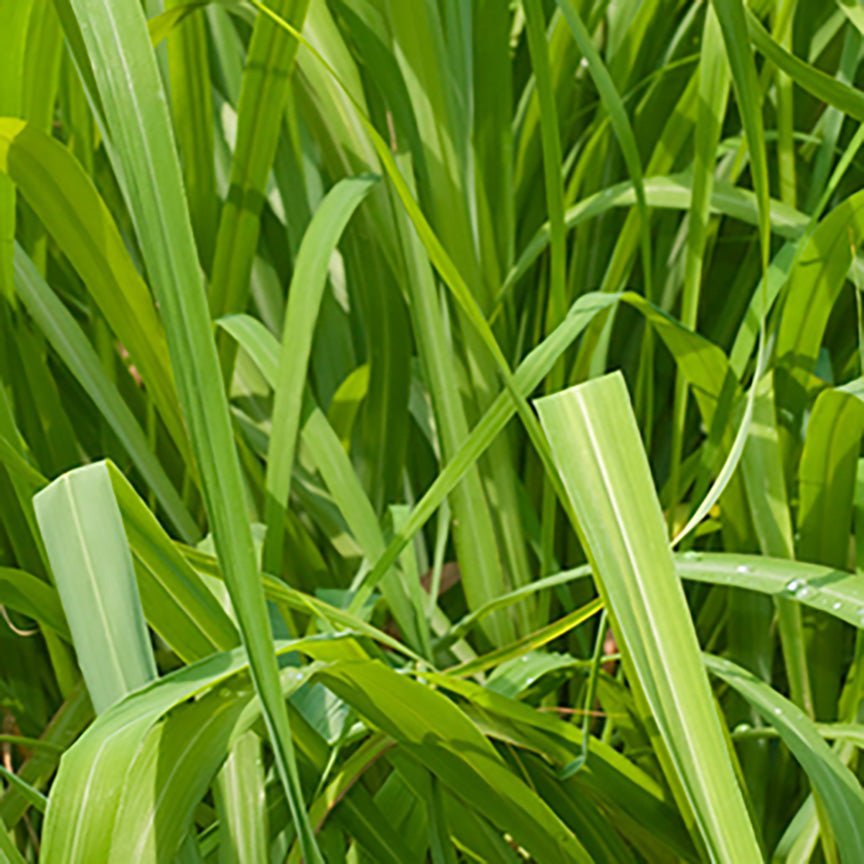
- Plant part
- Leaves
- Vietnamese name
- Sả java
- Scent family
- Green
- Plant family
- Poaceae
- Lots published
- —
 Leaves
Also made another way
The “Method” field above gives the usual commercial method. The lines below are other documented methods, each giving a different product.
- Citronellal-rich cut; citronellol and geraniol cut · Fractional distillation The vacuum column removed all limonene, giving a citronellal-rich cut and a stream mainly of citronellol and geraniol. Source: S. C. Beneti et al. (2011), Journal of Food Engineering 102(4): 348–354
Composition profile
The composition in the article, read as structure: 6 compounds, each with its chemical class and note. The article gives only a standard’s permitted ranges, not measurements.
| Compound | Level | Class | Note |
|---|---|---|---|
| Citronellal | 40 % | Aldehydes | Middle |
| Geraniol EU | 25 % | Alcohols | Base |
| Citronellol EU | 8.5–14 % | Alcohols | Middle |
| Geranyl acetate | 2.5–5.5 % | — | — |
| Limonene EU | 2–5 % | Monoterpenes | Top |
| Elemol | 1.3–4.8 % | — | — |
No group totals: these are a standard’s permitted ranges, and adding ranges does not give the composition of any real sample.
Compare with the 2 chemically closest oils Which other oils are rich in Citronellal?
Java citronella and lemongrass
In Vietnam, the word sả on an essential oil label can mean at least three plants:
- Java citronella, Cymbopogon winterianus, gives Java-type citronella oil. A light, sweet lemon smell leaning towards floral.
- Lemongrass, Cymbopogon citratus, and East Indian lemongrass, Cymbopogon flexuosus, give lemongrass oil. A sharp, green lemon smell, because they are rich in citral.
- Ceylon citronella, Cymbopogon nardus, gives Ceylon-type citronella oil, less common on the Vietnamese market.
Java citronella and lemongrass smell alike but their chemistry is quite different. Lemongrass oil rests on citral. Java citronella oil rests on citronellal, together with geraniol and citronellol.
The Vietnamese standard for Java citronella oil
Java citronella oil is one of the few essential oils with its own national standard: TCVN 11426:2016, an identical adoption of ISO 3848:2016. The standard sets composition ranges for a conforming oil, including:
| Compound | Range in TCVN 11426:2016 |
|---|---|
| Citronellal | up to 40 % |
| Geraniol | up to 25 % |
| Citronellol | 8.5–14 % |
| Geranyl acetate | 2.5–5.5 % |
| Limonene | 2–5 % |
| Elemol | 1.3–4.8 % |
The standard also specifies a relative density at 20 °C of 0.880 to 0.902 and a refractive index of 1.4663 to 1.4770. These are measurements even a small laboratory can make, and a cheap way to weed out an adulterated sample before sending it for GC/MS.
A national standard means the buyer has a public yardstick to compare against. A trustworthy supplier of Java citronella oil should be able to say where their lot falls within these ranges.
About mosquitoes
Most people looking for citronella oil want it for mosquitoes. Citronella oil is indeed used as the active ingredient in insect repellents in many countries. But comparative studies show its protection lasts considerably less time than synthetic actives such as DEET, because its main compounds evaporate quickly. If you need protection from mosquitoes where dengue occurs, use an insect repellent registered with the health authorities, not essential oil alone.
Sources
- TCVN 11426:2016 (ISO 3848:2016). Oil of citronella, Java type (Cymbopogon winterianus Jowitt).
- Maia and Moore (2011). Plant-based insect repellents: a review of their efficacy, development and testing. Malaria Journal 10(Suppl 1), S11. doi:10.1186/1475-2875-10-s1-s11
Buy Java citronella
Java citronella oil: no lot has been brought in yet, so it is not on sale. Message us if you need it.
Where you may already have smelled it
According to the analyses cited above, this oil contains up to 40 % citronellal and up to 25 % geraniol. Both are also the leading compound in the scenes below from the scent dictionary. Smelling one of those scenes again is a way to get to know them without opening a bottle. A shared compound does not mean the oil smells exactly like the scene.
Chemically close
The oils whose published composition is closest to this one, compared across every compound we could read. Close in composition does not mean the scent is identical or that one can replace the other.
- Lemon eucalyptus Corymbia citriodora shared: Citronellal, Citronellol · closeness 0.82 · compare
- Kaffir lime leaf Citrus hystrix shared: Citronellal · closeness 0.80 · compare
Further reading
Close to Java citronella
Same plant family: Poaceae East Indian lemongrass · Haitian vetiver · Lemongrass · Vetiver
Also from the leaves Black spruce · Douglas fir · Fragonia · Lolot pepper leaf · Perilla · Ponderosa pine · Scots pine · Thuja
Same method: direct steam distillation Bergamot mint · Carrot seed · Douglas fir · Mastic · Neroli · Ponderosa pine · Sweet fennel · Thuja
Quick answers
What does java citronella essential oil smell like?
Lemon, lighter than lemongrass, and behind it a floral sweetness lemongrass does not have. It evaporates more slowly and leaves a slightly waxy tail.
What is the botanical name of java citronella oil?
The plant is Cymbopogon winterianus, in the Poaceae family. In Vietnamese it is called sả java.
How is java citronella oil produced?
From the leaves of the plant, by direct steam distillation. See the method for what that does to the oil.
What are the main compounds of java citronella oil?
From the composition data on this page, the oil is led by Citronellal, Geraniol and Citronellol. Proportions vary with origin, harvest and method; a lot analysis is the only answer for a given bottle.
Last updated