Essential oils · Medicinal family
Thyme ct thymol essential oil
Thymus vulgaris ct. thymol
Cỏ xạ hương ct. thymol · Lamiaceae
Sharp, hot, medicinal, on a base of dry herbs. This is the strongest version of thyme, and close up it is almost harsh.
This chemotype is rich in thymol, a phenol. The same species, Thymus vulgaris, also gives a linalool chemotype, so soft and sweet that it is hard to believe it is the same plant. On that page and this one, the chemotype is the most important line.
Many people have met thymol without knowing it, because it is one of the signature smells of some long-established mouthwashes. If the bottle makes you think of the bathroom rather than the kitchen, your nose is picking up the right compound.
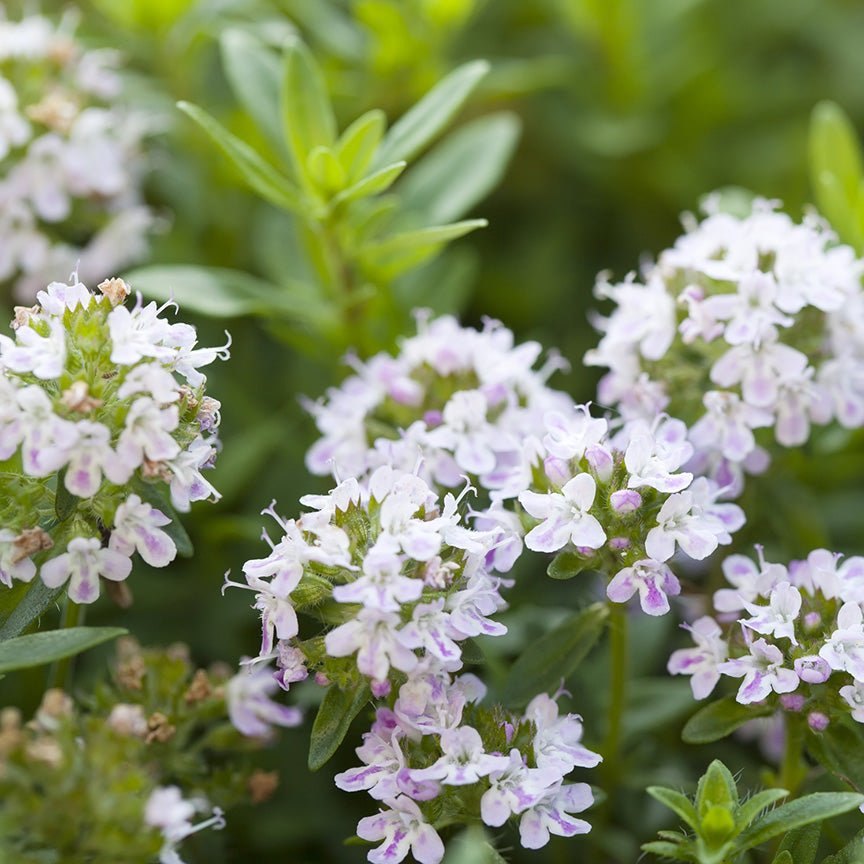
- Plant part
- Whole plant
- Chemotype
- ct. thymol
- Vietnamese name
- Cỏ xạ hương ct. thymol
- Scent family
- Medicinal
- Plant family
- Lamiaceae
- Lots published
- —
 Whole plant
Composition profile
The published composition from the article, read as structure: 1 compounds adding up to about 50 % of the sample. Figures are printed as the source gives them — one sample, not a species average.
| Compound | Level | Class | Note |
|---|---|---|---|
| Thymol | 49.6 % | Phenols | Base |
By chemical class
- Phenols49.6 %
By note
- Base49.6 %
Group totals use the upper bound of each range and only the compounds the article lists; bars are relative to the identified total.
Put it beside another oil in the Compare tool Which other oils are rich in Thymol?
Thyme, thymol type
Thyme (Thymus vulgaris) is a small Mediterranean shrub. One species gives several quite different oils, called chemotypes. This page covers the thymol type, the strongest: sharp, hot, medicinal, with a dry herbal base. The soft, sweet linalool type is covered on the thyme ct. linalool page.
Six chemotypes in one species
A classic 2003 study in the Journal of Chemical Ecology describes six chemotypes of Thymus vulgaris, in two groups:
- Phenolic: thymol, carvacrol.
- Non-phenolic: geraniol, α-terpineol, linalool and thujanol.
The phenolic types smell hot and harsh; the non-phenolic ones much softer. It is one of the clearest examples of chemotypes: one species, two natures.
Composition by ISO 19817
ISO 19817:2017 for thymol-type thyme oil, together with ten batches analysed by the European Food Safety Authority (EFSA) in 2025:
| Compound | ISO 19817 range | Mean of 10 EFSA batches |
|---|---|---|
| Thymol | 35.0–55.0% | 49.6% |
| p-Cymene | 14.0–28.0% | 17.7% |
| γ-Terpinene | 4.0–13.0% | 8.6% |
| Linalool | 0.5–6.5% | 4.1% |
| Carvacrol | 0.5–5.5% | about 4% |
| Myrcene | 1.0–2.8% | – |
| β-Caryophyllene | 0.5–4.0% | – |
The thymol, p-cymene, γ-terpinene trio
The top three compounds are related. In the plant, γ-terpinene and p-cymene are earlier steps on the pathway that produces thymol. So natural thymol oil usually carries both, as the ISO standard and the EFSA batches show. A bottle labelled “thyme” with high thymol but almost no p-cymene or γ-terpinene deserves questions about its origin.
Thymol is a phenol, from the same family as compounds in mouthwash and some antiseptic products. Many people know the smell without knowing its name.
Safety
EFSA records thyme oil as an irritant and a sensitiser. Phenol-rich oils such as thymol thyme are harsh on skin and mucous membranes, so they need far more dilution than soft oils such as the linalool type. Linalool is on the EU list of cosmetic ingredients that must be labelled above a threshold.
Sources
- ISO 19817:2017. Essential oil of thyme [Thymus vulgaris L. and Thymus zygis (Loefl.) L.], thymol type.
- EFSA FEEDAP Panel (2025). Safety and efficacy of a feed additive consisting of an essential oil obtained from the flowering aerial parts of Thymus vulgaris L. and/or Thymus zygis L. (thyme oil) for use in all animal species. EFSA Journal 23(12), e9691. doi:10.2903/j.efsa.2025.9691
- Thompson J.D., Chalchat J.-C., Michet A., Linhart Y.B., Ehlers B. (2003). Qualitative and quantitative variation in monoterpene co-occurrence and composition in the essential oil of Thymus vulgaris chemotypes. Journal of Chemical Ecology 29(4), 859–880. doi:10.1023/A:1022927615442
Buy Thyme ct thymol
Thyme ct thymol oil: no lot has been brought in yet, so it is not on sale. Message us if you need it.
Further reading
Close to Thyme ct thymol
Same plant family: Lamiaceae Basil ct linalool · Bergamot mint · Clove basil · Hyssop ct 1,8-cineole · Indian patchouli · Lavandin · Patchouli · Rosemary ct verbenone
Also from the whole plant Baeckea · Basil ct linalool · Basil ct methyl chavicol · Clove basil · Davana · Peppermint · Rosemary ct camphor · Sweet marjoram
Same method: direct steam distillation Baeckea · Cinnamon leaf · Davana · Elemi · Engelmann spruce · Fragonia · Oregano · Spike lavender
Quick answers
What does thyme ct thymol essential oil smell like?
Sharp, hot, medicinal, on a base of dry herbs. This is the strongest version of thyme, and close up it is almost harsh.
What is the botanical name of thyme ct thymol oil?
The plant is Thymus vulgaris, in the Lamiaceae family; this oil is the thymol chemotype. In Vietnamese it is called cỏ xạ hương ct. thymol.
How is thyme ct thymol oil produced?
From the whole plant of the plant, by direct steam distillation. See the method for what that does to the oil.
What are the main compounds of thyme ct thymol oil?
From the composition data on this page, the oil is led by Thymol. Proportions vary with origin, harvest and method; a lot analysis is the only answer for a given bottle.
Is there anything to watch out for with thyme ct thymol oil?
Rich in phenols (carvacrol or thymol) — strongly irritating to skin and mucous membranes. Never apply neat, and do not diffuse in a closed room with small children.
Last updated