Tarragon essential oil
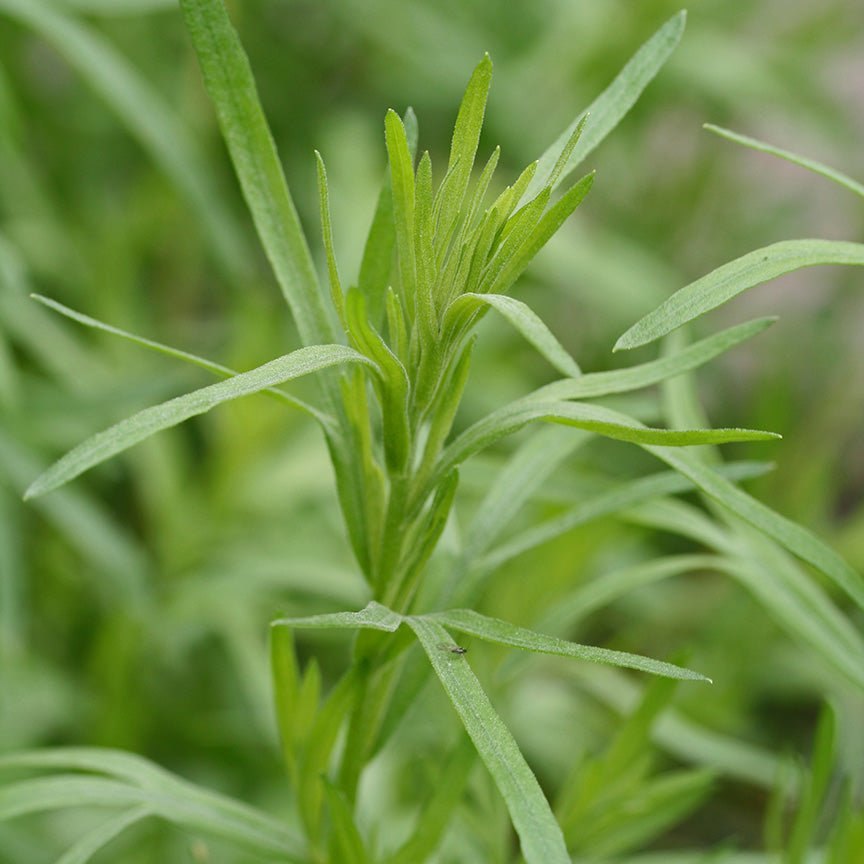
Artemisia dracunculus
Ngải giấm · Asteraceae
Anise, liquorice, green and slightly spicy. It is closer to Thai basil and fennel than to other wormwoods.
Tarragon (Artemisia dracunculus) oil is usually very rich in estragole (methyl chavicol), the compound that also gives basil ct methyl chavicol its anise note. That is why a wormwood smells of anise.
Estragole is monitored in food and cosmetics, and IFRA sets limits for it. Tarragon oil should therefore be used only at low concentrations.
- Plant part
- Whole plant
- Vietnamese name
- Ngải giấm
- Scent family
- Spicy
- Plant family
- Asteraceae
- Lots published
- —
 Whole plant
Composition profile
The published composition from the article, read as structure: 3 compounds adding up to about 86 % of the sample. Figures are printed as the source gives them — one sample, not a species average.
| Compound | Level | Class | Note |
|---|---|---|---|
| Estragole | 28.3–74.46 % | Other compounds | Middle |
| Limonene EU | 6.98 % | Monoterpenes | Top |
| Methyl eugenol | 5 % | — | — |
By chemical class
- Other compounds74.5 %
- Monoterpenes7.0 %
- Unclassified5.0 %
By note
- Top7.0 %
- Middle74.5 %
- Unclassified5.0 %
Group totals use the upper bound of each range and only the compounds the article lists; bars are relative to the identified total.
Put it beside another oil in the Compare tool Which other oils are rich in Estragole?
What tarragon is
Tarragon (Artemisia dracunculus) is a herb in the same genus as mugwort, yet it smells of aniseed and liquorice. The reason is chemical: its oil is usually very rich in estragole (methyl chavicol), the main compound of methyl chavicol basil.
French and Russian tarragon
A 2011 review in the Journal of Agricultural and Food Chemistry distinguishes two main forms:
- French tarragon is a sterile tetraploid, propagated vegetatively. Its oil is dominated by estragole, about 68–74% in most samples, though one sample had only 28.3%.
- Russian tarragon varies far more with origin. Its recorded main compounds include terpinen-4-ol (up to 41.34%), sabinene (up to 39.44%) and elemicin (up to 57.21%); estragole is only about 3%, but methyl eugenol is about 10%, up to 14% in some samples.
Composition by source
| Compound | France | Armenia (2018) | Italy (2026) | Denmark |
|---|---|---|---|---|
| Estragole | 28.3–74.46% | 84.9% | 70.17% | 1.08% |
| Methyl eugenol | up to 5% | – | – | 39.35% |
| (Z)-β-Ocimene | – | – | 9.89% | – |
| (E)-β-Ocimene | – | 4.00% | 12.27% | – |
| Limonene | 6.98% | 1.63% | – | – |
The French and Danish columns come from the 2011 review, which also records a Canadian sample with 16.2% estragole and 35.8% methyl eugenol; the Armenian sample was aerial parts from the Kotayk uplands; the Italian sample was greenhouse by-product biomass from Salerno. A dash means it was not in the part we read.
The table shows that “tarragon” has no fixed composition: some samples are almost all estragole, others rich in methyl eugenol.
Estragole, methyl eugenol and regulation
- Food (EU): Regulation (EC) 1334/2008 prohibits adding estragole and methyl eugenol as such to food, and sets limits when they come from natural flavourings, for example estragole at most 10 mg/kg in non-alcoholic drinks and methyl eugenol 1 mg/kg. The limits do not apply where only fresh, dried or frozen herbs are used.
- Fragrance (IFRA): the IFRA Standard for estragole (51st Amendment, 2023) is a restriction, because of dermal sensitisation and systemic toxicity, for example a maximum of 0.014% estragole in fine fragrance (category 4) and 0.0022% in body lotion (category 5A). The annex to the 49th Amendment estimates tarragon oil at about 80% estragole where no analytical figure is available.
- Methyl eugenol: the EU cosmetics scientific committee (SCCNFP) recommended in 2000 that it should not be intentionally added to cosmetics, and limited the amount arriving from essential oils, for example 0.01% in fine fragrance.
For an oil of about 80% estragole, 0.014% estragole in a perfume corresponds to less than 0.02% oil. Do not take it by mouth, do not use it for children or during pregnancy (see children and pregnancy), and always dilute.
Its smell
The French type is sweet like star anise and liquorice, with a green note from ocimene. The methyl eugenol-rich type is softer, slightly spicy and floral. The Russian type, rich in terpinen-4-ol and sabinene, is green and pungent, closer to a herb than to aniseed.
Sources
- Obolskiy D., Pischel I., Feistel B. et al. (2011). Artemisia dracunculus L. (Tarragon): A Critical Review of Its Traditional Use, Chemical Composition, Pharmacology, and Safety. Journal of Agricultural and Food Chemistry 59(21), 11367–11384. doi:10.1021/jf202277w
- Petrosyan M.T., Sahakyan N.Zh., Trchounian A.H. (2018). Chemical Composition and Antimicrobial Potential of Essential Oil of Artemisia dracunculus L., Cultivated at High Altitude Armenian Landscape. Proceedings of the Yerevan State University, Chemistry and Biology 52(2), 116–121.
- Polito F., Candido V., Potenza G. et al. (2026). Essential Oil Derived from Horticultural By-Products of Artemisa dracunculus L.: A Sustainable Source of Bioactive Compounds with Multiple Biological Activities. Molecules 31(15), 2583. doi:10.3390/molecules31152583
- Regulation (EC) No 1334/2008 on flavourings, Annex III.
- IFRA Standard: Estragole. Amendment 51 (2023); annex to Amendment 49.
- SCCNFP (2000). Opinion concerning Methyleugenol.
Buy Tarragon
Tarragon oil: no lot has been brought in yet, so it is not on sale. Message us if you need it.
Where you may already have smelled it
According to the analyses cited above, this oil contains up to 74.5 % estragole. It is also part of, though not the lead in, the scenes below from the scent dictionary. Smelling one of those scenes again is a way to get to know it without opening a bottle. A shared compound does not mean the oil smells exactly like the scene.
Further reading
Close to Tarragon
Same plant family: Asteraceae Blue tansy · Davana · German chamomile · Helichrysum · Moroccan blue chamomile · Roman chamomile
Also from the whole plant Baeckea · Bee balm · Bergamot mint · Catnip · Japanese mint · Peppermint · Rosemary ct verbenone · Spearmint
Same method: direct steam distillation Basil ct methyl chavicol · Black pepper · Copaiba · Frankincense · Frankincense frereana · Frankincense sacra · White spruce · Ylang ylang
Quick answers
What does tarragon essential oil smell like?
Anise, liquorice, green and slightly spicy. It is closer to Thai basil and fennel than to other wormwoods.
What is the botanical name of tarragon oil?
The plant is Artemisia dracunculus, in the Asteraceae family. In Vietnamese it is called ngải giấm.
How is tarragon oil produced?
From the whole plant of the plant, by direct steam distillation. See the method for what that does to the oil.
Last updated