Pink pepper essential oil
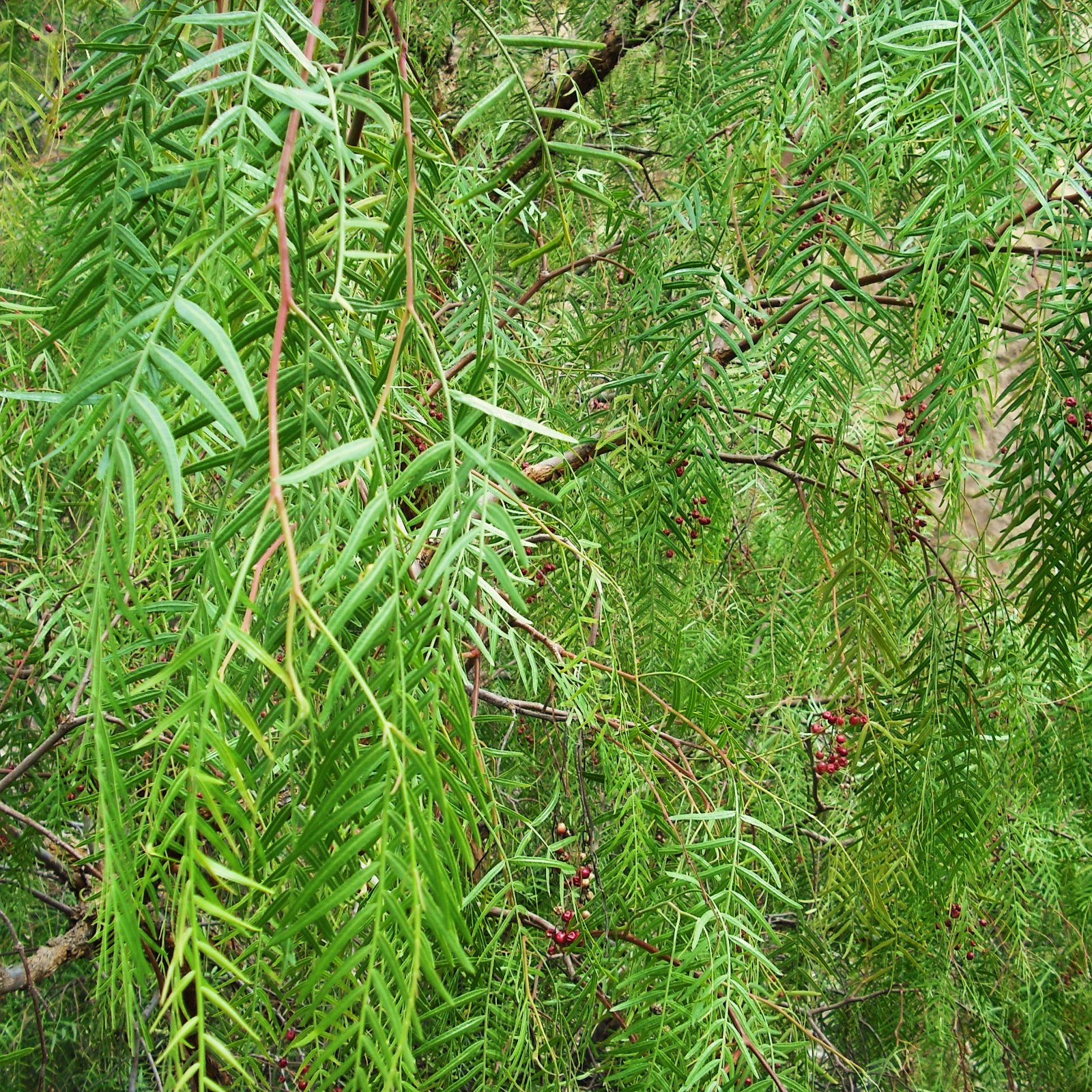
Schinus molle
Hồ tiêu hồng · Anacardiaceae
Pepper, but with fruit and rose. The opening is spicy and bright, then it settles into a sweet, slightly berry-like layer.
Pink pepper is not pepper: it is the fruit of Schinus molle, in the cashew family, unrelated to Piper nigrum. The oil is rich in monoterpenes such as α-phellandrene, limonene and myrcene, so it is brighter and evaporates faster than black pepper oil.
People allergic to plants of the cashew family (such as mango and cashew) should be cautious with this fruit. With the essential oil, dilution and a patch test on a small area of skin are essential.
- Plant part
- Seeds
- Vietnamese name
- Hồ tiêu hồng
- Scent family
- Spicy
- Plant family
- Anacardiaceae
- Lots published
- —
 Seeds
Composition profile
The published composition from the article, read as structure: 5 compounds adding up to about 79 % of the sample. Figures are printed as the source gives them — one sample, not a species average.
| Compound | Level | Class | Note |
|---|---|---|---|
| δ-3-Carene | 30.37 % | Monoterpenes | Top |
| Limonene EU | 17.44 % | Monoterpenes | Top |
| α-Phellandrene | 12.60 % | Monoterpenes | Top |
| α-Pinene EU | 12.59 % | Monoterpenes | Top |
| Myrcene | 5.82 % | Monoterpenes | Top |
By chemical class
- Monoterpenes78.8 %
By note
- Top78.8 %
Group totals use the upper bound of each range and only the compounds the article lists; bars are relative to the identified total.
Compare with the 1 chemically closest oil Which other oils are rich in δ-3-Carene?
What pink pepper is
Pink pepper is not pepper. It is the fruit of two species of Schinus, in the cashew family: Schinus molle (Peruvian pepper tree) and Schinus terebinthifolius (Brazilian pepper tree). Neither is related to black pepper (Piper nigrum). The oils of the two species differ in composition, so the species on the label is the first thing to check.
Composition
| Compound | Ripe fruit (2014) | Fruit (2021) | Leaf (2021) | *S. molle* (2025) |
|---|---|---|---|---|
| δ-3-Carene | 30.37% | 22.74% | – | – |
| α-Phellandrene | 12.60% | 8.67% | – | 34.02% |
| Myrcene | 5.82% | 33.76% | 0.35% | 23.87% |
| Limonene | 17.44% | 3.62% | 31.13% | 13.99% |
| α-Pinene | 12.59% | 3.18% | 2.32% | – |
| β-Phellandrene | – | – | – | 7.01% |
The S. terebinthifolius samples were all from Brazil and hydrodistilled. A dash means the study did not report it or we could not read it.
A 2026 review of S. molle (leaves and fruits, many countries) gives these ranges: α-phellandrene 9.60–48.01%, myrcene 12.20–58.70%, limonene 8.60–31.14%, β-phellandrene 10.50–33.89%.
Reading the table: two species, two types
- S. terebinthifolius (fruit): usually rich in δ-3-carene, with α-phellandrene and limonene.
- S. molle: led by α-phellandrene, myrcene and limonene, with no δ-3-carene recorded in the data we read.
- Leaves are quite different from fruit: the Brazilian leaf sample was mostly limonene.
Its smell
α-Phellandrene gives a peppery, spicy, slightly scorched top note; myrcene and limonene add a fruity, green part. Because it is almost entirely light monoterpenes, pink pepper oil is brighter and more fleeting than black pepper oil, which has more of the longer-lasting β-caryophyllene.
Safety: people allergic to cashew or pistachio
A 2019 study in Singapore found that 16 of 21 children allergic to cashew and/or pistachio (76.2%) had positive skin-prick tests to S. terebinthifolius peppercorns; no oral challenge was done, so clinical cross-reactivity was not confirmed. The American Academy of Allergy, Asthma & Immunology (AAAAI) also notes the potential for cross-reaction between cashew and pink peppercorn. People allergic to plants of the cashew family (cashew, mango, pistachio) should avoid this oil or ask a doctor first. Always dilute and test on a small patch of skin first.
Sources
- Cole E.R., dos Santos R.B., Lacerda Junior V. et al. (2014). Chemical composition of essential oil from ripe fruit of Schinus terebinthifolius Raddi and evaluation of its activity against wild strains of hospital origin. Brazilian Journal of Microbiology 45(3), 821–828. doi:10.1590/S1517-83822014000300009
- Magalhaes M.L., Ionta M., Ferreira G.A. et al. (2021). Genotoxic, cytotoxic and fungicidal activity of the essential oil extracted from the leaves and fruits of the pink pepper (Schinus terebinthifolius Raddi). Australian Journal of Crop Science 15(07), 997–1004. doi:10.21475/ajcs.21.15.07.p2962
- Oses R., Ferrando M., Bruna F. et al. (2025). Exploring the Bioactive Potential and Chemical Profile of Schinus molle Essential Oil: An Integrated In Silico and In Vitro Evaluation. Plants 14(15), 2449. doi:10.3390/plants14152449
- Radice M., Durofil A., Rios-Nunez S. et al. (2026). Schinus molle L. Essential Oil: Chemotypes, Bioactive Compounds, and Pharmaceutical Insights: A Systematic Review. Processes 14(2), 180. doi:10.3390/pr14020180
- Too J.J.Y., Shek L.P., Rajakulendran M. (2019). Cross-reactivity of pink peppercorn in cashew and pistachio allergic individuals. Asia Pacific Allergy 9(3), e25. doi:10.5415/apallergy.2019.9.e25
Buy Pink pepper
Pink pepper oil: no lot has been brought in yet, so it is not on sale. Message us if you need it.
Where you may already have smelled it
According to the analyses cited above, this oil contains up to 17.4 % limonene. It is also the leading compound in the scenes below from the scent dictionary. Smelling one of those scenes again is a way to get to know it without opening a bottle. A shared compound does not mean the oil smells exactly like the scene.
- Ripe kumquat peelLightly squeeze the peel of a ripe yellow kumquat
- Vietnamese lime peelSqueeze a Vietnamese lime and smell the peel, not the juice
- Buddha’s handTake a ripe yellow Buddha’s hand and lightly scratch the peel with a fingernail
- Crushed pomelo peelSqueeze a piece of Nam Roi pomelo peel hard, so the oil sprays out
Chemically close
The oils whose published composition is closest to this one, compared across every compound we could read. Close in composition does not mean the scent is identical or that one can replace the other.
- Larch / Tamarack Larix laricina shared: δ-3-Carene, α-Pinene · closeness 0.76 · compare
Further reading
Close to Pink pepper
Same plant family: Anacardiaceae Mastic
Also from the seeds Coriander seed · May chang · Nutmeg · Star anise · Sweet fennel · Vanilla CO₂
Same method: direct steam distillation Frankincense serrata · German chamomile · Himalayan cedarwood · Lemon myrtle · Oregano · Ravintsara ct 1,8-cineole · Star anise · Vietnamese balm
Quick answers
What does pink pepper essential oil smell like?
Pepper, but with fruit and rose. The opening is spicy and bright, then it settles into a sweet, slightly berry-like layer.
What is the botanical name of pink pepper oil?
The plant is Schinus molle, in the Anacardiaceae family. In Vietnamese it is called hồ tiêu hồng.
How is pink pepper oil produced?
From the seeds of the plant, by direct steam distillation. See the method for what that does to the oil.
What are the main compounds of pink pepper oil?
From the composition data on this page, the oil is led by δ-3-Carene, Limonene and α-Phellandrene. Proportions vary with origin, harvest and method; a lot analysis is the only answer for a given bottle.
Last updated