Essential oils · Woody & Resinous family
Sitka spruce essential oil
Picea sitchensis
Vân sam Sitka · Pinaceae
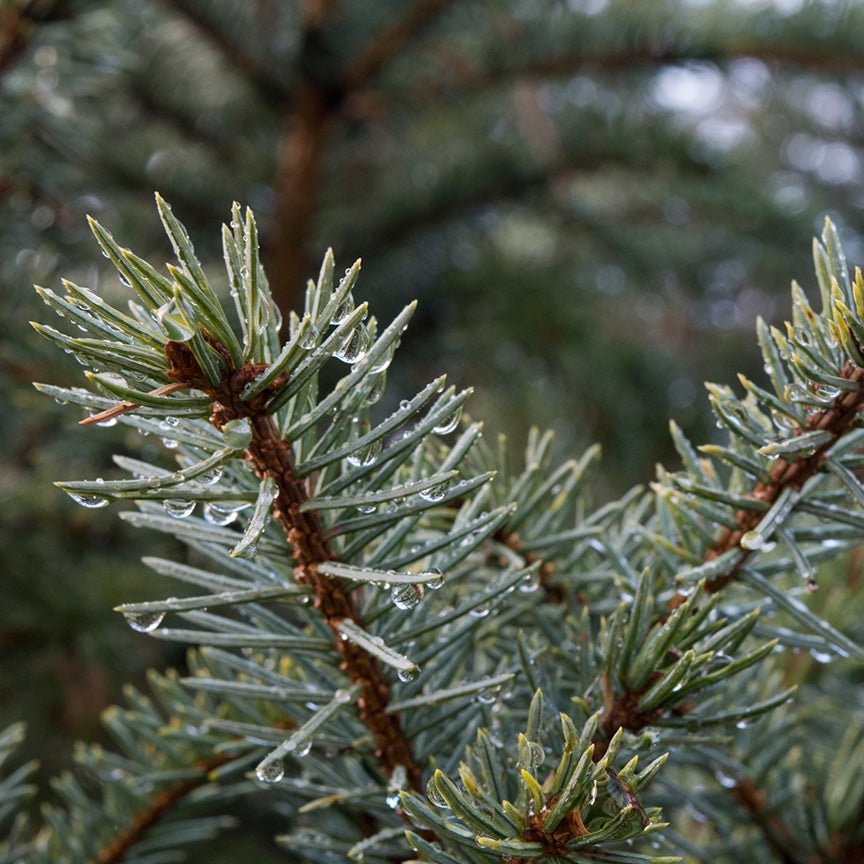
Green, damp needles, like a forest after rain, with a touch of sweet resin. It is fresh and slightly cool.
Sitka spruce (Picea sitchensis) is the largest spruce, growing along the wet coast from Alaska to California. Unlike many conifer oils, its needle oil is not led by the pinenes but by β-phellandrene, myrcene and piperitone, with fruity isovalerate esters.
Sitka spruce wood is famous for being light yet strong, once used in light aircraft and guitar soundboards. The oil is distilled from the needles, not the wood, so it smells of needles rather than timber.
- Plant part
- Leaves
- Vietnamese name
- Vân sam Sitka
- Scent family
- Woody & Resinous
- Plant family
- Pinaceae
- Lots published
- —
 Leaves
Composition profile
The published composition from the article, read as structure: 9 compounds adding up to about 73 % of the sample. Figures are printed as the source gives them — one sample, not a species average.
| Compound | Level | Class | Note |
|---|---|---|---|
| Myrcene | 22.2 % | Monoterpenes | Top |
| Piperitone | 18.0 % | — | — |
| β-Phellandrene | 9.1 % | Monoterpenes | Top |
| 3-Methyl-3-butenyl isovalerate | 6.9 % | — | — |
| Isoamyl isovalerate | 6.4 % | — | — |
| Camphor EU | 4.4 % | Ketones | Middle |
| Borneol | 3.4 % | Alcohols | Middle |
| α-Pinene EU | 1.2 % | Monoterpenes | Top |
| β-Pinene EU | 1.2 % | Monoterpenes | Top |
By chemical class
- Monoterpenes33.7 %
- Unclassified31.3 %
- Ketones4.4 %
- Alcohols3.4 %
By note
- Top33.7 %
- Middle7.8 %
- Unclassified31.3 %
Group totals use the upper bound of each range and only the compounds the article lists; bars are relative to the identified total.
Put it beside another oil in the Compare tool Which other oils are rich in Myrcene?
What Sitka spruce is
Sitka spruce (Picea sitchensis) is the largest of the world’s spruces, growing in a narrow strip along the north Pacific coast from Alaska to northern California. Unlike many conifer oils, Sitka oil is not led by pinene.
Composition: three trees in Oregon
A 2024 study in the Journal of Essential Oil and Plant Composition distilled oil from the leaves and twigs at the ends of the branches of three trees in the Van Duzer forest, Oregon Coast Range (collected April 2023):
| Compound | Tree 1 | Tree 2 | Tree 3 |
|---|---|---|---|
| β-Phellandrene | 9.1% | 25.1% | 17.5% |
| Myrcene | 22.2% | 15.9% | 18.2% |
| Piperitone | 18.0% | 2.9% | 5.8% |
| α-Pinene | 1.2% | 12.5% | 5.9% |
| β-Pinene | 1.2% | 7.2% | 4.4% |
| Isoamyl isovalerate | 6.4% | 2.3% | 3.2% |
| 3-Methyl-3-butenyl isovalerate | 6.9% | 1.5% | 1.9% |
| Camphor | 4.4% | 0.9% | 3.1% |
| Borneol | 3.4% | 0.4% | 3.9% |
Oil yield was 1.30–2.10%. Three trees from the same forest already differ clearly: tree 1 is rich in piperitone and esters, tree 2 in β-phellandrene and pinene.
British Columbia: commercial oils
A 2018 study in the American Journal of Essential Oils and Natural Products analysed Sitka spruce leaf oils from producers in three areas of British Columbia (Canada): Haida Gwaii, Kitamaat and the Bella Coola Valley. The oils were steam-distilled for 90 minutes, with a typical batch of about 100 kg of foliage. Means across the samples:
| Compound | Mean | Range |
|---|---|---|
| Myrcene | 23.1% | 12.1–33.3% |
| β-Phellandrene | 21.1% | 15.5–35.6% |
| α-Pinene | 7.4% | 2.9–11.5% |
| Piperitone | 7.0% | 0.5–12.5% |
| β-Pinene | 5.6% | 2.9–9.8% |
| Limonene | 4.5% | 1.3–9.9% |
| Isoamyl isovalerate | 3.4% | 0.8–6.4% |
| Camphor | 2.25% | 0.0–3.5% |
The β-phellandrene maximum of 35.6% includes 1,8-cineole, which comes off in the same chromatographic peak. The main compounds are the same as in Oregon: myrcene and β-phellandrene lead, with piperitone and the isovalerate esters present. The Oregon paper compares the two regions by compound class: monoterpene hydrocarbons averaged 53.2% in Oregon against 77.1% in British Columbia; oxygenated monoterpenes 21.6% against 9.9%.
A fingerprint: piperitone and the isovalerate esters
Two features appear in both regions:
- Piperitone, a monoterpene ketone, reaching 18% in one Oregon tree and 12.5% in the British Columbia samples.
- The isovalerate esters (isoamyl isovalerate and 3-methyl-3-butenyl isovalerate).
The Oregon paper also cites a 1974 study showing myrcene to be high in young foliage and to fall as the foliage ages, while piperitone rises. That is one reason the proportions vary between trees and lots.
Isomers
Chiral analysis of the Oregon samples showed β-phellandrene and piperitone almost entirely in the (−) form, δ-3-carene in the (+) form, and camphor mostly in the (+) form. This kind of data can be used to cross-check an oil’s origin. See also isomers cannot replace each other.
Safety
Oils rich in monoterpenes oxidise when left exposed to air. Pinene, limonene and camphor are on the EU list of fragrance allergens that must be declared on cosmetic labels above a threshold (Regulation 2023/1545). Keep it tightly closed in a cool place and dilute before use on skin.
Sources
- Satyal P., Poudel A., Swor K., Setzer W.N. (2024). The essential oil composition of Picea sitchensis growing in the Oregon Coast Range. Journal of Essential Oil and Plant Composition 2(1), 30–37. doi:10.58985/jeopc.2024.v02i01.41
- St-Gelais A., Collin G., Helbig J., Gagnon H. (2018). Essential oils from the foliage of Picea sitchensis from British Columbia. American Journal of Essential Oils and Natural Products 6(3), 19–26. essencejournal.com
- Harris A.S. Picea sitchensis (Bong.) Carr. Sitka Spruce. In: Silvics of North America, USDA Forest Service.
- Regulation (EU) 2023/1545 on the labelling of fragrance allergens.
Buy Sitka spruce
Sitka spruce oil: no lot has been brought in yet, so it is not on sale. Message us if you need it.
Where you may already have smelled it
According to the analyses cited above, this oil contains up to 23.1 % myrcene and up to 21.1 % β-phellandrene. Both are also part of, though not the lead in, the scenes below from the scent dictionary. Smelling one of those scenes again is a way to get to know them without opening a bottle. A shared compound does not mean the oil smells exactly like the scene.
Further reading
Close to Sitka spruce
Same plant family: Pinaceae Balsam fir · Black spruce · Hemlock spruce · Ponderosa pine · Siberian fir · White pine · White spruce
Also from the leaves Black spruce · Douglas fir · Green myrtle · Honey myrtle · Kanuka · Utah juniper · White spruce · Wintergreen
Same method: direct steam distillation Black spruce · Cassia bark · Hemlock spruce · Spike lavender · Sweet marjoram · Thyme ct thymol · White spruce · Wintergreen
Quick answers
What does Sitka spruce essential oil smell like?
Green, damp needles, like a forest after rain, with a touch of sweet resin. It is fresh and slightly cool.
What is the botanical name of Sitka spruce oil?
The plant is Picea sitchensis, in the Pinaceae family. In Vietnamese it is called vân sam sitka.
How is Sitka spruce oil produced?
From the leaves of the plant, by direct steam distillation. See the method for what that does to the oil.
What are the main compounds of Sitka spruce oil?
From the composition data on this page, the oil is led by Myrcene, β-Phellandrene and α-Pinene. Proportions vary with origin, harvest and method; a lot analysis is the only answer for a given bottle.
Last updated