Essential oils · Woody & Resinous family
Black spruce essential oil
Picea mariana
Vân sam đen · Pinaceae
Sweet, soft needles, a little like balsam resin, with a warm woody note. It is sweeter than pine and smoother than many conifers.
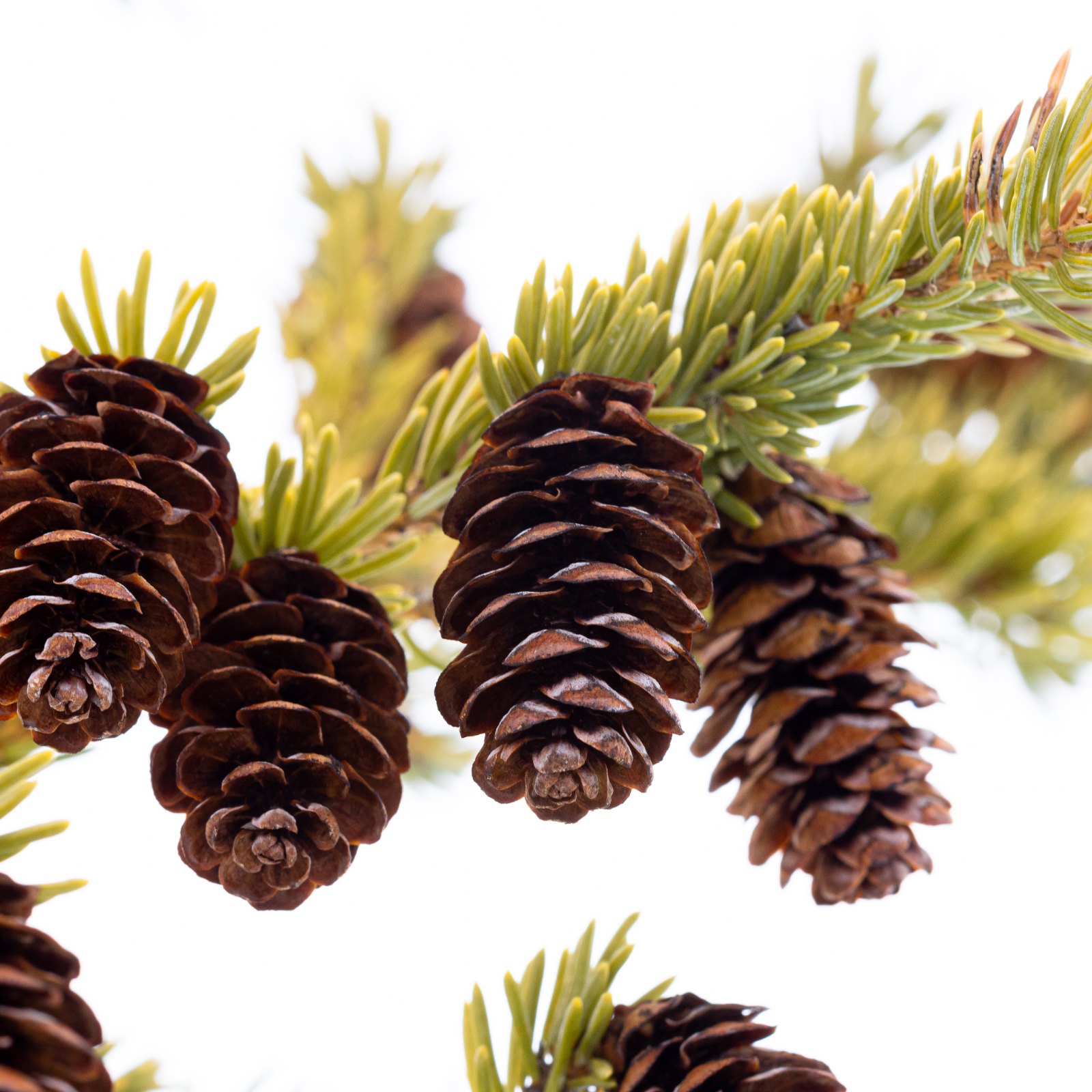
Black spruce (Picea mariana) grows in the cold boreal forests of Canada. Its needle oil is among those rich in bornyl acetate, the ester behind a sweet conifer smell, along with camphene and α-pinene.
In a study in Quebec, black spruce needle oil had 34.2% bornyl acetate, about three times the level in balsam fir from the same place. Oil distilled from the bark is quite different: mostly pinene, with almost no bornyl acetate.
- Plant part
- Leaves
- Vietnamese name
- Vân sam đen
- Scent family
- Woody & Resinous
- Plant family
- Pinaceae
- Lots published
- —
 Leaves
Composition profile
The published composition from the article, read as structure: 3 compounds adding up to about 64 % of the sample. Figures are printed as the source gives them — one sample, not a species average.
| Compound | Level | Class | Note |
|---|---|---|---|
| Bornyl acetate | 34.2 % | — | — |
| Camphene | 16.4 % | Monoterpenes | Top |
| α-Pinene EU | 12.9 % | Monoterpenes | Top |
By chemical class
- Unclassified34.2 %
- Monoterpenes29.3 %
By note
- Top29.3 %
- Unclassified34.2 %
Group totals use the upper bound of each range and only the compounds the article lists; bars are relative to the identified total.
Black spruce
Black spruce (Picea mariana) is primarily a species of the cold northern (boreal) forest. According to the US Forest Service’s FEIS database, it is most abundant on low, acidic peatlands, although it also grows on upland sites.
Composition of the needle oil
A 2012 study analysed the oil and the distillation water of three conifers growing at Grondines, Quebec. For black spruce:
According to the authors, monoterpenes, mainly α-pinene and camphene, made up at least 45% of the oil.
Bornyl acetate accounts for more than a third of the oil, about three times the level in balsam fir in the same study (10%).
Hydrosol
Black spruce hydrosol is mainly α-terpineol and borneol (about 14% each), with bornyl acetate 7.8%, cis-3-hexenol 6.5%, and terpinen-4-ol and camphene hydrate (about 6% each). Monoterpene hydrocarbons are barely present in the hydrosol. See also the article on hydrosols.
Needles and bark: two oils
Black spruce is a major timber species in Canada, and bark residue can be distilled for oil. A 2017 study in BioResources distilled black spruce bark oil in two ways, with steam and with water:
| Compound | Steam | Water |
|---|---|---|
| α-Pinene | 40.6% | 40.5% |
| β-Pinene | 33.9% | 25.9% |
| β-Phellandrene | 4.8% | 3.6% |
| δ-3-Carene | 4.1% | 3.1% |
| Limonene | 4.0% | 3.7% |
Bark oil is a pinene oil: α- and β-pinene together make up about three quarters of it, while bornyl acetate is only a trace. The authors note that needle oils are rich in bornyl acetate, which matches the Quebec figures above. Two bottles both labelled “black spruce” can be two quite different oils, so the label should state the part distilled.
Storage and safety
Pinene, limonene and terpineol are on the EU list of fragrance allergens that must be declared on cosmetic labels (Regulation 2023/1545); pinene and limonene also carry a low peroxide value requirement because they oxidise in air. Keep the oil tightly closed and cool, and dilute before use on skin.
Sources
- Garneau F.-X., Collin G., Gagnon H., Pichette A. (2012). Chemical Composition of the Hydrosol and the Essential Oil of Three Different Species of the Pinaceae Family: Picea glauca, Picea mariana, and Abies balsamea. Journal of Essential Oil Bearing Plants 15(2), 227–236. doi:10.1080/0972060X.2012.10644040 (abstract read)
- Francezon N., Stevanovic T. (2017). Chemical composition of essential oil and hydrosol from Picea mariana bark residue. BioResources 12(2), 2635–2645. doi:10.15376/biores.12.2.2635-2645
- Fryer J.L. (2014). Picea mariana. Fire Effects Information System (FEIS), USDA Forest Service.
- Regulation (EU) 2023/1545 on the labelling of fragrance allergens.
Buy Black spruce
Black spruce oil: no lot has been brought in yet, so it is not on sale. Message us if you need it.
Where you may already have smelled it
According to the analyses cited above, this oil contains up to 40.6 % α-pinene. It is also the leading compound in the scenes below from the scent dictionary. Smelling one of those scenes again is a way to get to know it without opening a bottle. A shared compound does not mean the oil smells exactly like the scene.
Chemically close
The oils whose published composition is closest to this one, compared across every compound we could read. Close in composition does not mean the scent is identical or that one can replace the other.
- Hemlock spruce Tsuga canadensis shared: Bornyl acetate, Camphene · closeness 0.97 · compare
- Siberian fir Abies sibirica shared: Bornyl acetate, Camphene · closeness 0.92 · compare
- Amomum Amomum villosum shared: Bornyl acetate, Camphene · closeness 0.85 · compare
Further reading
Close to Black spruce
Same plant family: Pinaceae Atlas cedarwood · Balsam fir · Douglas fir · Hemlock spruce · Pinyon pine · Siberian fir · White fir
Also from the leaves Eucalyptus dives · Indian patchouli · Lemon eucalyptus · Manuka · Scots pine · Siberian fir · Utah juniper · Wintergreen
Same method: direct steam distillation Baeckea · Cassia bark · Clary sage · Clove bud · Fokienia · Kunzea · Neroli · Wintergreen
Quick answers
What does black spruce essential oil smell like?
Sweet, soft needles, a little like balsam resin, with a warm woody note. It is sweeter than pine and smoother than many conifers.
What is the botanical name of black spruce oil?
The plant is Picea mariana, in the Pinaceae family. In Vietnamese it is called vân sam đen.
How is black spruce oil produced?
From the leaves of the plant, by direct steam distillation. See the method for what that does to the oil.
Last updated