Essential oils · Medicinal family
Rosemary ct verbenone essential oil
Salvia rosmarinus ct. verbenone
Hương thảo ct. verbenone · Lamiaceae
Rosemary, but softer and sweeter, with less of the camphor edge. There is a slightly honeyed, woody note behind.
That softness is verbenone, a ketone related to α-pinene. In this type, verbenone takes over part of camphor’s role, so the smell is less sharp.
Setting it beside rosemary chemotype camphor is the best way to hear how a chemotype changes a smell: the same plant, the same pine and cineole opening, but a clearly different body.
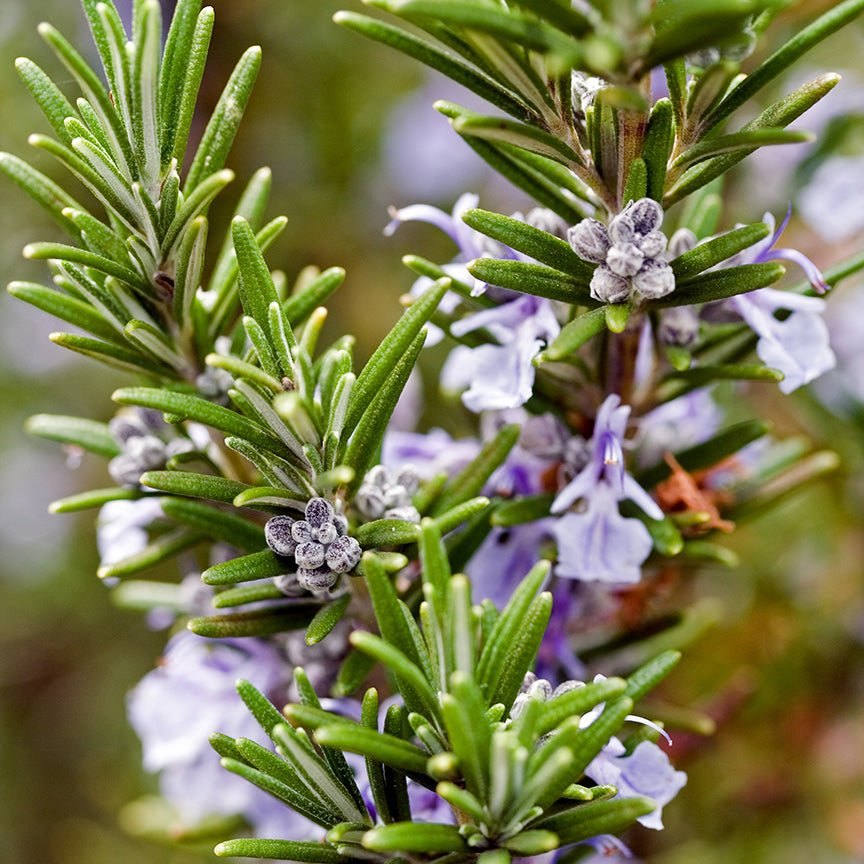
- Plant part
- Whole plant
- Chemotype
- ct. verbenone
- Vietnamese name
- Hương thảo ct. verbenone
- Scent family
- Medicinal
- Plant family
- Lamiaceae
- Lots published
- —
 Whole plant
Composition profile
The published composition from the article, read as structure: 3 compounds adding up to about 84 % of the sample. Figures are printed as the source gives them — one sample, not a species average.
| Compound | Level | Class | Note |
|---|---|---|---|
| α-Pinene EU | 13.5–37.7 % | Monoterpenes | Top |
| 1,8-Cineole | 16.1–29.3 % | Oxides | Top |
| Verbenone | 0.8–16.9 % | Ketones | Middle |
By chemical class
- Monoterpenes37.7 %
- Oxides29.3 %
- Ketones16.9 %
By note
- Top67.0 %
- Middle16.9 %
Group totals use the upper bound of each range and only the compounds the article lists; bars are relative to the identified total.
Compare with the 2 chemically closest oils Which other oils are rich in α-Pinene?
Rosemary has at least thirteen chemotypes
Rosemary (Salvia rosmarinus, formerly Rosmarinus officinalis) gives oils of very variable composition. According to a 2017 study in Foods, earlier literature had identified at least 13 different chemotypes based on the proportions of α-pinene, 1,8-cineole, camphor, borneol, verbenone and bornyl acetate.
The authors distilled oil from rosemary plants collected in six places (Australia, Alabama in the USA, South Africa, Kenya, Nepal and Yemen), with yields of 0.5–1.7%, and then combined them with 72 published compositions for cluster analysis, 78 samples in all. The result showed at least five clear chemotypes, including a “verbenone/α-pinene/camphor/1,8-cineole” cluster of 8 samples. In their six samples, according to the abstract, the main compounds ranged as follows:
| Compound | Range |
|---|---|
| (+)-α-Pinene | 13.5–37.7% |
| 1,8-Cineole | 16.1–29.3% |
| (+)-Verbenone | 0.8–16.9% |
| (−)-Borneol | 2.1–6.9% |
| (−)-Camphor | 0.7–7.0% |
| Limonene | 1.6–4.4% |
The results section of the paper gives some figures slightly different from the abstract, including verbenone at 18.6% in the Yemeni sample, above the 16.9% shown here.
Verbenone in ordinary oil and in verbenone-type oil
In ordinary commercial rosemary oil, verbenone is only a minor compound. The European Food Safety Authority’s (EFSA) 2025 assessment of rosemary oil as a feed additive, on 13 batches distilled from flowering aerial parts in Spain, Tunisia, Morocco and India, recorded 1,8-cineole at 16.17–57.33%, camphor 11.12–23.13%, α-pinene 8.60–19.74%, and verbenone at only 0.27–2.10%.
The verbenone type is rarer. A 2011 study of 31 wild rosemary populations in the Murcia region (Spain) found most to be of the cineole and camphor types, with only some plants giving oil rich in verbenone (13%). A 2002 study of rosemary oils from Sardinia and Corsica classed them as an α-pinene/verbenone/bornyl acetate type.
So a bottle labelled “rosemary ct. verbenone” only means something when the analysis shows verbenone clearly higher than the 0.27–2.10% of ordinary oil.
Enantiomers matter too
The 2017 study also used chiral chromatography to identify the optical isomers of each compound: α-pinene (97–99%) and verbenone (100%) in the (+) form, borneol (95–98%) and camphor in the (−) form, while limonene was close to an even mix (40–54% (+)). The article on chiral chromatography explains why isomer ratios help check where a compound came from. A rosemary oil whose verbenone or camphor shows isomer ratios far from these figures is worth questioning.
Safe use
Verbenone-type oil still contains 1,8-cineole and camphor. Under Regulation (EU) 2023/1545, camphor is on the list of fragrance allergens that must be named on cosmetic labels (above 0.001% in leave-on and 0.01% in rinse-off products). EFSA classes rosemary oil as an irritant to skin and eyes and a skin and respiratory sensitiser for people who handle it. Always dilute, and see the page on children and pregnancy.
Sources
- Satyal P., Jones T.H., Lopez E.M. et al. (2017). Chemotypic Characterization and Biological Activity of Rosmarinus officinalis. Foods 6(3), 20. doi:10.3390/foods6030020
- EFSA FEEDAP Panel (2025). Safety and efficacy of a feed additive consisting of an essential oil derived from the flowering aerial parts of Salvia rosmarinus Spenn. (rosemary oil) for use in all animal species (FEFANA asbl). EFSA Journal 23(10), e9685. doi:10.2903/j.efsa.2025.9685
- Jordan M.J., Lax V., Martinez C., Aouissat M., Sotomayor J.A. (2011). Chemical intraspecific variability and chemotype determination of Rosmarinus officinalis L. in the region of Murcia. Acta Horticulturae 925, 109–114. doi:10.17660/ActaHortic.2011.925.14 (abstract read)
- Pintore G.A.M., Usai M., Bradesi P. et al. (2002). Flavour and Fragrance Journal 17(1), 15–19. doi:10.1002/ffj.1022 (abstract read)
- Regulation (EU) 2023/1545 on the labelling of fragrance allergens.
Buy Rosemary ct verbenone
Rosemary ct verbenone oil: no lot has been brought in yet, so it is not on sale. Message us if you need it.
Where you may already have smelled it
According to the analyses cited above, this oil contains up to 37.7 % α-pinene and up to 29.3 % 1,8-cineole. Both are also the leading compound in the scenes below from the scent dictionary. Smelling one of those scenes again is a way to get to know them without opening a bottle. A shared compound does not mean the oil smells exactly like the scene.
- Canarium resinScrape a fresh drop of resin oozing from a Canarium trunk and smell it on the knife tip
- Pine woodFresh pine sawdust, just sawn
- Cajeput oilOpen a bottle of cajeput oil and put a drop on the back of your hand
- Black cardamomA black cardamom pod charred over a flame, shelled, the seeds inside smelled
Chemically close
The oils whose published composition is closest to this one, compared across every compound we could read. Close in composition does not mean the scent is identical or that one can replace the other.
Further reading
Close to Rosemary ct verbenone
Same plant family: Lamiaceae Clary sage · Hyssop ct 1,8-cineole · Japanese mint · Oregano · Patchouli · Spike lavender · Sweet marjoram · Vietnamese balm
Also from the whole plant Baeckea · Bee balm · Hyssop ct 1,8-cineole · Mugwort · Oregano · Spearmint · Sweet marjoram · Vietnamese balm
Same method: direct steam distillation Atlas cedarwood · Coriander seed · Frankincense sacra · Helichrysum · Lemon myrtle · Pink pepper · Star anise · Vietnamese balm
Quick answers
What does rosemary ct verbenone essential oil smell like?
Rosemary, but softer and sweeter, with less of the camphor edge. There is a slightly honeyed, woody note behind.
What is the botanical name of rosemary ct verbenone oil?
The plant is Salvia rosmarinus, in the Lamiaceae family; this oil is the verbenone chemotype. In Vietnamese it is called hương thảo ct. verbenone.
How is rosemary ct verbenone oil produced?
From the whole plant of the plant, by direct steam distillation. See the method for what that does to the oil.
What are the main compounds of rosemary ct verbenone oil?
From the composition data on this page, the oil is led by α-Pinene, 1,8-Cineole and Verbenone. Proportions vary with origin, harvest and method; a lot analysis is the only answer for a given bottle.
Last updated