Essential oils · Woody & Resinous family
Ponderosa pine essential oil
Pinus ponderosa
Thông Ponderosa · Pinaceae
Bright pine resin, with a lemony note and a light touch of vanilla behind. It is fresh and clean.
Ponderosa pine (Pinus ponderosa) is a large pine common across the American West. The bark of old trees is famous for smelling of vanilla or baking in warm sun, while the needle oil is usually rich in β-pinene; some trees give oil high in methyl chavicol, with an aniseed sweetness rare in a pine.
The bark smell and the needle-oil smell are different things: the oil is distilled from the needles, so the vanilla note is only a small part.
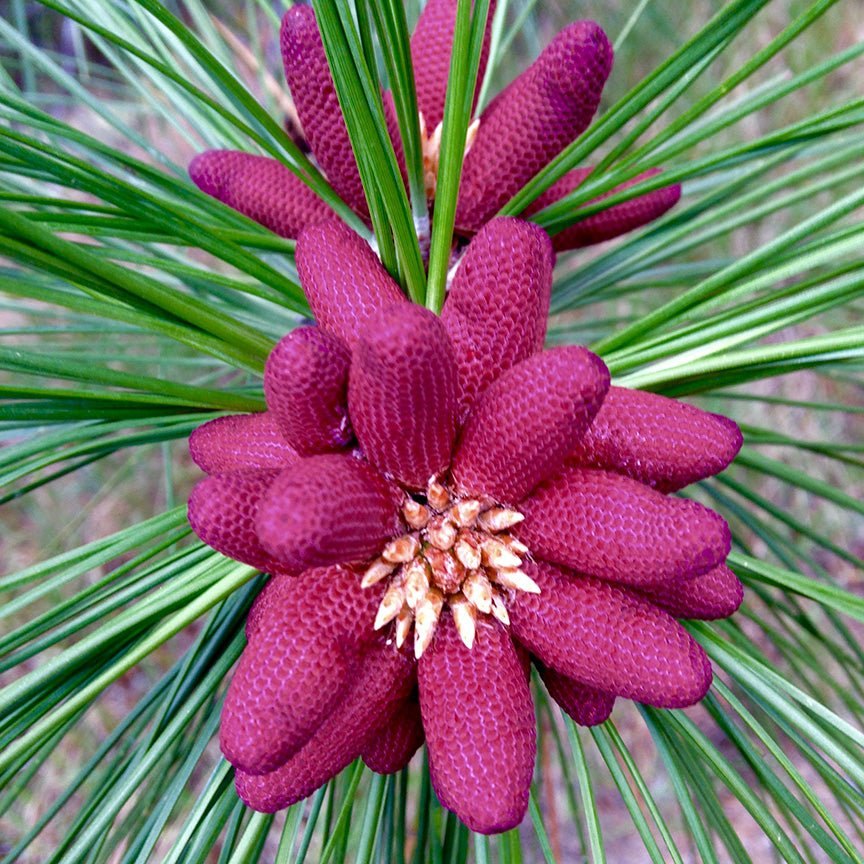
- Plant part
- Leaves
- Vietnamese name
- Thông Ponderosa
- Scent family
- Woody & Resinous
- Plant family
- Pinaceae
- Lots published
- —
 Leaves
Composition profile
The published composition from the article, read as structure: 7 compounds adding up to about 80 % of the sample. Figures are printed as the source gives them — one sample, not a species average.
| Compound | Level | Class | Note |
|---|---|---|---|
| Methyl chavicol (estragole) | 41.5 % | — | — |
| β-Pinene EU | 21.5 % | Monoterpenes | Top |
| α-Terpineol EU | 5.3 % | Alcohols | Middle |
| α-Pinene EU | 3.6 % | Monoterpenes | Top |
| δ-3-Carene | 3.6 % | Monoterpenes | Top |
| trans-Anethole EU | 2.3 % | Other compounds | Base |
| Linalool EU | 2.1 % | Alcohols | Middle |
By chemical class
- Unclassified41.5 %
- Monoterpenes28.7 %
- Alcohols7.4 %
- Other compounds2.3 %
By note
- Top28.7 %
- Middle7.4 %
- Base2.3 %
- Unclassified41.5 %
Group totals use the upper bound of each range and only the compounds the article lists; bars are relative to the identified total.
What ponderosa pine is
Ponderosa pine (Pinus ponderosa) is a large pine common throughout the American West. The oil is distilled from the needles, sometimes with small twigs. The biggest surprise about this oil is that some trees give oil with a clear aniseed smell, something rare in a pine.
Composition: three trees in Oregon
A 2022 study distilled fresh needle oil from three trees at La Pine, Oregon:
| Compound | Tree 1 | Tree 2 | Tree 3 |
|---|---|---|---|
| β-Pinene | 21.5% | 35.3% | 55.3% |
| Methyl chavicol (estragole) | 41.5% | 27.4% | 8.5% |
| α-Pinene | 3.6% | 5.7% | 9.6% |
| δ-3-Carene | 3.6% | 5.5% | 6.2% |
| α-Terpineol | 5.3% | 1.4% | 3.0% |
| (E)-Anethole | 2.3% | 1.6% | 0.1% |
| Linalool | 2.1% | 0.4% | 0.3% |
Yields were only 0.32–0.46%. In three trees from the same place, methyl chavicol ranged from 8.5% to 41.5%: the more methyl chavicol a tree had, the less β-pinene.
A pine that smells of aniseed
Methyl chavicol (estragole) is the main compound of tarragon and methyl chavicol basil; anethole is the main compound of star anise. A pine oil with 41.5% estragole and a further 2.3% anethole will have a sweet aniseed note over the pine resin. Tree 3, rich in β-pinene, is closer to an ordinary pine smell.
The β-pinene in all three trees was almost entirely in the (−) form (about 98%), a feature that can be used to check origin.
Distillation time changes the composition too
A 2012 study in Wyoming distilled the needles and small twigs of one tree for between 1.25 and 360 minutes. α-Pinene ranged from 17% to 40% and β-pinene from 21% to 29% depending on distillation time, while germacrene D, a slow-evaporating sesquiterpene, ranged from 0.1% to 19%. Yield peaked at around 160 minutes. This study did not record estragole, which shows that the chemotype varies between trees and regions.
Safety
For the estragole-rich type, the EU position on estragole applies: the Scientific Committee on Food (SCF) concluded in 2001 that estragole is genotoxic and carcinogenic, and that no safe exposure limit could be established. Do not take it by mouth, and do not use it for children or during pregnancy (see children and pregnancy). Pinene must be labelled above a threshold under EU Regulation 2023/1545. Keep tightly closed and dilute before use on skin.
Sources
- Ankney E., Swor K., Satyal P., Setzer W.N. (2022). Essential Oil Compositions of Pinus Species (P. contorta Subsp. contorta, P. ponderosa var. ponderosa, and P. flexilis); Enantiomeric Distribution of Terpenoids in Pinus Species. Molecules 27(17), 5658. doi:10.3390/molecules27175658
- Zheljazkov V.D., Astatkie T., Schlegel V. (2012). Effects of Distillation Time on the Pinus ponderosa Essential Oil Yield, Composition, and Antioxidant Activity. HortScience 47(6), 785–789. doi:10.21273/HORTSCI.47.6.785
- SCF (2001). Opinion on Estragole (1-Allyl-4-methoxybenzene). SCF/CS/FLAV/FLAVOUR/6 ADD2 FINAL.
Buy Ponderosa pine
Ponderosa pine oil: no lot has been brought in yet, so it is not on sale. Message us if you need it.
Where you may already have smelled it
According to the analyses cited above, this oil contains up to 21.5 % β-pinene. It is also part of, though not the lead in, the scenes below from the scent dictionary. Smelling one of those scenes again is a way to get to know it without opening a bottle. A shared compound does not mean the oil smells exactly like the scene.
Further reading
Close to Ponderosa pine
Same plant family: Pinaceae Engelmann spruce · Hemlock spruce · Larch / Tamarack · Norway pine · Pinyon pine · Scots pine · White pine
Also from the leaves Eucalyptus dives · Green myrtle · Larch / Tamarack · Patchouli · Pinyon pine · Scots pine · Sitka spruce · White pine
Same method: direct steam distillation Cornmint · German chamomile · Larch / Tamarack · Lavandin · Manuka · Pinyon pine · Scots pine · White pine
Quick answers
What does ponderosa pine essential oil smell like?
Bright pine resin, with a lemony note and a light touch of vanilla behind. It is fresh and clean.
What is the botanical name of ponderosa pine oil?
The plant is Pinus ponderosa, in the Pinaceae family. In Vietnamese it is called thông ponderosa.
How is ponderosa pine oil produced?
From the leaves of the plant, by direct steam distillation. See the method for what that does to the oil.
What are the main compounds of ponderosa pine oil?
From the composition data on this page, the oil is led by β-Pinene, α-Terpineol and α-Pinene. Proportions vary with origin, harvest and method; a lot analysis is the only answer for a given bottle.
Last updated