Essential oils · Earthy family
Patchouli essential oil
Pogostemon cablin
Hoắc hương · Lamiaceae
Damp earth, must, a little sweetness at the bottom. It is slow from start to finish and has no opening to speak of.
This is the oil that splits people into two clear camps, and both are right, because there is nothing wrong with disliking a smell. What is remarkable is how few people find it unremarkable.
It clings to a smelling strip for days. And unlike most essential oils, patchouli smells better aged than freshly distilled, because time softens the harshness without taking away the earth.
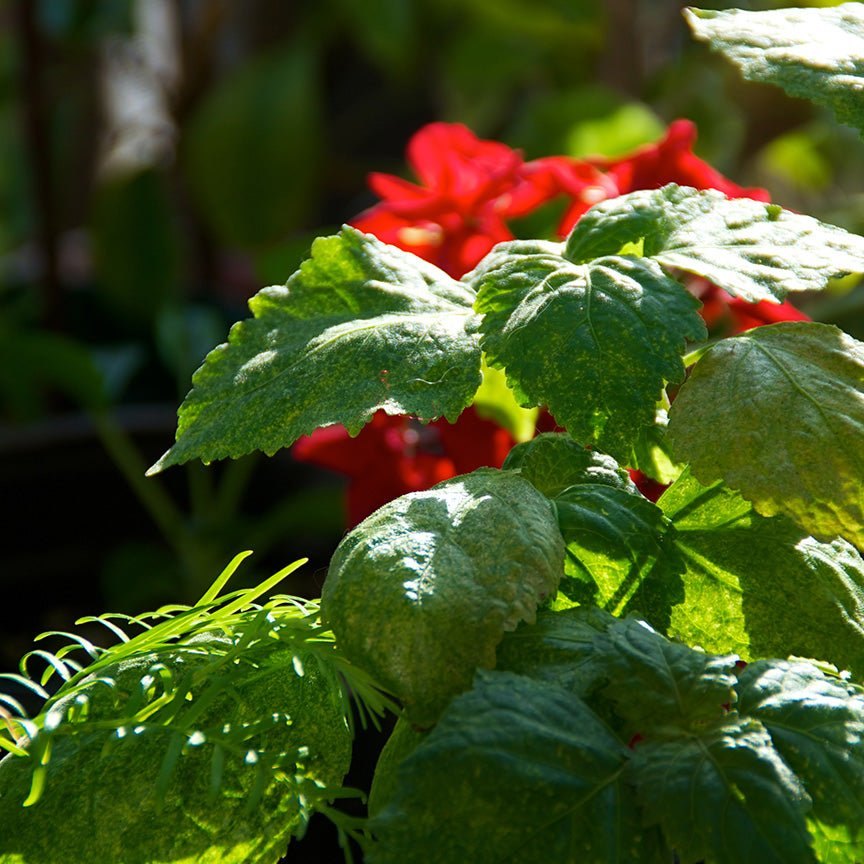
- Plant part
- Leaves
- Vietnamese name
- Hoắc hương
- Scent family
- Earthy
- Plant family
- Lamiaceae
- Lots published
- —
 Leaves
Composition profile
The published composition from the article, read as structure: 1 compounds adding up to about 0 % of the sample. Figures are printed as the source gives them — one sample, not a species average.
| Compound | Level | Class | Note |
|---|---|---|---|
| Patchoulol | — | Alcohols | Base |
By chemical class
By note
Group totals use the upper bound of each range and only the compounds the article lists; bars are relative to the identified total.
Put it beside another oil in the Compare tool Which other oils are rich in Patchoulol?
Dried leaves, not fresh ones
Most leaf oils are distilled while the leaves are still fresh. Patchouli is the other way round: the leaves are dried before they go into the still, and the time they spend waiting shapes the smell directly.
The PROSEA handbook records a comparison that makes the point. Oil distilled in Indonesia is dark orange to brown, viscous, and clearly earthy and woody-balsamic. Oil distilled in Europe or the United States from imported dried leaves is paler, with a more pronounced fruity, wine-like top note and less of the woody base. Same species; according to PROSEA, the difference may come from the leaves continuing to cure during transport and storage before distillation.
Main compounds
According to PROSEA, the main compounds of patchouli oil are:
| Compound | Note |
|---|---|
| Patchoulol (patchouli alcohol) | The main compound, carrying the woody, earthy part |
| Guaiene | Sesquiterpene hydrocarbon, present in quantity |
| Patchoulene, seychellene | Hydrocarbons characteristic of the species |
| Norpatchoulenol, nortetrapatchoulol | Minor, but characteristic |
Composition shifts with cultivar and growing region. PROSEA cites a cultivar from Tsukuba (Japan) grown in the southern Philippines that gave an oil poor in guaiene, quite unlike Sumatran oil. So the analysis of a patchouli lot should only be compared with oil from the same region and the same kind of distillation. Differing from Sumatran oil does not by itself mean the oil is fake.
A rare oil that improves with age
PROSEA notes that both types of oil improve on ageing, gradually losing the sharp-green, wet-earthy and slightly minty notes of freshly distilled oil. That is the opposite of tea tree or citrus peel oils, which deteriorate quickly once exposed to air.
The reason lies in the composition. Patchouli oil is almost entirely sesquiterpenes, large molecules that evaporate slowly and are far more stable than the light monoterpenes in peel oils. In practice, a newly bought bottle of patchouli that smells a little harsh is not necessarily a poor oil. Still, “improves” does not mean it can be kept anywhere; storage that is airtight and dark remains the condition.
From Indian shawls to Sumatra
Dried patchouli leaves were once laid between clothes in chests to keep insects away and to scent the fabric. Europe came to know the smell through shawls imported from India, before the first dried leaves reached London in 1844. The plant was taken to Java in 1895 and to Sumatra in 1910, and by 1920 Aceh in northern Sumatra had become the main producing area.
Today, according to PROSEA, more than 80% of the world’s patchouli oil comes from Sumatra, with the rest from southern China, Brazil, India and a few other places. The international standard for the oil is ISO 3757.
Sources
- PROSEA, Pogostemon cablin (Plant Resources of South-East Asia), Pl@ntUse edition. uses.plantnet-project.org
- van Beek T.A. and Joulain D. (2018). The essential oil of patchouli, Pogostemon cablin: A review. Flavour and Fragrance Journal 33(1), 6–51. doi:10.1002/ffj.3418
- ISO 3757:2002. Oil of patchouli (Pogostemon cablin (Blanco) Benth.).
In the car
The main compounds of this oil boil above 250 °C, so it is among the oils that hold up when a car is parked in the sun. Which essential oils can take a hot car explains why. We are measuring a hanging scented wood for the car, vacuum-infused with essential oil.
Buy Patchouli
Patchouli oil: no lot has been brought in yet, so it is not on sale. Message us if you need it.
Further reading
Close to Patchouli
Same plant family: Lamiaceae Basil ct linalool · Basil ct methyl chavicol · Clove basil · Indian patchouli · Japanese mint · Oregano · Rosemary ct camphor · Spike lavender
Also from the leaves Green myrtle · Indian bay leaf · Indian patchouli · Kanuka · Kunzea · Lemon myrtle · Ponderosa pine · Sitka spruce
Same method: direct steam distillation Basil ct linalool · Basil ct methyl chavicol · Eucalyptus radiata · Indian patchouli · Larch / Tamarack · Opopanax · Vetiver · Zedoary (white turmeric)
Quick answers
What does patchouli essential oil smell like?
Damp earth, must, a little sweetness at the bottom. It is slow from start to finish and has no opening to speak of.
What is the botanical name of patchouli oil?
The plant is Pogostemon cablin, in the Lamiaceae family. In Vietnamese it is called hoắc hương.
How is patchouli oil produced?
From the leaves of the plant, by direct steam distillation. See the method for what that does to the oil.
What are the main compounds of patchouli oil?
From the composition data on this page, the oil is led by Patchoulol. Proportions vary with origin, harvest and method; a lot analysis is the only answer for a given bottle.
Last updated