Basil ct methyl chavicol essential oil
Ocimum basilicum ct. methyl chavicol
Húng quế ct. methyl chavicol · Lamiaceae
Sweet like anise, warm, with green leaf underneath. This is the basil closest to the plate of herbs served with phở, because Vietnamese and Thai basil are naturally rich in methyl chavicol.
The same compound is found in tarragon, and its close relative is the anethole of star anise and fennel. That is why the nose files this whole group in the same drawer, even though they come from plants that have nothing to do with one another.
Setting this bottle next to the linalool chemotype is the quickest way to understand what a chemotype is. The same species, the same name on the label, and one side is anise while the other is flowers.
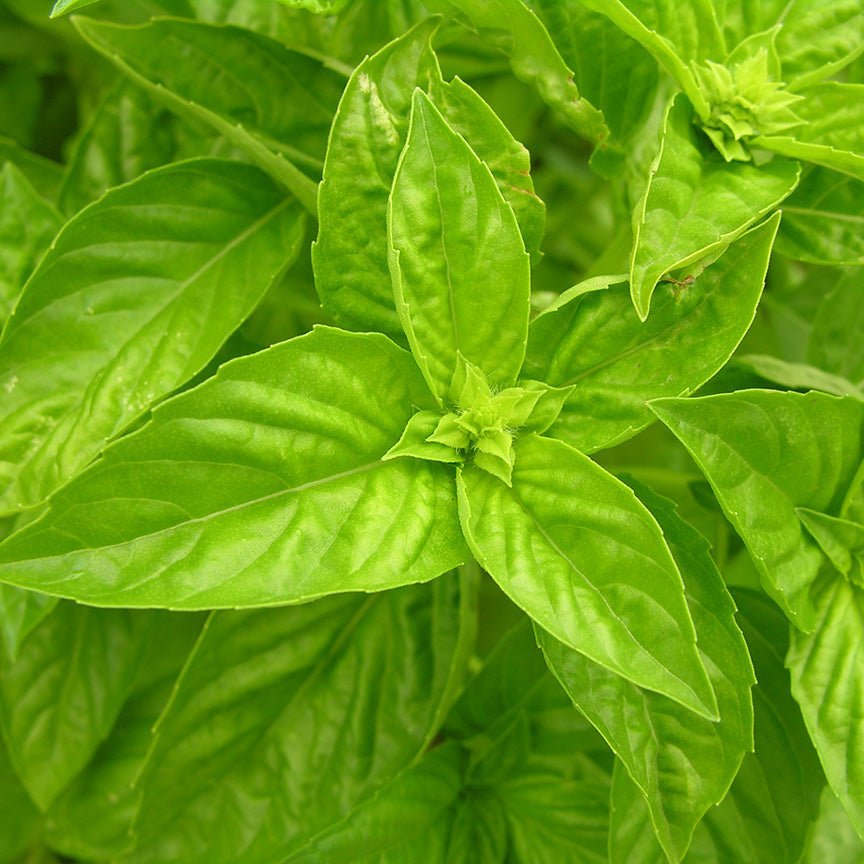
- Plant part
- Whole plant
- Chemotype
- ct. methyl chavicol
- Vietnamese name
- Húng quế ct. methyl chavicol
- Scent family
- Spicy
- Plant family
- Lamiaceae
- Lots published
- —
 Whole plant
Composition profile
The published composition from the article, read as structure: 1 compounds adding up to about 90 % of the sample. Figures are printed as the source gives them — one sample, not a species average.
| Compound | Level | Class | Note |
|---|---|---|---|
| Estragole | 89.91 % | Other compounds | Middle |
By chemical class
- Other compounds89.9 %
By note
- Middle89.9 %
Group totals use the upper bound of each range and only the compounds the article lists; bars are relative to the identified total.
Put it beside another oil in the Compare tool Which other oils are rich in Estragole?
Vietnamese basil and methyl chavicol
Basil (Ocimum basilicum) is a species with a great many chemotypes. Oil distilled from basil grown in Vietnam usually belongs to the methyl chavicol (estragole) type, the compound with the sweet aniseed smell of tarragon. Two Vietnamese studies give very high figures:
| Compound | Thai Nguyen (2023) | Binh Dinh (2020) |
|---|---|---|
| Methyl chavicol (estragole) | 89.91% | 85.92% |
| 1,8-Cineole | 1.69% | – |
| δ-3-Carene | 0.99% | – |
| trans-α-Bergamotene | 0.52% | – |
| Oil yield | 0.56% (air-dried) | 0.64% (fresh) |
The Thai Nguyen study lists a further 2.25% “methyl chavicol” separately from the 89.91% estragole, although the two names refer to the same compound; together they come to about 92%. Both samples were steam-distilled. A dash means the study did not report it.
One species, many oils
Elsewhere, basil gives quite different oils:
| Type | Main compounds | Sample |
|---|---|---|
| Linalool | linalool 50.97–75.09% | cultivar groups grown in Brazil (2015) |
| Linalool and methyl chavicol | linalool 7.28–26.36%, methyl chavicol 9.10–45.82% | same study |
| Methyl cinnamate | methyl cinnamate 35–80% | 10 varieties in Colombia (2003) |
| Citral | neral 33.98%, geranial 43.02% | ‘Sweet Dani’ cultivar, Brazilian study |
| “Clove” type | caryophyllene 43%, methyl eugenol 26% | ‘Clove’ variety, Colombia |
A 2006 study of 18 Turkish basils identified seven chemotypes. The authors favoured the linalool, methyl cinnamate and citral types for use, because methyl eugenol and methyl chavicol resemble carcinogenic phenylpropanoids.
Its smell
The methyl chavicol type is sweet like star anise and tarragon, with a green leafy note. Placed next to linalool basil, the difference is plain: one is aniseed, the other floral, though the label gives the same name.
Estragole and safety
- The EU Scientific Committee on Food (SCF) concluded in 2001 that estragole has been shown to be genotoxic and carcinogenic, and that no safe exposure limit could be established.
- The European Medicines Agency (EMA) statement, revised in 2021, treats estragole as a genotoxic carcinogen in rodents and recommends intake from herbal medicines “as low as possible”, with a guidance value of 0.05 mg per person per day for adults.
Basil leaves eaten with a meal are one thing; a concentrated oil of nearly 90% estragole is another. Do not take this oil by mouth on your own, do not use it for children or during pregnancy (see children and pregnancy), and always dilute it on skin.
Sources
- Thành phần hoá học và hoạt tính sinh học của tinh dầu cây Húng quế (Ocimum basilicum L.) ở Thái Nguyên Chemical composition and biological activity of basil essential oil from Thai Nguyen] (2023). TNU Journal of Science and Technology 228(09), 169–174. [doi:10.34238/tnu-jst.7278
- Khảo sát thành phần hoá học và hoạt tính kháng vi sinh của tinh dầu cây húng quế (Ocimum basilicum L.) trồng ở Bình Định [Chemical composition and antimicrobial activity of basil essential oil grown in Binh Dinh] (2020). Tap chi Khoa hoc & Cong nghe 56(3).
- da Costa A.S., Arrigoni-Blank M.F., Carvalho Filho J.L.S. et al. (2015). Chemical Diversity in Basil (Ocimum sp.) Germplasm. The Scientific World Journal 2015, 352638. doi:10.1155/2015/352638
- Vina A., Murillo E. (2003). Essential oil composition from twelve varieties of basil (Ocimum spp) grown in Colombia. Journal of the Brazilian Chemical Society 14(5), 744–749. doi:10.1590/S0103-50532003000500008
- Telci I., Bayram E., Yilmaz G. et al. (2006). Variability in essential oil composition of Turkish basils (Ocimum basilicum L.). Biochemical Systematics and Ecology 34(6), 489–497. doi:10.1016/j.bse.2006.01.009
- SCF (2001). Opinion on Estragole (1-Allyl-4-methoxybenzene). SCF/CS/FLAV/FLAVOUR/6 ADD2 FINAL.
- EMA/HMPC (2021). Public statement on the use of herbal medicinal products containing estragole. EMA/HMPC/137212/2005 Rev 1.
Buy Basil ct methyl chavicol
Basil ct methyl chavicol oil: no lot has been brought in yet, so it is not on sale. Message us if you need it.
Where you may already have smelled it
According to the analyses cited above, this oil contains up to 89.9 % estragole. It is also part of, though not the lead in, the scenes below from the scent dictionary. Smelling one of those scenes again is a way to get to know it without opening a bottle. A shared compound does not mean the oil smells exactly like the scene.
Further reading
Close to Basil ct methyl chavicol
Same plant family: Lamiaceae Catnip · Clary sage · Clove basil · Holy basil (tulsi) · Lavender · Oregano · Rosemary ct camphor · Rosemary ct verbenone
Also from the whole plant Bee balm · Catnip · Clove basil · Holy basil (tulsi) · Rosemary ct camphor · Rosemary ct verbenone · Sweet marjoram · Vietnamese balm
Same method: direct steam distillation Black pepper · Clove basil · Geranium · Holy basil (tulsi) · Mugwort · Rosemary ct camphor · Spikenard · Vetiver
Quick answers
What does basil ct methyl chavicol essential oil smell like?
Sweet like anise, warm, with green leaf underneath. This is the basil closest to the plate of herbs served with phở, because Vietnamese and Thai basil are naturally rich in methyl chavicol.
What is the botanical name of basil ct methyl chavicol oil?
The plant is Ocimum basilicum, in the Lamiaceae family; this oil is the methyl chavicol chemotype. In Vietnamese it is called húng quế ct. methyl chavicol.
How is basil ct methyl chavicol oil produced?
From the whole plant of the plant, by direct steam distillation. See the method for what that does to the oil.
What are the main compounds of basil ct methyl chavicol oil?
From the composition data on this page, the oil is led by Estragole. Proportions vary with origin, harvest and method; a lot analysis is the only answer for a given bottle.
Is there anything to watch out for with basil ct methyl chavicol oil?
Rich in methyl chavicol (estragole). Use well diluted; not for use in pregnancy or with young children.
Last updated