Essential oils · Woody & Resinous family
Larch / Tamarack essential oil
Larix laricina
Thông rụng lá · Pinaceae
Light, green resin, slightly sweet, with a grassy note. It is softer and less resinous than pine.
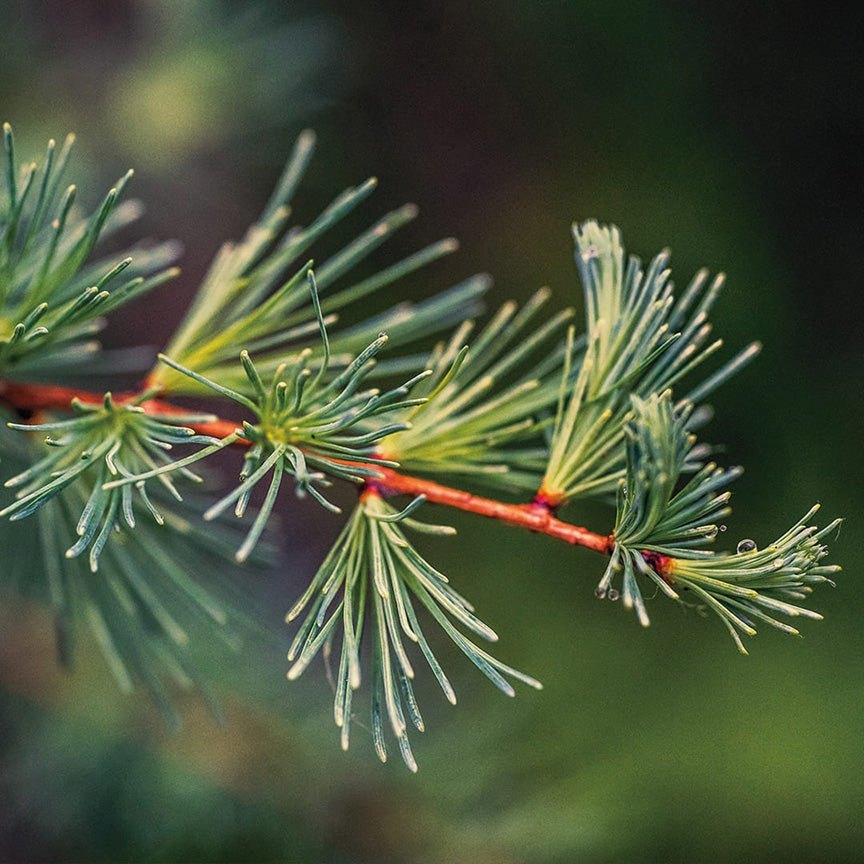
Tamarack (Larix laricina) is one of the rare conifers that drops its needles in autumn, growing in cold North American bogs. According to suppliers, its oil contains the pinenes, δ-3-carene and bornyl acetate, giving freshness and a light sweetness.
Because the needles are shed each year, its spring growth is much softer and greener than evergreen needles. It is an uncommon oil; its foliar monoterpenes vary with the season and the type of shoot.
- Plant part
- Leaves
- Vietnamese name
- Thông rụng lá
- Scent family
- Woody & Resinous
- Plant family
- Pinaceae
- Lots published
- —
 Leaves
Composition profile
The published composition from the article, read as structure: 7 compounds adding up to about 100 % of the sample. Figures are printed as the source gives them — one sample, not a species average.
| Compound | Level | Class | Note |
|---|---|---|---|
| δ-3-Carene | 10–35 % | Monoterpenes | Top |
| α-Pinene EU | 15–30 % | Monoterpenes | Top |
| Bornyl acetate | 5–20 % | — | — |
| β-Pinene EU | 5–15 % | Monoterpenes | Top |
| Limonene EU | 3–10 % | Monoterpenes | Top |
| Myrcene | 2–10 % | Monoterpenes | Top |
| Camphene | 2–10 % | Monoterpenes | Top |
By chemical class
- Monoterpenes100.0 %
- Unclassified20.0 %
By note
- Top100.0 %
- Unclassified20.0 %
Group totals use the upper bound of each range and only the compounds the article lists; bars are relative to the identified total.
Compare with the 2 chemically closest oils Which other oils are rich in δ-3-Carene?
What tamarack is
Tamarack (American larch, Larix laricina) is a deciduous conifer: according to the US Forest Service species review, its needles turn yellow in autumn before they are shed. It grows most commonly on cold, wet, poorly drained sites such as swamps, bogs and muskegs, and is the first tree to pioneer the sphagnum moss mat floating over water. The commercial oil is steam-distilled from the needles and young twigs, mainly in Canada.
Composition: supplier figures
We have not read any peer-reviewed study of this species’ leaf oil that gives the share of each compound. The main study on the subject (von Rudloff, 1987) was not accessible to us. The table gives typical ranges published by two Canadian suppliers, not peer-reviewed data:
| Compound | Supplier A (Quebec) | Supplier B (eastern Canada) |
|---|---|---|
| α-Pinene | 15–30% | 20–35% |
| δ-3-Carene | 10–35% | 15–25% |
| β-Pinene | 5–15% | 9–15% |
| Bornyl acetate | 5–20% | 4–11% |
| Limonene | 3–10% | 2–10% |
| Myrcene | 2–10% | 2–10% |
| Camphene | 2–10% | 2–6% |
Supplier A is Aliksir; another data page from the same company gives β-pinene at 10–30%, so these ranges should be read only as a guide. Supplier B is a profile by Aromahead, which also gives terpinolene at 1.5–3%.
A peer-reviewed pointer: the inner bark
A 2023 study analysed the monoterpenes in the inner bark (phloem) of 56 trees at 14 sites in Minnesota and Wisconsin. This is not leaf oil, but it shows the same picture:
- α-pinene averaged 39.4%, δ-3-carene 30.0%, β-pinene 6.5%;
- between trees, α-pinene ranged from 12.8% to 75.5% and δ-3-carene from 1.5% to 67.4%.
So besides the pinenes, δ-3-carene is also a main compound of this species.
By season and by shoot
A 1999 study of seedlings found that most foliar monoterpenes declined over the growing season, while β-pinene increased; long shoots had higher concentrations than short shoots, and variation within a tree was larger than between trees. We have not read any source that measures seasonal change in commercial distilled oil directly.
Its smell
α-Pinene and β-pinene give a bright pine-resin note; δ-3-carene adds a sweet, slightly sharp resinous note; bornyl acetate gives a soft, sweet pine-needle note. The soft young needles give a greener, lighter smell than stiff-needled pines.
Safety
Pinene and limonene are on the EU list of fragrance allergens that must be named on cosmetic labels (Regulation (EU) 2023/1545), with peroxide values required to be below 10 mmol/L for pinene and below 20 mmol/L for limonene. Monoterpene-rich oils oxidise easily, so store the oil tightly closed in a cool, dark place, and always dilute before use on skin.
Sources
- Althoff, O’Loughlin, Wakarchuk, Aukema, Aukema (2023). Forests 14(3), 566. doi:10.3390/f14030566
- Powell, Raffa (1999). Journal of Chemical Ecology 25(8), 1771–1797. doi:10.1023/A:1020973514476
- von Rudloff E. (1987). The Volatile Twig and Leaf Oil Terpene Compositions of Three Western North American Larches. Journal of Natural Products 50(2), 317–321. doi:10.1021/np50050a051 (contents not read).
- Uchytil (1991). Larix laricina. Fire Effects Information System, USDA Forest Service.
- Aliksir. Tamarack (Larix laricina) essential oil, product page.
- Aromahead. Larch profile.
- Regulation (EU) 2023/1545 on the labelling of fragrance allergens.
Buy Larch / Tamarack
Larch / Tamarack oil: no lot has been brought in yet, so it is not on sale. Message us if you need it.
Where you may already have smelled it
According to the analyses cited above, this oil contains up to 30 % α-pinene. It is also the leading compound in the scenes below from the scent dictionary. Smelling one of those scenes again is a way to get to know it without opening a bottle. A shared compound does not mean the oil smells exactly like the scene.
Chemically close
The oils whose published composition is closest to this one, compared across every compound we could read. Close in composition does not mean the scent is identical or that one can replace the other.
Further reading
Close to Larch / Tamarack
Same plant family: Pinaceae Atlas cedarwood · Black spruce · Engelmann spruce · Himalayan cedarwood · Norway pine · White fir · White pine
Also from the leaves Bay laurel · Cajeput · Eucalyptus globulus · Kunzea · Niaouli ct 1,8-cineole · Norway pine · White pine · Wintergreen
Same method: direct steam distillation Black pepper · Cajeput · Eucalyptus radiata · Lemon verbena · Norway pine · Patchouli · White pine · Zedoary (white turmeric)
Quick answers
What does larch / Tamarack essential oil smell like?
Light, green resin, slightly sweet, with a grassy note. It is softer and less resinous than pine.
What is the botanical name of larch / Tamarack oil?
The plant is Larix laricina, in the Pinaceae family. In Vietnamese it is called thông rụng lá.
How is larch / Tamarack oil produced?
From the leaves of the plant, by direct steam distillation. See the method for what that does to the oil.
What are the main compounds of larch / Tamarack oil?
From the composition data on this page, the oil is led by δ-3-Carene, α-Pinene and β-Pinene. Proportions vary with origin, harvest and method; a lot analysis is the only answer for a given bottle.
Last updated