Essential oils · Earthy family
Indian patchouli essential oil
Pogostemon cablin
Hoắc hương Ấn · Lamiaceae
Damp earth, wood and deep sweetness, like patchouli but usually described as softer and less musty than Indonesian oil.
It is the same species, Pogostemon cablin, as patchouli, differing only in where it is grown and distilled. As the patchouli page explains, how long the leaves are dried, where they are distilled and how long the oil is aged all change the smell considerably.
It shows that a single species still gives many oils. When comparing two patchouli lots, compare like origin with like before deciding which is “standard”.
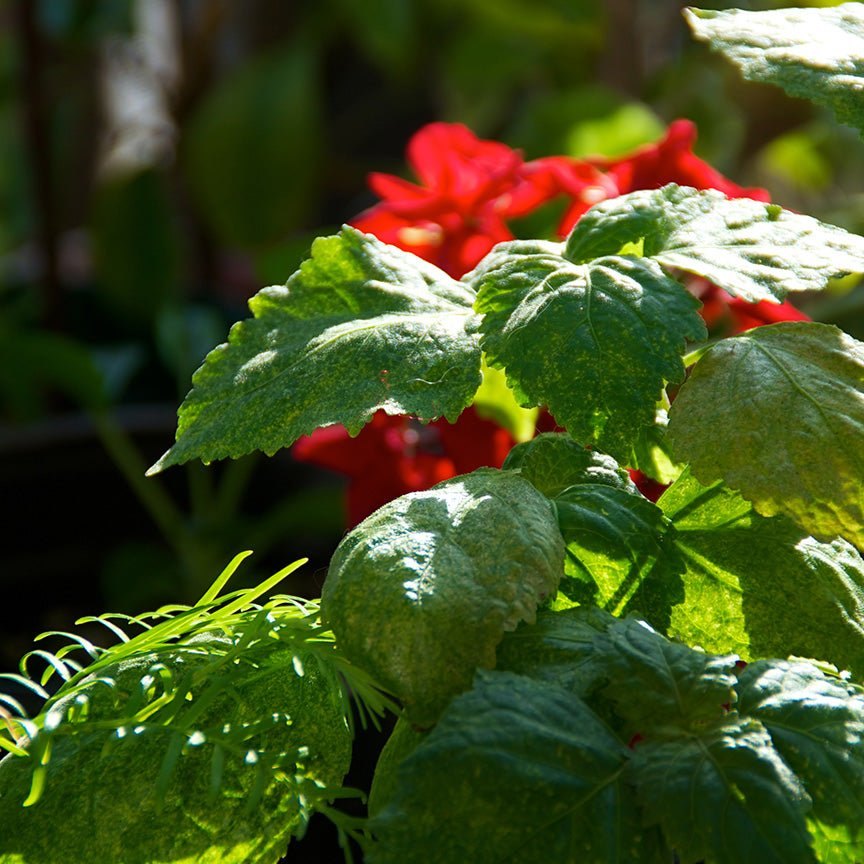
- Plant part
- Leaves
- Vietnamese name
- Hoắc hương Ấn
- Scent family
- Earthy
- Plant family
- Lamiaceae
- Lots published
- —
 Leaves
Composition profile
The published composition from the article, read as structure: 4 compounds adding up to about 47 % of the sample. Figures are printed as the source gives them — one sample, not a species average.
| Compound | Level | Class | Note |
|---|---|---|---|
| Patchoulol | 23.2 % | Alcohols | Base |
| α-Guaiene | 14.6 % | — | — |
| Seychellene | 5.6 % | — | — |
| α-Patchoulene | 3.3 % | — | — |
By chemical class
- Unclassified23.5 %
- Alcohols23.2 %
By note
- Base23.2 %
- Unclassified23.5 %
Group totals use the upper bound of each range and only the compounds the article lists; bars are relative to the identified total.
Put it beside another oil in the Compare tool Which other oils are rich in Patchoulol?
Indian patchouli and other sources
Indian patchouli is Pogostemon cablin oil from plants grown in India, the same species as patchouli from Indonesia, China or Vietnam. The most striking thing when comparing sources is the range of patchoulol, the compound behind the damp, earthy woodiness: figures from the same country can differ twofold.
Composition by source
| Compound | India, Lucknow | Indonesia, Aceh | Indonesia, Sulawesi | China, commercial oil |
|---|---|---|---|---|
| Patchoulol | 23.2% | 34.24% | 22.7% | 27.80% |
| α-Guaiene | 14.6% | 15.24% | 18.61% | 13.30% |
| Seychellene | 5.6% | 8.95% | 5.70% | 6.63% |
| α-Bulnesene | – | – | – | 17.45% |
| α-Patchoulene | 3.3% | – | – | 5.02% |
| δ-Guaiene | – | – | 18.90% | – |
The Lucknow sample was fresh leaf hydrodistilled for 8 hours (2009); the Aceh sample was community-distilled leaf oil (2023); the Sulawesi sample was leaf sun-dried for 4 days and steam-distilled (2020); the Chinese sample was a commercial oil stored for one year (2017). A dash means the study did not report it.
Reviews cite much higher figures: 57.7% patchoulol for one Indian oil, and 37.53–60.59% for three growing areas in China. So “Indian patchouli” is not automatically a quality grade; only the batch analysis tells you.
Pogostone: a marker of Chinese oil
Pogostone, a ketone found in patchouli, appears only in the Chinese data: one review cites 7.47% (Guangdong), 9.65% (Guangxi) and 2.11% (Hunan) from 36 samples. None of the Indonesian or Indian samples in the table above recorded it.
How the oil changes with age
In the trade, patchouli is often regarded as an oil that rounds out with age. A 2017 study compared a commercial oil stored for one year with one stored for ten:
| Compound | Stored 1 year | Stored 10 years |
|---|---|---|
| Patchoulol | 27.80% | 28.18% |
| α-Bulnesene | 17.45% | 14.37% |
| α-Guaiene | 13.30% | 11.80% |
| Seychellene | 6.63% | 8.62% |
| Patchoulene epoxide | absent | 5.34% |
Patchoulol stayed almost the same, while sesquiterpene hydrocarbons such as bulnesene and guaiene fell and a new oxidation product appeared. This shift may be part of why aged oil is described as less harsh and rounder, although the study did not assess smell.
Fermented leaves and yield
A study in Thailand (2009) showed that leaf treatment decides how much oil is obtained: fresh leaves gave 0.60% oil on a dry-weight basis, oven-dried leaves 0.30%, and leaves fermented for 77 days 2.48%. This is a difference in yield, not in composition percentages.
In Vietnam, a study of patchouli harvested in Cai Lay, Tien Giang, also compared fresh, wilted and fermented leaves, and found that fermented leaves gave the most oil. According to its abstract, the Cai Lay oil had a higher patchouli alcohol content than the Nghia Do (Hanoi), Brazilian and Indian oils used for comparison; the abstract gives no figures.
Safety
Patchouli has no IFRA standard of its own in the sources we read. As with any essential oil, always dilute before use on skin.
Sources
- Sundaresan V., Singh S.P., Mishra A.N. et al. (2009). Composition and Comparison of Essential Oils of Pogostemon cablin (Blanco) Benth. (Patchouli) and Pogostemon travancoricus Bedd. var. travancoricus. Journal of Essential Oil Research 21, 220–222.
- Ginting B., Sufriadi E., Harnelly E. et al. (2023). Identification of volatile compounds contained in the therapeutic essential oils from Pogostemon cablin, Melaleuca leucadendra, and Mentha piperita and their purified fractions. Journal of Advanced Pharmaceutical Technology & Research 14(3), 208–212. doi:10.4103/JAPTR.JAPTR_161_23
- Souhoka F.A., Al Aziz A.Z., Nazudin N. (2020). Patchouli Oil Isolation and Identification of Chemical Components Using GC-MS. Indonesian Journal of Chemical Research 8(2).
- Liang J.L., Wu J.Z., Liu Y.H. et al. (2017). Patchoulene Epoxide Isolated from Patchouli Oil Suppresses Acute Inflammation through Inhibition of NF-κB and Downregulation of COX-2/iNOS. Mediators of Inflammation 2017, 1089028. doi:10.1155/2017/1089028
- Kongkathip N., Sam-ang P., Kongkathip B. et al. (2009). Development of Patchouli Extraction with Quality Control and Isolation of Active Compounds with Antibacterial Activity. Kasetsart Journal (Natural Science) 43(3), 519–525.
- Mrisho I.I., Musazade E., Chen H. et al. (2025). Unlocking the Therapeutic Potential of Patchouli Leaves: A Comprehensive Review of Phytochemical and Pharmacological Insights. Plants 14, 1034. doi:10.3390/plants14071034
- Khairan, Muhammad S., Diah M. (2020). Patchouli (Pogostemon cablin Benth): Chemistry, Biology, and Anti-inflammatory Activities: A Review. Proceedings of ICEO 2019, 67–73. doi:10.5220/0009956600670073
- Khảo sát tinh dầu từ cây hoắc hương (Pogostemon cablin (Blanco) Benth.) thu hái tại thị trấn Cai Lậy, tỉnh Tiền Giang [A study of essential oil from patchouli harvested in Cai Lay, Tien Giang] (2012). Tap chi Duoc hoc 52(10), 38–45.
Buy Indian patchouli
Indian patchouli oil: no lot has been brought in yet, so it is not on sale. Message us if you need it.
Further reading
Close to Indian patchouli
Same plant family: Lamiaceae Basil ct linalool · Basil ct methyl chavicol · Clove basil · Holy basil (tulsi) · Perilla · Rosemary ct verbenone · Spearmint · Sweet marjoram
Also from the leaves Balsam fir · Kanuka · Kunzea · Lemon myrtle · Ravintsara ct 1,8-cineole · Red myrtle · Scots pine · White spruce
Same method: direct steam distillation Basil ct linalool · Basil ct methyl chavicol · Bay laurel · Clove basil · Eucalyptus globulus · Lavender · Vetiver · White pine
Quick answers
What does Indian patchouli essential oil smell like?
Damp earth, wood and deep sweetness, like patchouli but usually described as softer and less musty than Indonesian oil.
What is the botanical name of Indian patchouli oil?
The plant is Pogostemon cablin, in the Lamiaceae family. In Vietnamese it is called hoắc hương ấn.
How is Indian patchouli oil produced?
From the leaves of the plant, by direct steam distillation. See the method for what that does to the oil.
What are the main compounds of Indian patchouli oil?
From the composition data on this page, the oil is led by Patchoulol. Proportions vary with origin, harvest and method; a lot analysis is the only answer for a given bottle.
Last updated