Holy basil (tulsi) essential oil
Ocimum tenuiflorum
Hương nhu tía · Lamiaceae
Clove on a base of leaf. Warm, spicy, slightly sweet, with a green herbal part that clove buds do not have.
The standout compound is usually eugenol, exactly the main compound of clove and cinnamon leaf, so three unrelated plants give oils that the nose places side by side. But the proportions vary widely: one sample grown in Hanoi had nearly four times as much methyl eugenol as eugenol, making it softer and rounder. Methyl eugenol is very tightly restricted, so with holy basil the batch analysis matters more than the description of the smell.
Many Vietnamese people know this smell from the pot of hair-washing water boiled with soap-pod and pomelo peel, before they know what it is called. The same plant is the one Indians call tulsi, so a single bush lives two very different cultural lives.
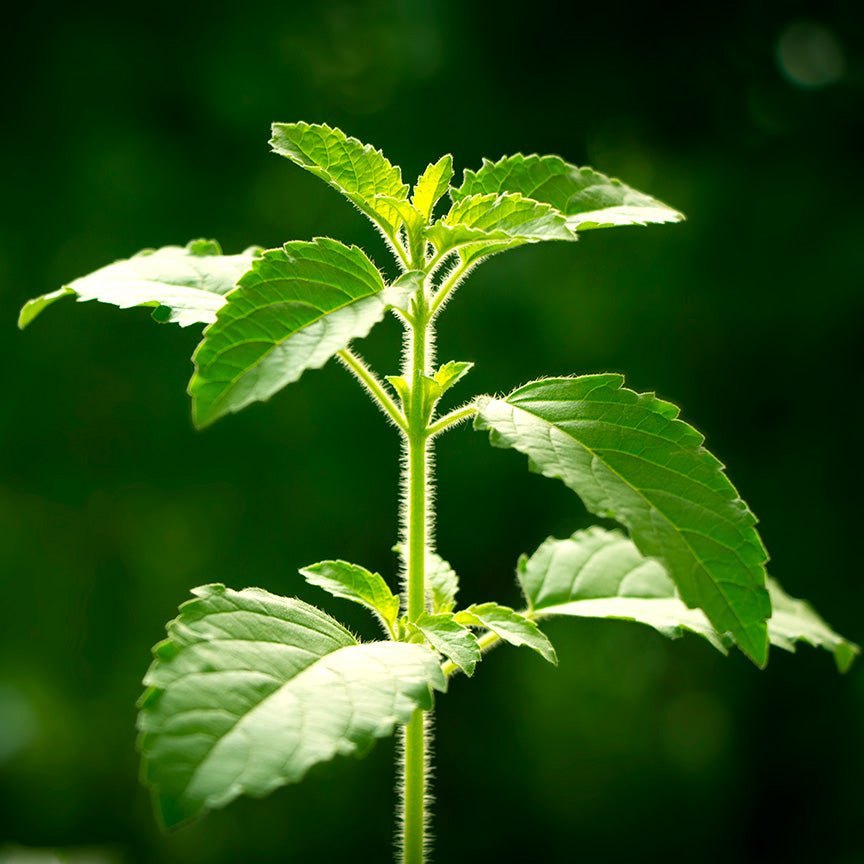
- Plant part
- Whole plant
- Vietnamese name
- Hương nhu tía
- Scent family
- Spicy
- Plant family
- Lamiaceae
- Lots published
- —
 Whole plant
Composition profile
The published composition from the article, read as structure: 4 compounds adding up to about 78 % of the sample. Figures are printed as the source gives them — one sample, not a species average.
| Compound | Level | Class | Note |
|---|---|---|---|
| Methyl eugenol | 46.07 % | — | — |
| β-Caryophyllene EU | 15.65 % | Sesquiterpenes | Base |
| Eugenol EU | 11.83 % | Phenols | Base |
| β-Elemene | 4.33 % | Sesquiterpenes | Base |
By chemical class
- Unclassified46.1 %
- Sesquiterpenes20.0 %
- Phenols11.8 %
By note
- Base31.8 %
- Unclassified46.1 %
Group totals use the upper bound of each range and only the compounds the article lists; bars are relative to the identified total.
Purple holy basil and tulsi
Holy basil (Ocimum tenuiflorum, formerly O. sanctum), hương nhu tía in Vietnamese, is the plant Indians call tulsi. It has two main forms: a green-leaved form and a purple-leaved form. In Vietnam it is distinct from clove basil (O. gratissimum), another species in the same genus.
Holy basil oil is rich in phenylpropanoids such as eugenol and methyl eugenol, but the balance between them varies greatly with the form of the plant and where it grows. This is the most important point on this page, because eugenol and methyl eugenol have very different safety profiles.
Composition: Vietnam and India
| Compound | Hanoi (2024) | India, green form | India, purple form |
|---|---|---|---|
| Eugenol | 11.83% | 75.5% | 33.8% |
| Methyl eugenol | 46.07% | – | 17.7% |
| β-Caryophyllene | 15.65% | 9.6% | 21.3% |
| β-Elemene | 4.33% | 9.9% | 15.7% |
The Hanoi sample was fresh leaf from the garden of the National Institute of Medicinal Materials, hydrodistilled for 4 hours, with a yield of 1.05%; the study does not say whether the plants were the green or purple form. The two Indian columns are aerial parts grown in western India (2015). A dash means methyl eugenol was not among the main compounds reported.
Another study in western India (2016) also found methyl eugenol in the purple form but not in the green form, although both were rich in eugenol.
Its smell
Eugenol-rich oil smells close to clove and cinnamon leaf: warm, spicy, a little medicinal. Methyl eugenol is softer and less harsh, with a sweet, slightly floral note. Caryophyllene and β-elemene give the spicy woody base. So a holy basil oil rich in methyl eugenol, like the Hanoi sample, is gentler and rounder than a eugenol-rich one like the Indian green form.
Methyl eugenol: very low limits
- The EU Scientific Committee on Food (SCF) concluded in 2001 that methyl eugenol has been shown to be genotoxic and carcinogenic, and that no safe exposure limit could be established.
- The EU cosmetics scientific committee (SCCNFP) recommended in 2000 that methyl eugenol should not be intentionally added to cosmetics, and limited the amount arriving naturally from essential oils, for example 0.01% in fine fragrance and 0.0002% in leave-on products.
- The IFRA Standard for methyl eugenol (51st Amendment) sets very low maximum levels, for example 0.011% in fine fragrance (category 4) and 0.00042% in category 5C (hand cream).
For an oil with 46% methyl eugenol, like the Hanoi sample, 0.011% in a perfume corresponds to less than 0.03% oil. This is an oil for which a batch analysis is essential, not optional. Do not take it by mouth, and do not use it for children or during pregnancy (see children and pregnancy).
Sources
- Chemical constituents, antioxidant and antifungal activities of the essential oil from Vietnamese Ocimum tenuiflorum L. leaves (2024). Vietnam Journal of Science, Technology and Engineering 66(2), 69–75. doi:10.31276/VJSTE.66(2).69-75
- Rana V.S., Blazquez M.A. (2015). Essential Oil Composition of the Aerial Parts of Five Ocimum species from Western India. Journal of Essential Oil Bearing Plants 18(5), 1234–1241. doi:10.1080/0972060X.2014.931255
- Smitha G.R., Tripathy V. (2016). Seasonal variation in the essential oils extracted from leaves and inflorescence of different Ocimum species grown in Western plains of India. Industrial Crops and Products 94, 52–64.
- SCF (2001). Opinion on Methyleugenol (4-Allyl-1,2-dimethoxybenzene). SCF/CS/FLAV/FLAVOUR/4 ADD1 FINAL.
- SCCNFP (2000). Opinion concerning Methyleugenol.
- IFRA Standard: Methyl eugenol. Amendment 51.
Buy Holy basil (tulsi)
Holy basil (tulsi) oil: no lot has been brought in yet, so it is not on sale. Message us if you need it.
Where you may already have smelled it
According to the analyses cited above, this oil contains up to 15.7 % β-caryophyllene and up to 11.8 % eugenol. Both are also the leading compound in the scenes below from the scent dictionary. Smelling one of those scenes again is a way to get to know them without opening a bottle. A shared compound does not mean the oil smells exactly like the scene.
Further reading
Close to Holy basil (tulsi)
Same plant family: Lamiaceae Bergamot mint · Hyssop ct 1,8-cineole · Oregano · Perilla · Rosemary ct camphor · Rosemary ct verbenone · Thyme ct thymol · Vietnamese balm
Also from the whole plant Mugwort · Oregano · Peppermint · Rosemary ct camphor · Rosemary ct verbenone · Sweet marjoram · Thyme ct thymol · Vietnamese balm
Same method: direct steam distillation Catnip · Frankincense · Indian bay leaf · Pink pepper · Rosemary ct camphor · Rosemary ct verbenone · Star anise · Tea tree
Quick answers
What does holy basil (tulsi) essential oil smell like?
Clove on a base of leaf. Warm, spicy, slightly sweet, with a green herbal part that clove buds do not have.
What is the botanical name of holy basil (tulsi) oil?
The plant is Ocimum tenuiflorum, in the Lamiaceae family. In Vietnamese it is called hương nhu tía.
How is holy basil (tulsi) oil produced?
From the whole plant of the plant, by direct steam distillation. See the method for what that does to the oil.
What are the main compounds of holy basil (tulsi) oil?
From the composition data on this page, the oil is led by β-Caryophyllene, Eugenol and β-Elemene. Proportions vary with origin, harvest and method; a lot analysis is the only answer for a given bottle.
Last updated