Clove basil essential oil
Ocimum gratissimum
Hương nhu trắng · Lamiaceae
Clove, hot, medicinal, stronger and coarser than holy basil. The green leaf is there, but the spice drowns it.
Clove basil in Vietnam is usually very rich in eugenol, and Vietnam is the only place in South-East Asia where the plant is grown commercially, so that eugenol from the oil can stand in for clove oil. Elsewhere in the world the species also has a thymol-rich form that smells completely different, so the chemotype is worth checking.
Set it beside holy basil, cinnamon leaf and clove, and you have four unrelated plants converging on one compound. Of the four, clove basil is the straightest and has the fewest layers.
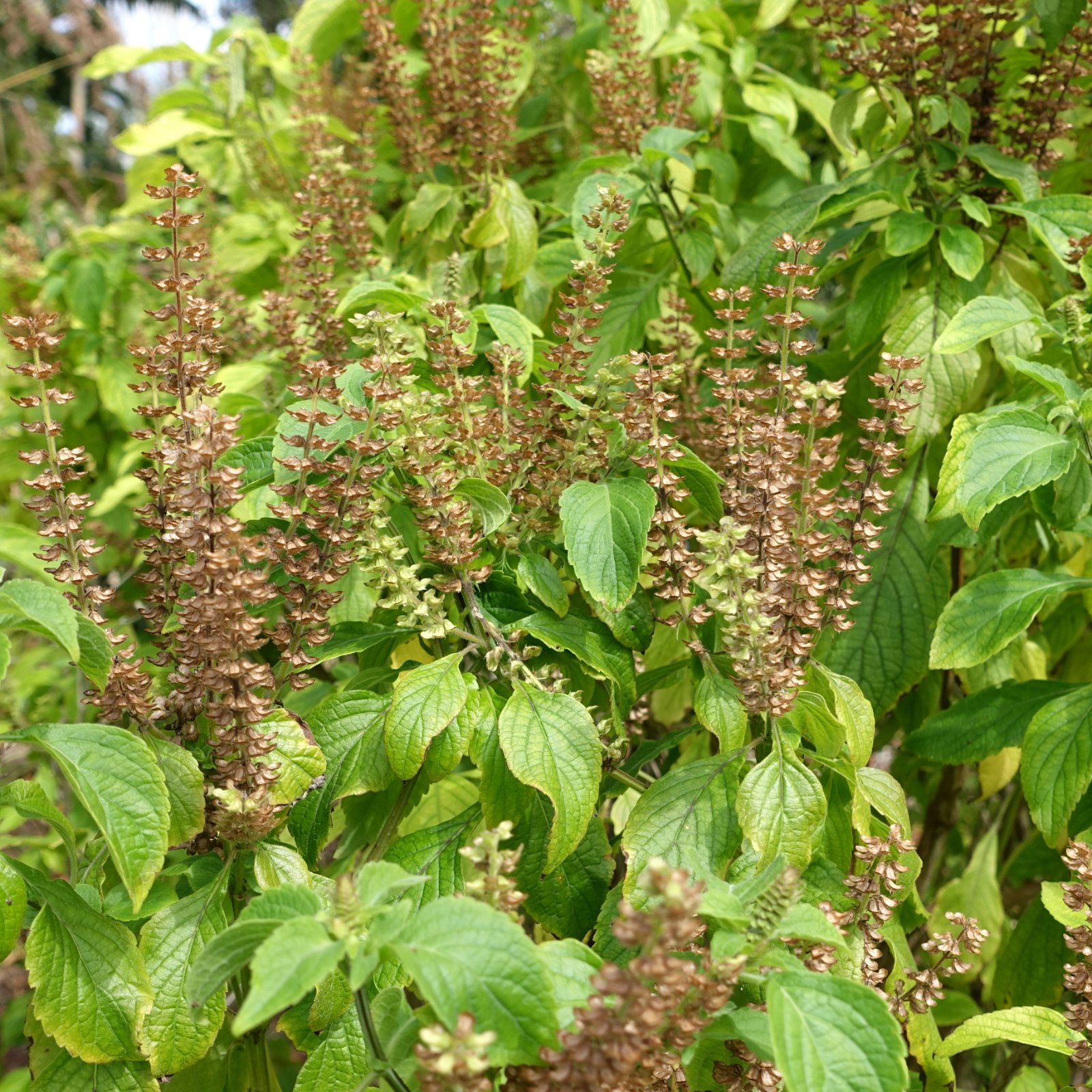
- Plant part
- Whole plant
- Vietnamese name
- Hương nhu trắng
- Scent family
- Spicy
- Plant family
- Lamiaceae
- Lots published
- —
 Whole plant
Composition profile
The published composition from the article, read as structure: 4 compounds adding up to about 90 % of the sample. Figures are printed as the source gives them — one sample, not a species average.
| Compound | Level | Class | Note |
|---|---|---|---|
| Eugenol EU | 80.38 % | Phenols | Base |
| Germacrene D | 5.79 % | Sesquiterpenes | Base |
| β-Caryophyllene EU | 3.31 % | Sesquiterpenes | Base |
| (Z)-β-Ocimene | 0.94 % | — | — |
By chemical class
- Phenols80.4 %
- Sesquiterpenes9.1 %
- Unclassified0.9 %
By note
- Base89.5 %
- Unclassified0.9 %
Group totals use the upper bound of each range and only the compounds the article lists; bars are relative to the identified total.
Compare with the 2 chemically closest oils Which other oils are rich in Eugenol?
A plant grown for eugenol
According to PROSEA, clove basil (Ocimum gratissimum) is grown in South-East Asia mainly in home gardens. Only in Vietnam is it also grown on a commercial scale.
The reason is eugenol. PROSEA records that eugenol, and to a lesser extent thymol, isolated from the oil is used as a substitute for clove oil and thyme oil. The fresh above-ground parts of the plant contain about 0.8–1.2% essential oil. World production of the oil, as estimated in PROSEA, is about 50 tonnes a year, and the oil is rarely traded internationally.
Composition of Vietnamese oil
Two sources of figures for eugenol-type oil from Vietnam:
| Compound | Vietnamese sample (PROSEA) | Hanoi (2022) |
|---|---|---|
| Eugenol | 71% | 80.38% |
| Germacrene D | small | 5.79% |
| β-Caryophyllene | – | 3.31% |
| (Z)-β-Ocimene | small | 0.94% |
The 2022 Hanoi sample (TNU Journal of Science and Technology) was grown in Hanoi, dried and then steam-distilled for 3 hours in a Clevenger apparatus; the yield was 0.96% on a dry-weight basis, and the study identified 23 compounds. PROSEA also records a sample from southern China with up to 95% eugenol, and samples from Madagascar with 40–90%. A dash means it was not reported.
Six chemotypes
Also according to PROSEA, the composition of Ocimum gratissimum oil varies widely, and at least six chemotypes have been recorded, named after their main compound:
| Chemotype | Main compound |
|---|---|
| Eugenol | Eugenol |
| Thymol | Thymol |
| Citral | Citral |
| Ethyl cinnamate | Ethyl cinnamate |
| Geraniol | Geraniol |
| Linalool | Linalool |
The eugenol type is the most important economically. PROSEA records that most thymol today is synthetic, while natural thymol comes mainly from thyme (Thymus vulgaris) and ajwain seed (Trachyspermum ammi). PROSEA also notes that an overview of which type grows where is lacking, though it gives scattered records: the thymol type in Central and West Africa, the citral type in Iran, Pakistan and India, the geraniol type in the USA.
For the buyer, this means the species name is not enough. A bottle of “Ocimum gratissimum” from Africa may be the thymol type, quite unlike the eugenol-type oil of Vietnam.
Four plants, one compound
Eugenol is the meeting point of several unrelated plants: clove, cinnamon leaf, holy basil and clove basil are all rich in it. The annex to the IFRA Standard for eugenol gives typical levels: clove bud oil 82%, clove leaf oil 85.3%, cinnamon leaf oil 74%. The differences between these oils lie in the minor compounds, so to know which plant an oil came from, look at the rest of the analysis, not only the eugenol figure.
Safe use
Eugenol is on the EU list of fragrance allergens that must be named on cosmetic labels (above 0.001% in leave-on and 0.01% in rinse-off products). IFRA restricts eugenol because of dermal sensitisation and systemic toxicity, for example to at most 2.5% in fine fragrance (category 4) and 0.64% in body lotion (category 5A). For an oil with about 80% eugenol, 0.64% eugenol corresponds to about 0.8% oil. Always dilute before applying.
Sources
- Sulistiarini D. Ocimum gratissimum L. In PROSEA (Plant Resources of South-East Asia), Pl@ntUse edition. plantuse.plantnet.org
- Chemical composition and antioxidant activity of the essential oil of Ocimum gratissimum L. grown in Hanoi, Vietnam (2022, in Vietnamese). TNU Journal of Science and Technology 227(14), 130–136. doi:10.34238/tnu-jst.6294
- IFRA Standard: Eugenol, Amendment 49 (2020).
- Regulation (EC) 1223/2009, Annex III, and Regulation (EU) 2023/1545 on the labelling of fragrance allergens.
Buy Clove basil
Clove basil oil: no lot has been brought in yet, so it is not on sale. Message us if you need it.
Where you may already have smelled it
According to the analyses cited above, this oil contains up to 80.4 % eugenol. It is also the leading compound in the scenes below from the scent dictionary. Smelling one of those scenes again is a way to get to know it without opening a bottle. A shared compound does not mean the oil smells exactly like the scene.
Chemically close
The oils whose published composition is closest to this one, compared across every compound we could read. Close in composition does not mean the scent is identical or that one can replace the other.
- Clove bud Syzygium aromaticum shared: Eugenol, β-Caryophyllene · closeness 1.00 · compare
- Cinnamon leaf Cinnamomum verum shared: Eugenol, β-Caryophyllene · closeness 1.00 · compare
Further reading
- One hundred per cent pure is a claim, not a certificate
- Checking essential oils with GC/MS: how to read the report a seller gives you
- Region, altitude, season — three things that change an analysis
- Part VI. Vietnamese essential oils: composition and chemotypes · research
- Appendix A3. Facts on Vietnamese essential oils · research
Close to Clove basil
Same plant family: Lamiaceae Bee balm · Holy basil (tulsi) · Rosemary ct camphor · Rosemary ct verbenone · Spike lavender · Sweet marjoram · Thyme ct linalool · Vietnamese balm
Also from the whole plant Bergamot mint · Holy basil (tulsi) · Hyssop ct 1,8-cineole · Oregano · Rosemary ct camphor · Rosemary ct verbenone · Thyme ct linalool · Vietnamese balm
Same method: direct steam distillation Carrot seed · Ceylon cinnamon · Holy basil (tulsi) · Niaouli ct 1,8-cineole · Pink pepper · Rosemary ct camphor · Rosemary ct verbenone · Ylang ylang
Quick answers
What does clove basil essential oil smell like?
Clove, hot, medicinal, stronger and coarser than holy basil. The green leaf is there, but the spice drowns it.
What is the botanical name of clove basil oil?
The plant is Ocimum gratissimum, in the Lamiaceae family. In Vietnamese it is called hương nhu trắng.
How is clove basil oil produced?
From the whole plant of the plant, by direct steam distillation. See the method for what that does to the oil.
What are the main compounds of clove basil oil?
From the composition data on this page, the oil is led by Eugenol, Germacrene D and β-Caryophyllene. Proportions vary with origin, harvest and method; a lot analysis is the only answer for a given bottle.
Is there anything to watch out for with clove basil oil?
Rich in eugenol, a fragrance allergen that must be labelled in the EU; IFRA restricts eugenol because of skin sensitisation. Dilute very well before applying.
Last updated