Galangal essential oil
Alpinia officinarum
Riềng · Zingiberaceae
Spicy, sharp, camphoraceous, drier and cooler than ginger. The opening is close to eucalyptus, then the warm spice of the root comes through.
That coolness is 1,8-cineole, the main compound of galangal oil. Ginger is warm and round, galangal pointed and airy, so the two cannot replace each other even though they are in the same family.
The species on this page is Alpinia officinarum, lesser galangal, with small reddish-brown roots. The large, ivory, pink-tipped galangal sold at Vietnamese markets for braising fish is usually greater galangal, another species of the same genus. The two roots share one everyday name, and their smells are close but not identical.
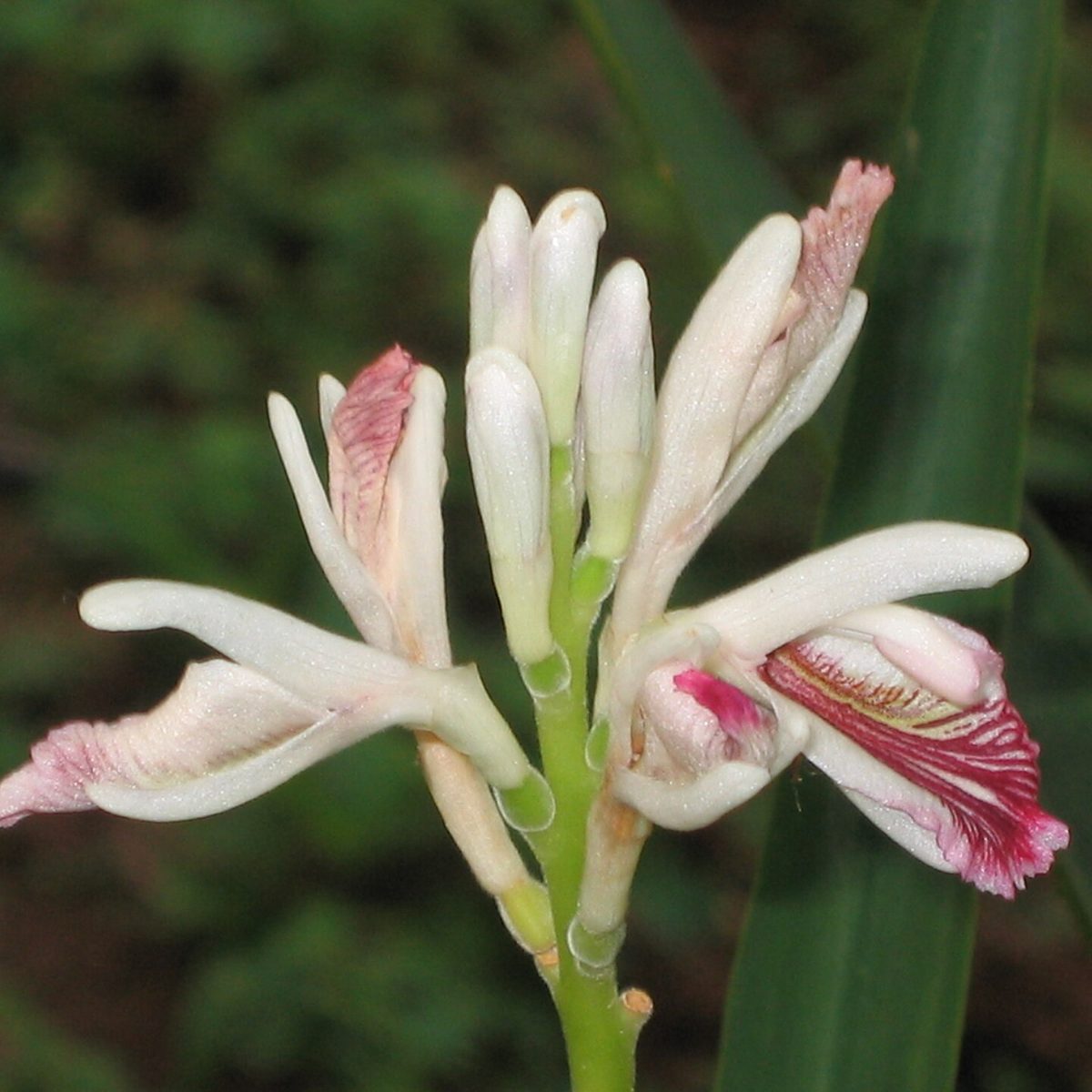
- Plant part
- Rhizome
- Vietnamese name
- Riềng
- Scent family
- Spicy
- Plant family
- Zingiberaceae
- Lots published
- —
 Rhizome
Composition profile
The published composition from the article, read as structure: 6 compounds adding up to about 63 % of the sample. Figures are printed as the source gives them — one sample, not a species average.
| Compound | Level | Class | Note |
|---|---|---|---|
| 1,8-Cineole | 50.0 % | Oxides | Top |
| β-Caryophyllene EU | 6.4 % | Sesquiterpenes | Base |
| β-Bisabolene | 2.6 % | Sesquiterpenes | Base |
| Chavicol | 2.0 % | — | — |
| Chavicol acetate | 1.2 % | — | — |
| Methyl eugenol | 1.0 % | — | — |
By chemical class
- Oxides50.0 %
- Sesquiterpenes9.0 %
- Unclassified4.2 %
By note
- Top50.0 %
- Base9.0 %
- Unclassified4.2 %
Group totals use the upper bound of each range and only the compounds the article lists; bars are relative to the identified total.
Compare with the 2 chemically closest oils Which other oils are rich in 1,8-Cineole?
Lesser galangal and market galangal
This page is about Alpinia officinarum, lesser galangal: a small rhizome with reddish-brown skin and firm flesh. The large, ivory rhizome sold in Vietnamese markets for braised fish and fermented shrimp paste is usually Alpinia galanga, greater galangal. Both belong to the same genus in the ginger family and share one everyday name, riềng. See the galangal entry in the scent dictionary.
Fresh and dried rhizome
A 2001 study on A. officinarum grown in Vietnam compared the essential oil of fresh and dried rhizomes:
| Compound | Fresh | Dried |
|---|---|---|
| 1,8-Cineole | 50.0% | 8.2% |
| exo-2-Hydroxy-1,8-cineole acetate | 11.2% | – |
| β-Caryophyllene | 6.4% | 2.9% |
| β-Bisabolene | 2.6% | 9.6% |
| Chavicol | 2.0% | 5.3% |
| Chavicol acetate | 1.2% | 5.9% |
| Methyl eugenol | 1.0% | 3.3% |
The difference is large. Fresh rhizome is a cineole oil: half the bottle is the cool, eucalyptus-like compound behind galangal’s cold, sharp opening. On drying, most of the cineole is lost; what remains is richer in sesquiterpenes and chavicol compounds, spicy, warm, a little like anise and clove. The authors note that drying lowers the monoterpene fraction and raises the sesquiterpene and aromatic fractions.
So oil from dried galangal and oil from fresh galangal are two different smells, even from the same species.
Origin changes the composition too
A 2021 review in RSC Advances gathered data from many regions: 1,8-cineole in A. officinarum oil was 72.7% in one Hainan sample but only 8.68–13.77% at ten other Chinese sites. With galangal, the species name is not enough to know how the bottle smells; only the analysis can tell.
Compared with ginger
Ginger and galangal share a family but their oils are very different. Ginger is warm and round, rich in zingiberene; fresh galangal is cold and pointed because of cineole. Setting two smelling strips side by side is the quickest way to hear the difference between “warm spice” and “cool spice”.
Safety
Galangal oil contains a little methyl eugenol, a substance restricted by IFRA, and more of it in dried rhizome. The analysis of a lot should give a specific methyl eugenol figure. Cineole-rich oils should not be used near the faces of young children; always dilute before use on skin.
Sources
- Volatile Components of the Essential Oils in Galanga (Alpinia officinarum Hance) from Vietnam (2001). Food Science and Technology Research 7(4), 303–306. doi:10.3136/fstr.7.303
- An overview of the chemical composition and biological activities of essential oils from Alpinia genus (Zingiberaceae) (2021). RSC Advances 11(60), 37767–37783. doi:10.1039/d1ra07370b
Buy Galangal
Galangal oil: no lot has been brought in yet, so it is not on sale. Message us if you need it.
In the scent dictionary: Galangal — a description of the smell, the compounds behind it, and how to smell it for yourself.
Where you may already have smelled it
According to the analyses cited above, this oil contains up to 50 % 1,8-cineole. It is also the leading compound in the scenes below from the scent dictionary. Smelling one of those scenes again is a way to get to know it without opening a bottle. A shared compound does not mean the oil smells exactly like the scene.
Chemically close
The oils whose published composition is closest to this one, compared across every compound we could read. Close in composition does not mean the scent is identical or that one can replace the other.
- Honey myrtle Melaleuca teretifolia shared: 1,8-Cineole · closeness 0.99 · compare
- Eucalyptus radiata Eucalyptus radiata shared: 1,8-Cineole · closeness 0.97 · compare
- Eucalyptus globulus Eucalyptus globulus shared: 1,8-Cineole · closeness 0.97 · compare
Further reading
Close to Galangal
Same plant family: Zingiberaceae Amomum · Cardamom · Ginger · Wild ginger · Zedoary (white turmeric)
Also from the rhizome Ginger · Spikenard · Turmeric · Wild ginger · Zedoary (white turmeric)
Same method: direct steam distillation Amomum · Angelica root · Camphor ct camphor · Ginger · Lemon eucalyptus · Lemongrass · Rosalina · Saro
Quick answers
What does galangal essential oil smell like?
Spicy, sharp, camphoraceous, drier and cooler than ginger. The opening is close to eucalyptus, then the warm spice of the root comes through.
What is the botanical name of galangal oil?
The plant is Alpinia officinarum, in the Zingiberaceae family. In Vietnamese it is called riềng.
How is galangal oil produced?
From the rhizome of the plant, by direct steam distillation. See the method for what that does to the oil.
What are the main compounds of galangal oil?
From the composition data on this page, the oil is led by 1,8-Cineole, β-Caryophyllene and β-Bisabolene. Proportions vary with origin, harvest and method; a lot analysis is the only answer for a given bottle.
Last updated