Cardamom essential oil
Elettaria cardamomum
Bạch đậu khấu · Zingiberaceae
Cool at the top, warm and sweet in the body. The opening is close to camphor, then it moves into a sweet spice layer a little like dried lemon peel.
Two compounds share the work: 1,8-cineole gives the coolness, terpinyl acetate the warm sweetness. By the EFSA specification, the two together usually make up more than half the oil.
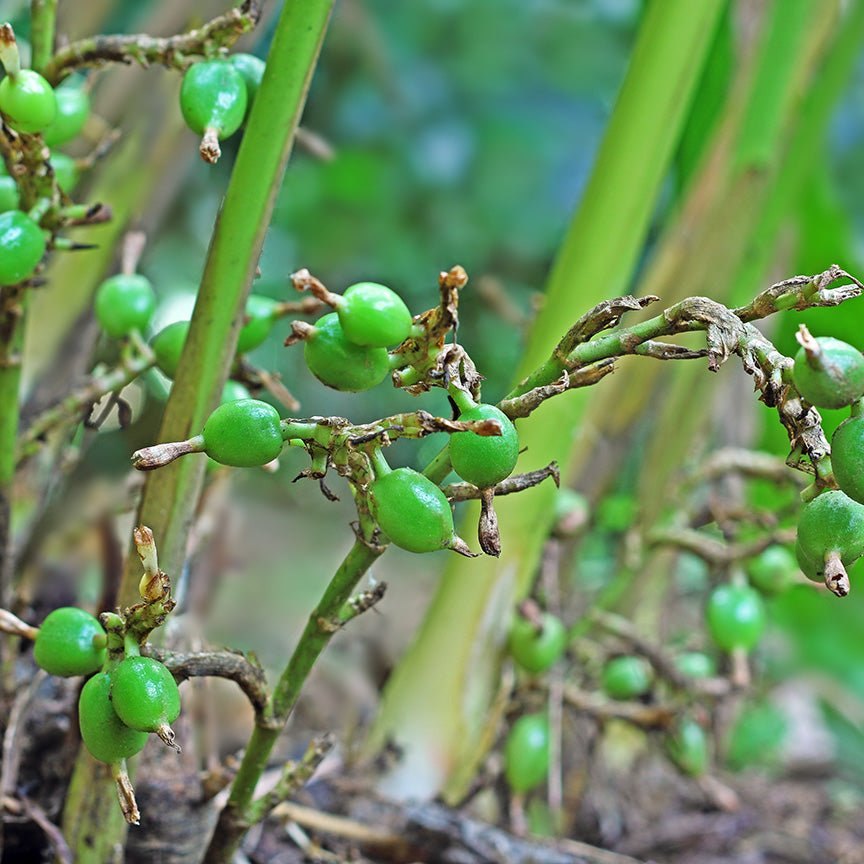
Do not confuse it with the thảo quả in a pot of phở. That is a different species, with much larger pods. Green cardamom (Elettaria cardamomum) has small pods with green skins. The two are often mixed up because in English both can carry the word cardamom.
- Plant part
- Seeds
- Vietnamese name
- Bạch đậu khấu
- Scent family
- Spicy
- Plant family
- Zingiberaceae
- Lots published
- —
 Seeds
Composition profile
The published composition from the article, read as structure: 9 compounds adding up to about 100 % of the sample. Figures are printed as the source gives them — one sample, not a species average.
| Compound | Level | Class | Note |
|---|---|---|---|
| α-Terpinyl acetate | 30–42 % | — | — |
| 1,8-Cineole | 16–35 % | Oxides | Top |
| Linalyl acetate EU | 5–9 % | Esters | Middle |
| Limonene EU | 1–6 % | Monoterpenes | Top |
| Sabinene | 2–6 % | Monoterpenes | Top |
| Linalool EU | 2–6 % | Alcohols | Middle |
| Myrcene | 1–4 % | Monoterpenes | Top |
| α-Pinene EU | 1–3 % | Monoterpenes | Top |
| α-Terpineol EU | 1–3 % | Alcohols | Middle |
By chemical class
- Unclassified42.0 %
- Oxides35.0 %
- Monoterpenes19.0 %
- Esters9.0 %
- Alcohols9.0 %
By note
- Top54.0 %
- Middle18.0 %
- Unclassified42.0 %
Group totals use the upper bound of each range and only the compounds the article lists; bars are relative to the identified total.
Two compounds share the smell
Cardamom oil (Elettaria cardamomum) is built around two compounds: α-terpinyl acetate for the warm sweetness, and 1,8-cineole for the coolness. The balance between them decides which way a bottle leans.
Commercial oil: the EFSA specification
The European Food Safety Authority’s (EFSA) 2019 scientific opinion on cardamom oil as a feed additive sets a specification, which EFSA describes as ISO-based, and analysed 5 commercial batches:
| Compound | Specification | 5 batches (mean) |
|---|---|---|
| α-Terpinyl acetate | 30–42% | 35.05% |
| 1,8-Cineole | 16–35% | 23.31% |
| Linalyl acetate | 5–9% | 6.95% |
| Limonene | 1–6% | 4.39% |
| Sabinene | 2–6% | 4.21% |
| Linalool | 2–6% | 4.17% |
| α-Pinene | 1–3% | 2.50% |
| Myrcene | 1–4% | 2.28% |
| α-Terpineol | 1–3% | 2.18% |
The specification also includes trans-nerolidol 0.5–2% and terpinen-4-ol 0.5–2.5%. The eleven specified compounds make up about 88% of the oil.
India and Guatemala
A 2021 study in Molecules bought green cardamom pods of Indian and Guatemalan origin in Saudi Arabia, ground the whole pods and hydrodistilled them for 3 hours in a Clevenger apparatus; yields were 4.8% and 3.9%. One lot per origin:
| Compound | India | Guatemala |
|---|---|---|
| α-Terpinyl acetate | 24.65% | 18.71% |
| 1,8-Cineole | 14.03% | 10.59% |
| Linalool | 2.63% | 5.51% |
| Limonene | 1.77% | 1.36% |
| Sabinene | 1.03% | 0.66% |
| Total monoterpenes | 83.24% | 73.03% |
| Total sesquiterpenes | 9.27% | 18.35% |
The Indian sample is richer in both main compounds and in monoterpenes; the Guatemalan sample has twice the sesquiterpenes. However, both samples have α-terpinyl acetate and 1,8-cineole below the specification ranges above. These were laboratory distillations of pods bought at market, not commercial oil, and only one lot per origin. In both studies, α-terpinyl acetate and 1,8-cineole are still the top two compounds.
Cardamom and black cardamom
In Vietnam, cardamom is often confused with thảo quả in the pho pot. Thao qua is a different plant, of the genus Amomum or Lanxangia. The English name “black cardamom” can refer to thao qua or to another Amomum species, so the names often get swapped in translation.
Amomum (sa nhân) also belongs to the ginger family but is a different species. On a label, only the botanical name Elettaria cardamomum identifies cardamom.
Safe use
Under Regulation (EU) 2023/1545, the linalyl acetate, terpineol, limonene and linalool in the oil are all on the list of fragrance allergens that must be named on cosmetic labels. EFSA notes that older literature reports methyl eugenol at about 0.1% in the oil, although all 5 batches analysed were below the detection limit, and recommends limiting it. The oil contains 1,8-cineole, so see the page on children and pregnancy; always dilute before use on skin.
Sources
- EFSA FEEDAP Panel (2019). Safety and efficacy of an essential oil from Elettaria cardamomum (L.) Maton when used as a sensory additive in feed for all animal species. EFSA Journal 17(6), e05721. doi:10.2903/j.efsa.2019.5721
- Alam A., Rehman N.U., Ansari M.N., Palla A.H. (2021). Effects of Essential Oils of Elettaria cardamomum Grown in India and Guatemala on Gram-Negative Bacteria and Gastrointestinal Disorders. Molecules 26(9), 2546. doi:10.3390/molecules26092546
- Regulation (EU) 2023/1545 on the labelling of fragrance allergens.
Buy Cardamom
Cardamom oil: no lot has been brought in yet, so it is not on sale. Message us if you need it.
Where you may already have smelled it
According to the analyses cited above, this oil contains up to 35 % 1,8-cineole. It is also the leading compound in the scenes below from the scent dictionary. Smelling one of those scenes again is a way to get to know it without opening a bottle. A shared compound does not mean the oil smells exactly like the scene.
Chemically close
The oils whose published composition is closest to this one, compared across every compound we could read. Close in composition does not mean the scent is identical or that one can replace the other.
- Bay laurel Laurus nobilis shared: 1,8-Cineole, α-Terpinyl acetate · closeness 0.77 · compare
Further reading
Close to Cardamom
Same plant family: Zingiberaceae Galangal · Ginger · Turmeric · Wild ginger · Zedoary (white turmeric)
Also from the seeds Black pepper · Carrot seed · Coriander seed · May chang · Pink pepper · Star anise
Same method: direct steam distillation Carrot seed · Catnip · Copaiba · Fingerroot · Indian patchouli · Oregano · Spikenard · White pine
Quick answers
What does cardamom essential oil smell like?
Cool at the top, warm and sweet in the body. The opening is close to camphor, then it moves into a sweet spice layer a little like dried lemon peel.
What is the botanical name of cardamom oil?
The plant is Elettaria cardamomum, in the Zingiberaceae family. In Vietnamese it is called bạch đậu khấu.
How is cardamom oil produced?
From the seeds of the plant, by direct steam distillation. See the method for what that does to the oil.
What are the main compounds of cardamom oil?
From the composition data on this page, the oil is led by 1,8-Cineole, Linalyl acetate and Limonene. Proportions vary with origin, harvest and method; a lot analysis is the only answer for a given bottle.
Last updated