Essential oils · Citrus family
Lemon myrtle essential oil
Backhousia citriodora
Khuynh diệp chanh · Myrtaceae
Strong, bright lemon, more lemony than lemongrass itself. It is sweet, sharp, with a lemon-sweet note.
Lemon myrtle (Backhousia citriodora) is native to Queensland, Australia. Its oil is among the richest in citral of all essential oils, usually higher even than lemongrass, so the lemon note is barely softened by anything else.
Being so rich in citral also means it readily sensitises skin. This oil needs high dilution, and an old bottle loses its fresh lemon note first.
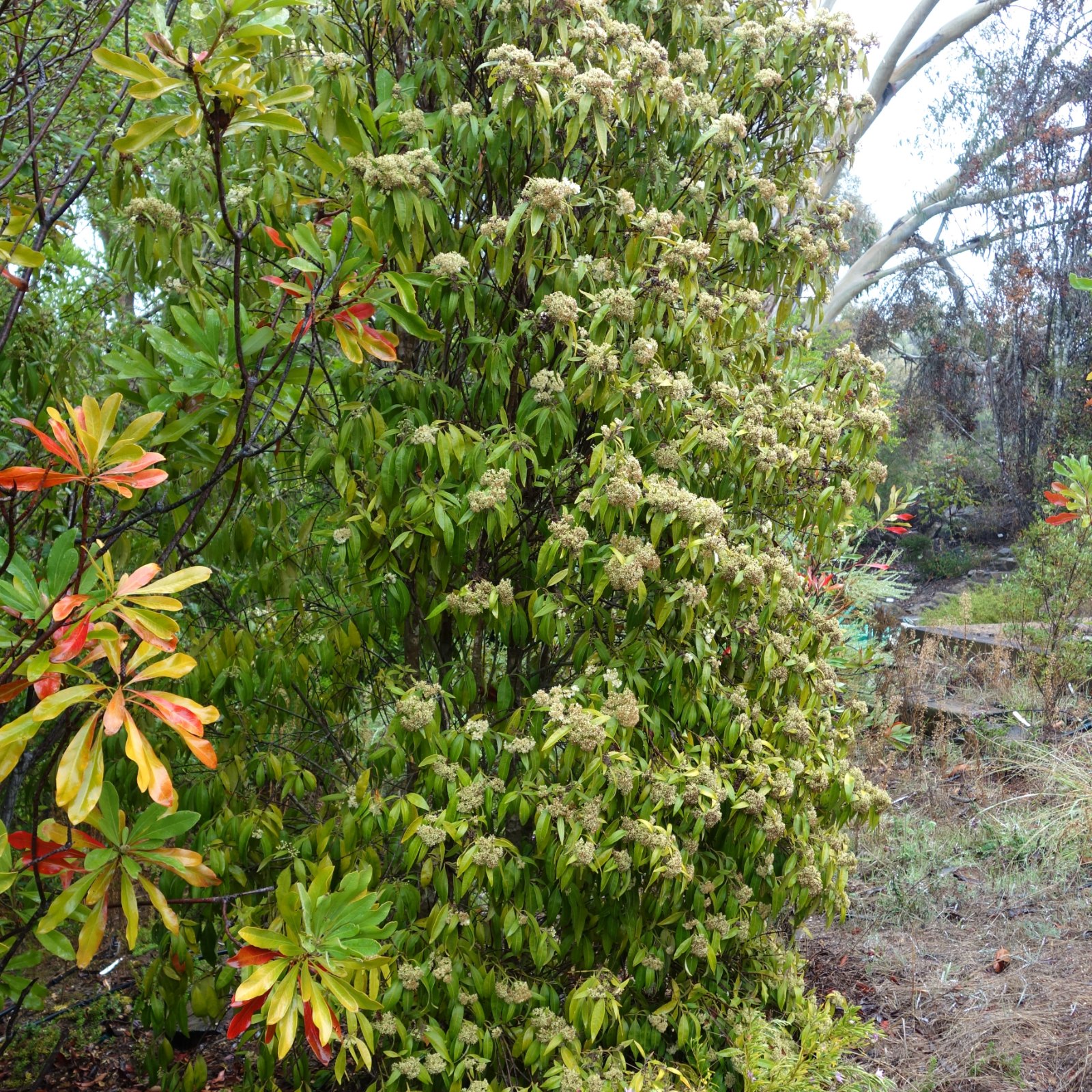
- Plant part
- Leaves
- Vietnamese name
- Khuynh diệp chanh
- Scent family
- Citrus
- Plant family
- Myrtaceae
- Lots published
- —
 Leaves
Composition profile
The published composition from the article, read as structure: 3 compounds adding up to about 100 % of the sample. Figures are printed as the source gives them — one sample, not a species average.
| Compound | Level | Class | Note |
|---|---|---|---|
| Geranial EU | 44.0–60.7 % | Aldehydes | Middle |
| Neral EU | 32.0–40.9 % | Aldehydes | Middle |
| Geraniol EU | 0.5–2.5 % | Alcohols | Base |
By chemical class
- Aldehydes100.0 %
- Alcohols2.5 %
By note
- Middle100.0 %
- Base2.5 %
Group totals use the upper bound of each range and only the compounds the article lists; bars are relative to the identified total.
Compare with the 2 chemically closest oils Which other oils are rich in Geranial?
What lemon myrtle is
Lemon myrtle (Backhousia citriodora) is native to the rainforests of Queensland, Australia. A 2021 review in Foods called it “an unrivalled source of citral”: oil distilled from the leaves typically contains 90–98% citral, more than lemongrass.
Composition
| Compound | Australian data (2021 review) | Malaysian sample (2022) |
|---|---|---|
| Geranial | 44.0–60.7% | 52.13% |
| Neral | 32.0–40.9% | 37.65% |
| Total citral | 80.0–96.0% | 89.78% |
| Geraniol | 0.5–2.5% | – |
| Isocitral (E, Z, exo) | trace to 4.3% | – |
| 6-Methyl-5-hepten-2-one | trace to 2.9% | – |
| Citronellal, linalool | trace to 1.0% each | – |
| Myrcene | trace to 0.7% | 0.22% |
The Malaysian sample was air-dried leaf from an organic plantation in Malacca, hydrodistilled for 4 hours. Australian oil yields are 1.1–3.2% of fresh leaf. The review notes that the isocitrals are heat artefacts formed during distillation.
Besides the citral form there is a separate chemotype rich in citronellal (62–80%). The two share a plant name but smell quite different.
Its smell: almost pure citral
Citral consists of two isomers, geranial and neral. Geranial gives the sharp, bright lemon part; neral is softer and sweeter. Because these two make up almost the whole bottle, lemon myrtle smells “cleaner” than lemongrass (which adds a grassy note) and lemon verbena (which adds floral and herbal notes). It is closer to lemon sweets than to lemon peel, because lemon peel oil is mostly limonene, not citral.
Citral is unstable: oil that is old, or exposed to heat and air, loses its fresh lemon note first.
Safety: the IFRA limit for citral
Citral is a skin sensitiser. The IFRA Standard for citral (49th Amendment) is a restriction based on dermal sensitisation and systemic toxicity. Some maximum levels in the finished product:
| IFRA product category | Maximum citral |
|---|---|
| 2 (products applied to the underarm, such as deodorants) | 0.032% |
| 4 (fine fragrance) | 0.60% |
| 5A–5C (body, face and hand creams) | 0.15% |
| 9 (rinse-off products such as soap) | 1.2% |
For an oil with about 90% citral, 0.60% citral in a perfume corresponds to about 0.67% oil. The 2021 review recommends topical use below 1% and restricted use in pregnancy. Always dilute before use.
Sources
- Southwell I. (2021). Backhousia citriodora F. Muell. (Lemon Myrtle), an Unrivalled Source of Citral. Foods 10(7), 1596. doi:10.3390/foods10071596
- Lim A.C., Tang S.G.H., Zin N.M. et al. (2022). Chemical Composition, Antioxidant, Antibacterial, and Antibiofilm Activities of Backhousia citriodora Essential Oil. Molecules 27(15), 4895. doi:10.3390/molecules27154895
- IFRA Standard: Citral. Amendment 49.
Buy Lemon myrtle
Lemon myrtle oil: no lot has been brought in yet, so it is not on sale. Message us if you need it.
Where you may already have smelled it
According to the analyses cited above, this oil contains up to 96 % citral. It is also the leading compound in the scenes below from the scent dictionary. Smelling one of those scenes again is a way to get to know it without opening a bottle. A shared compound does not mean the oil smells exactly like the scene.
Chemically close
The oils whose published composition is closest to this one, compared across every compound we could read. Close in composition does not mean the scent is identical or that one can replace the other.
Further reading
Close to Lemon myrtle
Same plant family: Myrtaceae Eucalyptus radiata · Green myrtle · Guava leaf · Kanuka · Kunzea · Manuka · Niaouli ct 1,8-cineole
Also from the leaves Balsam fir · Black spruce · Kanuka · Kunzea · Manuka · Pinyon pine · Rosalina · Siberian fir
Same method: direct steam distillation Haitian vetiver · Hyssop ct 1,8-cineole · Oregano · Perilla · Peru balsam · Rosalina · Sweet marjoram · Vietnamese balm
Quick answers
What does lemon myrtle essential oil smell like?
Strong, bright lemon, more lemony than lemongrass itself. It is sweet, sharp, with a lemon-sweet note.
What is the botanical name of lemon myrtle oil?
The plant is Backhousia citriodora, in the Myrtaceae family. In Vietnamese it is called khuynh diệp chanh.
How is lemon myrtle oil produced?
From the leaves of the plant, by direct steam distillation. See the method for what that does to the oil.
Last updated