Essential oils · Medicinal family
Everlasting Madagascar essential oil
Helichrysum gymnocephalum
Helichrysum gymnocephalum · Asteraceae
Cool and clean, close to eucalyptus, with a dry herbal and slightly woody layer underneath. It is straightforward, with few layers.
Helichrysum gymnocephalum is another everlasting from Madagascar, also rich in 1,8-cineole. Compared with H. bracteiferum, its oil is much richer in 1,8-cineole (about 47–67% against about a quarter), so it is closer to eucalyptus.
The two Malagasy species and the Mediterranean one all carry the name “helichrysum” but are three different oils. When buying, look at the full species name, not just the word helichrysum.
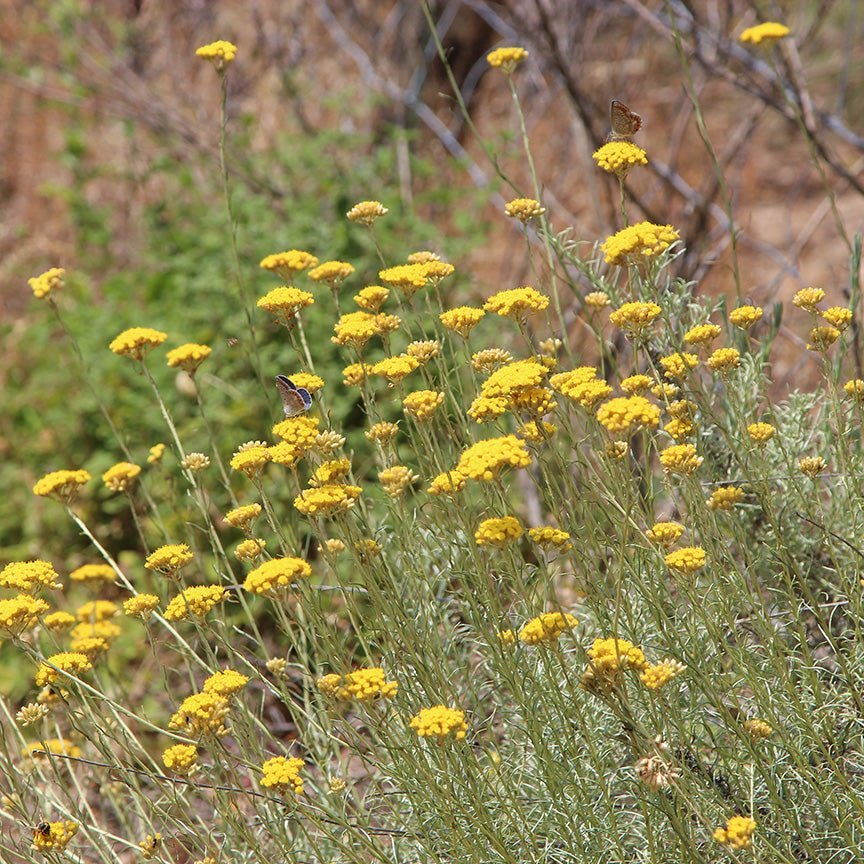
- Plant part
- Flowers
- Vietnamese name
- Helichrysum gymnocephalum
- Scent family
- Medicinal
- Plant family
- Asteraceae
- Lots published
- —
 Flowers
Composition profile
The published composition from the article, read as structure: 10 compounds adding up to about 85 % of the sample. Figures are printed as the source gives them — one sample, not a species average.
| Compound | Level | Class | Note |
|---|---|---|---|
| 1,8-Cineole | 47.4 % | Oxides | Top |
| Bicyclosesquiphellandrene | 5.6 % | — | — |
| γ-Curcumene | 5.6 % | — | — |
| α-Amorphene | 5.1 % | — | — |
| Bicyclogermacrene | 5.0 % | Sesquiterpenes | Base |
| p-Cymene | 4.3 % | Monoterpenes | Top |
| δ-Cadinene | 3.6 % | Sesquiterpenes | Base |
| β-Selinene | 3.3 % | Sesquiterpenes | Base |
| Terpinen-4-ol | 2.7 % | Alcohols | Middle |
| (E)-β-Ocimene | 2.4 % | Monoterpenes | Top |
By chemical class
- Oxides47.4 %
- Unclassified16.3 %
- Sesquiterpenes11.9 %
- Monoterpenes6.7 %
- Alcohols2.7 %
By note
- Top54.1 %
- Middle2.7 %
- Base11.9 %
- Unclassified16.3 %
Group totals use the upper bound of each range and only the compounds the article lists; bars are relative to the identified total.
Compare with the 2 chemically closest oils Which other oils are rich in 1,8-Cineole?
What Helichrysum gymnocephalum is
Helichrysum gymnocephalum is another everlasting from Madagascar. The oil is distilled from the leaves. Of the Helichrysum species sold commercially, it is the richest in 1,8-cineole among those for which we have read data.
Composition: leaves from Antananarivo
A 2011 study distilled leaves collected in Antananarivo in July 2008, with a yield of 0.40%:
| Compound | Share |
|---|---|
| 1,8-Cineole | 47.4% |
| Bicyclosesquiphellandrene | 5.6% |
| γ-Curcumene | 5.6% |
| α-Amorphene | 5.1% |
| Bicyclogermacrene | 5.0% |
| p-Cymene | 4.3% |
| δ-Cadinene | 3.6% |
| β-Selinene | 3.3% |
| Terpinen-4-ol | 2.7% |
| (E)-β-Ocimene | 2.4% |
Other studies
- 2001: 1,8-cineole 59.7%, p-cymene 6.3%, α-pinene 4.9%; yield 0.41%.
- 1997: 1,8-cineole 66.7%; yield 0.5%.
- 1992: 1,8-cineole only 17.4%, quite unlike the later studies.
Three of the four studies give 1,8-cineole at about 47–67%; the 1992 sample is the exception. We read the 1997 and 1992 figures through review papers, not the originals.
Compared with bracteiferum
Helichrysum bracteiferum has about a quarter 1,8-cineole, with β-pinene and α-humulene at about 10% each. Gymnocephalum is much richer in cineole, the rest being many small sesquiterpenes. Its smell is therefore closer to cineole oils such as eucalyptus. Both are far from Mediterranean helichrysum, a neryl acetate-rich species.
Its smell
1,8-Cineole gives the cool, clean, eucalyptus-like part. Sesquiterpenes such as bicyclogermacrene, γ-curcumene and δ-cadinene give a woody, dry-herb layer underneath.
Safety
Oils rich in 1,8-cineole should not be used near the face of young children. We have not found an IFRA standard or EU rule specific to this oil. Always dilute before use on skin.
Sources
- Afoulous S., Ferhout H., Raoelison E.G., Valentin A., Moukarzel B., Couderc F., Bouajila J. (2011). Helichrysum gymnocephalum Essential Oil: Chemical Composition and Cytotoxic, Antimalarial and Antioxidant Activities. Molecules 16(10), 8273–8291. doi:10.3390/molecules16108273
- Cavalli J.-F., Ranarivelo L., Ratsimbason M., Bernardini A.-F., Casanova J. (2001). Flavour and Fragrance Journal 16(4), 253–256. doi:10.1002/ffj.994
- Rabehaja D.J.R. et al. (2020). Plants 9(2), 265. doi:10.3390/plants9020265
Buy Everlasting Madagascar
Everlasting Madagascar oil: no lot has been brought in yet, so it is not on sale. Message us if you need it.
Where you may already have smelled it
According to the analyses cited above, this oil contains up to 47.4 % 1,8-cineole. It is also the leading compound in the scenes below from the scent dictionary. Smelling one of those scenes again is a way to get to know it without opening a bottle. A shared compound does not mean the oil smells exactly like the scene.
Chemically close
The oils whose published composition is closest to this one, compared across every compound we could read. Close in composition does not mean the scent is identical or that one can replace the other.
- Honey myrtle Melaleuca teretifolia shared: 1,8-Cineole · closeness 0.96 · compare
- Galangal Alpinia officinarum shared: 1,8-Cineole · closeness 0.95 · compare
- Eucalyptus globulus Eucalyptus globulus shared: 1,8-Cineole · closeness 0.95 · compare
Further reading
Close to Everlasting Madagascar
Same plant family: Asteraceae Blue tansy · German chamomile · Moroccan blue chamomile · Mugwort · Tagetes · Tarragon
Also from the flowers Clove bud · Hops · Lotus · Moroccan blue chamomile · Neroli · Osmanthus · Pomelo blossom · Rose otto
Same method: direct steam distillation Blue cypress · Fingerroot · Hemlock spruce · Hops · Lolot pepper leaf · Moroccan blue chamomile · Neroli · Saro
Quick answers
What does everlasting Madagascar essential oil smell like?
Cool and clean, close to eucalyptus, with a dry herbal and slightly woody layer underneath. It is straightforward, with few layers.
What is the botanical name of everlasting Madagascar oil?
The plant is Helichrysum gymnocephalum, in the Asteraceae family. In Vietnamese it is called helichrysum gymnocephalum.
How is everlasting Madagascar oil produced?
From the flowers of the plant, by direct steam distillation. See the method for what that does to the oil.
What are the main compounds of everlasting Madagascar oil?
From the composition data on this page, the oil is led by 1,8-Cineole, Bicyclogermacrene and p-Cymene. Proportions vary with origin, harvest and method; a lot analysis is the only answer for a given bottle.
Last updated