Oregano essential oil
Origanum vulgare
Kinh giới cay · Lamiaceae
Hot, spicy, dry herbs, with an almost medicinal edge. It is strong from the first breath and barely softens.
That heat is carvacrol, a phenol also found in thyme. Together with γ-terpinene and p-cymene it makes oregano oil far harsher than the dried oregano sprinkled on pizza.
EFSA classes oregano oil as an irritant to skin and eyes, so it needs dilution to a low level.
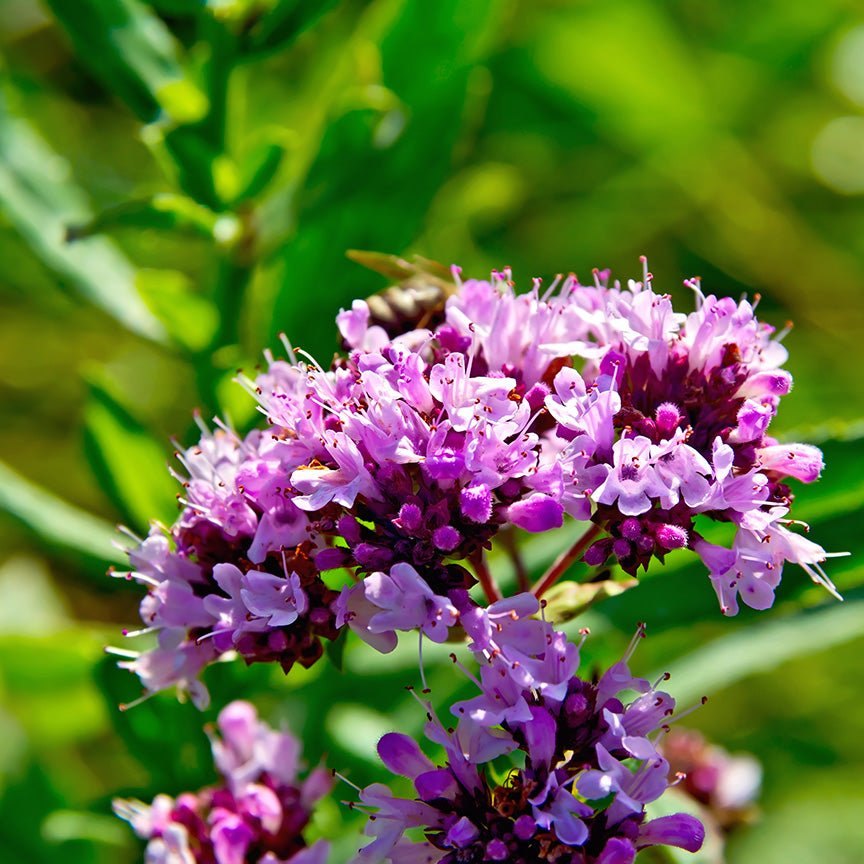
- Plant part
- Whole plant
- Vietnamese name
- Kinh giới cay
- Scent family
- Spicy
- Plant family
- Lamiaceae
- Lots published
- —
 Whole plant
Composition profile
The published composition from the article, read as structure: 3 compounds adding up to about 87 % of the sample. Figures are printed as the source gives them — one sample, not a species average.
| Compound | Level | Class | Note |
|---|---|---|---|
| Carvacrol | 78.1 % | Phenols | Base |
| p-Cymene | 6.11 % | Monoterpenes | Top |
| Thymol | 2.63 % | Phenols | Base |
By chemical class
- Phenols80.7 %
- Monoterpenes6.1 %
By note
- Top6.1 %
- Base80.7 %
Group totals use the upper bound of each range and only the compounds the article lists; bars are relative to the identified total.
Put it beside another oil in the Compare tool Which other oils are rich in Carvacrol?
Oregano is a group of plants, not one
Oregano (Origanum vulgare) is a very diverse species. According to a 2021 review in the Iranian Journal of Pharmaceutical Research, the botanist Ietswaart divided it into six subspecies on morphology: glandulosum, gracile, hirtum, virens, viridulum and vulgare. Each subspecies, and often each growing area, gives a different oil.
North and south of the Mediterranean
The review cites many studies showing a geographical pattern:
- The northern subspecies give little oil, and the oil is complex, with many sesquiterpenes.
- The southern subspecies give oil rich in phenolic monoterpenes, carvacrol or thymol, which can make up as much as 70% of the oil.
The review also notes that subspecies hirtum has a higher oil yield than the others. This is the subspecies usually called Greek oregano.
Greek oregano: a carvacrol oil
Two sources of figures for O. vulgare ssp. hirtum oil:
| Sample | Carvacrol | Thymol | p-Cymene |
|---|---|---|---|
| EFSA 2019 (5 batches) | 78.1% | 2.63% | 6.11% |
| Imathia, Greece | 89.1% | 0.09% | 5.23% |
| Chania, Crete | 79.8% | 3.55% | 4.75% |
| Leonidio, Greece | 63.2% | 11.6% | 7.91% |
The first row is the mean of 5 batches steam-distilled from stems, leaves and flowers in the European Food Safety Authority’s (EFSA) 2019 scientific opinion; EFSA recommends a specification of at least 75% carvacrol. The other three rows are plants cultivated in Greece, dried and then hydrodistilled for 3 hours, with yields of 3.7–8.9 mL per 100 g. γ-Terpinene in the four samples was 3.73%, 2.46%, 5.87% and 8.52% respectively. A 2007 study in the Marmara region (Turkey) showed that the same subspecies can lean towards carvacrol (up to 85.4%) or towards thymol (up to 68.0%).
Same subspecies, different chemotype
In other subspecies the differences are even larger. The 2021 review gives the example of subspecies gracile:
| Origin | Main compounds |
|---|---|
| Iran | Carvacrol 60.6%, γ-terpinene 16.64%, p-cymene 13.54% |
| France | Sabinene 26.0%, germacrene D 13.7%, β-caryophyllene 6.6% |
Two bottles with the same subspecies name: one mainly carvacrol, the other with no carvacrol among its main compounds. The review also cites an oil from Turkey with 96.31% linalool. So with oregano, the label should state the chemotype and the analysis should give specific carvacrol and thymol figures.
Carvacrol, thymol and γ-terpinene
A 2021 study in PNAS clarified how thymol and carvacrol are made in the mint family: γ-terpinene is oxidised by P450 enzymes, then a dehydrogenase carries it on to thymol or carvacrol; without the dehydrogenase, the product is p-cymene. That is why γ-terpinene and p-cymene usually accompany carvacrol and thymol in the oil, as in all four samples above.
Safe use
EFSA classes oregano oil as an irritant to skin and eyes and a potential skin and respiratory sensitiser. Always dilute to a low level, and see the page on children and pregnancy.
Sources
- Soltani S., Shakeri A., Iranshahi M., Boozari M. (2021). A Review of the Phytochemistry and Antimicrobial Properties of Origanum vulgare L. and Subspecies. Iranian Journal of Pharmaceutical Research 20(2), 268–285. doi:10.22037/ijpr.2020.113874.14539
- EFSA FEEDAP Panel (2019). Safety and efficacy of an essential oil from Origanum vulgare ssp. hirtum (Link) Ietsw. for all animal species. EFSA Journal 17(12), 5909. doi:10.2903/j.efsa.2019.5909
- Episkopou E., Kakouri E., Daferera D., Economou G., Tarantilis P.A. Comparative analysis of the essential oil yield and chemical composition of cultivated Origanum spp. in Greece. doi:10.62579/JAGC0017
- Esen G., Azaz A.D., Kurkcuoglu M., Baser K.H.C., Tinmaz A. (2007). Essential oil and antimicrobial activity of wild and cultivated Origanum vulgare L. subsp. hirtum from the Marmara region, Turkey. Flavour and Fragrance Journal 22(5), 371–376. doi:10.1002/ffj.1808 (abstract read)
- Krause S.T., Liao P., Crocoll C. et al. (2021). The biosynthesis of thymol, carvacrol, and thymohydroquinone in Lamiaceae proceeds via cytochrome P450s and a short-chain dehydrogenase. PNAS 118(52), e2110092118. doi:10.1073/pnas.2110092118 (abstract read)
Buy Oregano
Oregano oil: no lot has been brought in yet, so it is not on sale. Message us if you need it.
Further reading
Close to Oregano
Same plant family: Lamiaceae Basil ct linalool · Bergamot mint · Cornmint · Hyssop ct 1,8-cineole · Lavender · Melissa · Spike lavender · Sweet marjoram
Also from the whole plant Basil ct methyl chavicol · Bee balm · Catnip · Hyssop ct 1,8-cineole · Mugwort · Peppermint · Sweet marjoram · Tarragon
Same method: direct steam distillation Engelmann spruce · Hyssop ct 1,8-cineole · Kanuka · Kunzea · Lavender · Saro · Sweet marjoram · Thyme ct linalool
Quick answers
What does oregano essential oil smell like?
Hot, spicy, dry herbs, with an almost medicinal edge. It is strong from the first breath and barely softens.
What is the botanical name of oregano oil?
The plant is Origanum vulgare, in the Lamiaceae family. In Vietnamese it is called kinh giới cay.
How is oregano oil produced?
From the whole plant of the plant, by direct steam distillation. See the method for what that does to the oil.
What are the main compounds of oregano oil?
Is there anything to watch out for with oregano oil?
Rich in phenols (carvacrol or thymol). EFSA classes oregano oil as an irritant to skin and eyes and a potential skin and respiratory sensitiser. Never apply neat; see also the page on children and pregnancy.
Last updated