Mugwort essential oil
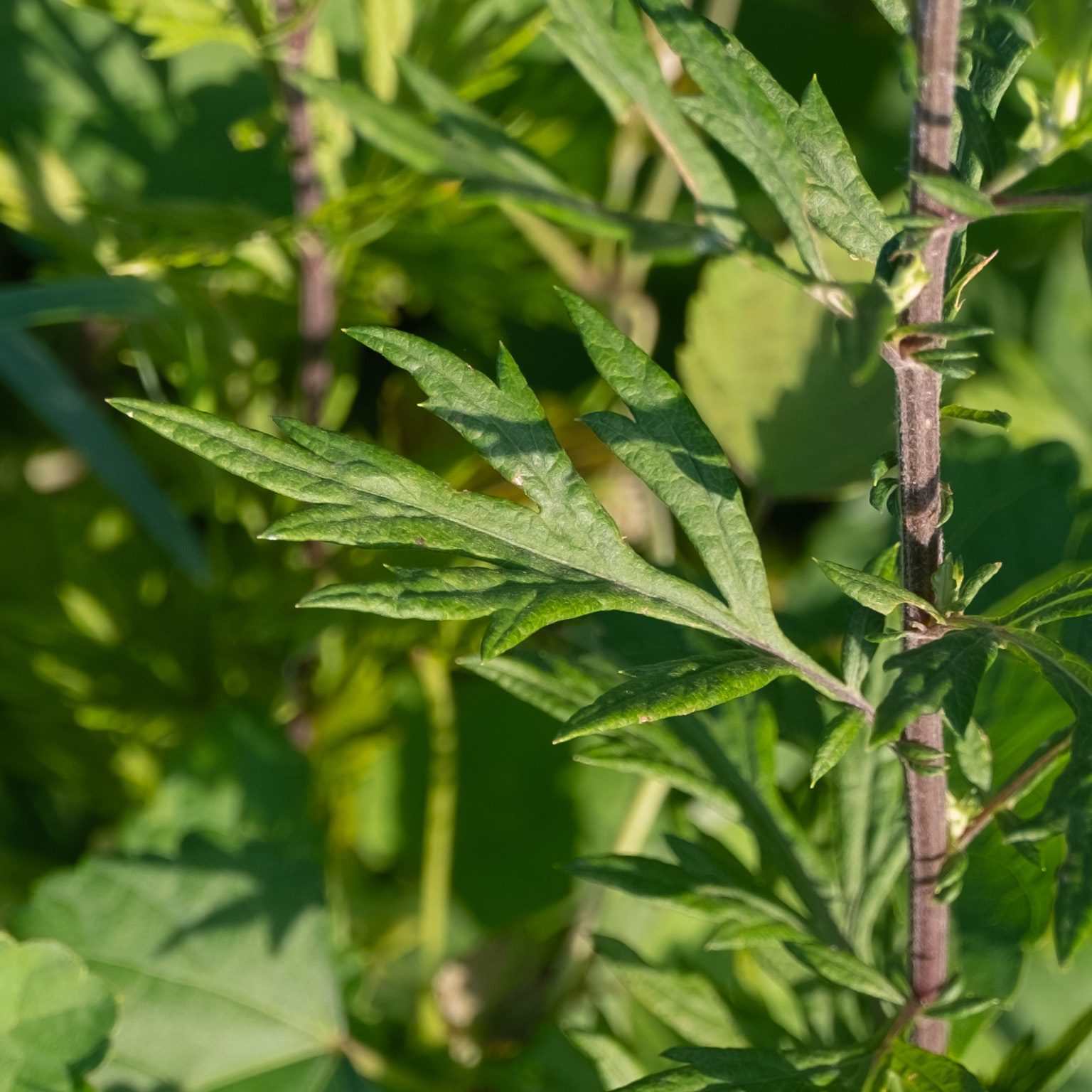
Artemisia vulgaris
Ngải cứu · Asteraceae
Green bitterness, camphor, a little pungency. This is the smell of a Vietnamese mugwort omelette, but much drier and sharper once it has become an essential oil.
Mugwort’s composition swings widely with where it is grown: some lots lean towards 1,8-cineole, some towards camphor, some carry thujone. So two bottles both labelled Artemisia vulgaris can differ more than bottles of two different species.
For this oil, the plant name on the label tells you very little. The composition table on this page shows that range, but only the lot analysis tells you which version you are holding.
- Plant part
- Whole plant
- Vietnamese name
- Ngải cứu
- Scent family
- Green
- Plant family
- Asteraceae
- Lots published
- —
 Whole plant
The kitchen herb and the bottle of oil are two different things
Mugwort is a familiar herb in Vietnamese cooking: omelette with mugwort, chicken stewed with mugwort. Because it is so familiar, many people assume mugwort oil is as gentle as a bunch of the leaves. But a bottle of essential oil is the volatile part of a great many mugwort plants, concentrated. Compounds present in tiny amounts in a plate of greens can make up a significant share of a few drops of oil.
The compound to watch most closely is thujone.
What thujone is, and why it matters
Thujone is found in the essential oils of many plants: wormwood, sage, thuja and many other species of Artemisia, the genus mugwort belongs to. A 2017 review of Artemisia species found thujone to be one of the main compounds commonly present in oils of the genus, alongside 1,8-cineole, camphor and caryophyllene. The amount of thujone varies greatly between samples, as the description at the top of the page says.
The European Medicines Agency (EMA) describes thujone as acting rapidly on the GABA-gated chloride channel in the nervous system. In overdose, the most prominent symptom is convulsions. For herbal medicinal products containing thujone, the EMA recommends:
- a daily exposure limit of 6 mg of thujone, with 3–7 mg/day regarded as of no special concern;
- stating the thujone content for each batch;
- restricting use in pregnant women and children as far as possible, because there are not enough data for these groups.
Composition: many chemotypes
Mugwort oil has no “typical” profile. Published analyses give very different types of oil:
| Sample | Main compounds |
|---|---|
| Vietnam, Tien Giang (2024) | 1,8-cineole 24.25%; α-pinene 10.57%; borneol 8.89%; β-caryophyllene 7.10%; camphor 6.87% |
| India, Manipur, leaves (2023) | 1,8-cineole 29.91%; sabinene 8.44%; borneol 8.24% |
| Turkey, by growth stage (2022) | α-thujone 30.68–47.41%; β-caryophyllene 7.92–22.05% |
| Lithuania, 7 wild populations (2006) | germacrene D 10.6–15.1% in 3 oils; trans-thujone 20.2% in 1 oil |
| Serbia, wild (2021) | myrcene 22.0%; artemisia ketone 17.6%; β-selinene 9.9% |
| Brazil, cultivated, leaves (2019) | caryophyllene 37.45%; germacrene D 16.17%; humulene 13.66% |
The Tien Giang sample is aerial parts, hydrodistilled, with a yield of 0.26%; the authors also note δ-elemene at 6.05%, a level uncommon in mugwort. A 1992 study of the leaves of A. vulgaris var. indica in Vietnam instead found an oil rich in β-caryophyllene (24.1%) and β-cubebene (12.0%). In Turkey, α-thujone rose from 30.68% before flowering to 47.41% at a later stage.
So some batches have almost no thujone, and in others thujone is the main compound. That is why the thujone question below matters so much.
What this means for buyers
- Do not swallow it, and do not add it to food. Mugwort leaves are a food. Mugwort oil is not.
- Ask for the thujone content of the lot. A serious supplier should be able to answer, since the EMA itself requires that figure for each batch of herbal medicine.
- Do not use it for pregnant women or young children. The children and pregnancy safety page has more.
Sources
- EMA, Committee on Herbal Medicinal Products (2012). Public statement on the use of herbal medicinal products containing thujone, Rev. 1 (EMA/HMPC/732886/2010). ema.europa.eu
- Antioxidant, Anti-Inflammatory, and Anti-Bacterial Activities of Artemisia vulgaris L. Essential Oil in Vietnam (2024). Natural Product Communications 19(8). doi:10.1177/1934578X241275782
- Chemical Composition of the Essential Oil of Artemisia vulgaris L. var. indica Maxim. from Vietnam (1992). Journal of Essential Oil Research 4(4), 433–434. doi:10.1080/10412905.1992.9698101
- Singh N.B. et al. (2023). Molecules 28(5), 2279. doi:10.3390/molecules28052279
- Demirbolat I., Inal E., Ulusoy S., Kartal M. (2022). Journal of Essential Oil Bearing Plants 25(2), 393–402. doi:10.1080/0972060X.2022.2084348
- Judzentiene A., Buzelyte J. (2006). Chemija 17(1), 12–16.
- Radulovic M. et al. (2021). Journal of the Serbian Chemical Society 86(12), 1281–1290. doi:10.2298/JSC210803088R
- Malik S. et al. (2019). Pharmaceuticals 12(2), 49. doi:10.3390/ph12020049
- Pandey and Singh (2017). The genus Artemisia: a 2012–2017 literature review on chemical composition, antimicrobial, insecticidal and antioxidant activities of essential oils. Medicines 4(3), 68. doi:10.3390/medicines4030068
Buy Mugwort
Mugwort oil: no lot has been brought in yet, so it is not on sale. Message us if you need it.
In the scent dictionary: Mugwort — a description of the smell, the compounds behind it, and how to smell it for yourself.
Further reading
Close to Mugwort
Same plant family: Asteraceae Blue tansy · Everlasting Madagascar · German chamomile · Helichrysum · Roman chamomile · Tarragon
Also from the whole plant Bee balm · Bergamot mint · Cornmint · Davana · Japanese mint · Peppermint · Rosemary ct camphor · Tarragon
Same method: direct steam distillation Basil ct linalool · Frankincense · Frankincense frereana · Norway pine · Sitka spruce · Spikenard · Tarragon · Ylang ylang
Quick answers
What does mugwort essential oil smell like?
Green bitterness, camphor, a little pungency. This is the smell of a Vietnamese mugwort omelette, but much drier and sharper once it has become an essential oil.
What is the botanical name of mugwort oil?
The plant is Artemisia vulgaris, in the Asteraceae family. In Vietnamese it is called ngải cứu.
How is mugwort oil produced?
From the whole plant of the plant, by direct steam distillation. See the method for what that does to the oil.
Is there anything to watch out for with mugwort oil?
Contains thujone. Not for use in pregnancy or with young children.
Last updated