Sweet marjoram essential oil
Origanum majorana
Kinh giới ngọt · Lamiaceae
Sweet, warm herbs, slightly spicy and slightly woody. It is much softer than oregano, with almost no hot edge.
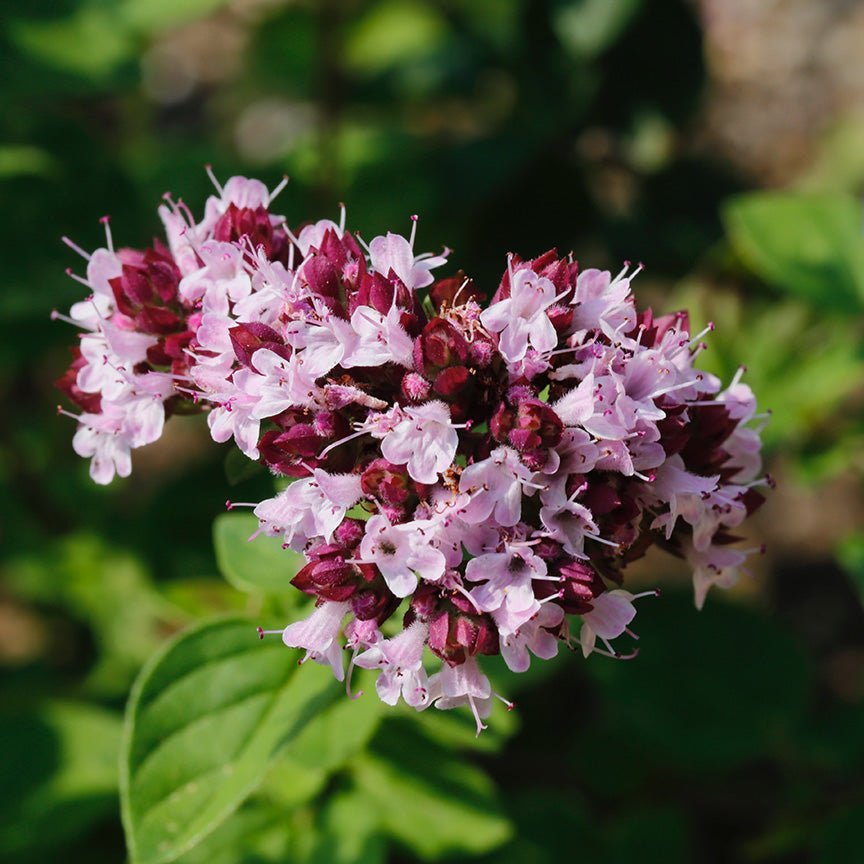
Sweet marjoram (Origanum majorana) shares a genus with oregano but has entirely different chemistry. Instead of carvacrol, marjoram oil is usually rich in terpinen-4-ol and sabinene hydrate, which give its warm sweetness.
So the two cannot replace each other, and should not be confused on a label: phenol-rich oregano needs very high dilution, while marjoram is far gentler.
- Plant part
- Whole plant
- Vietnamese name
- Kinh giới ngọt
- Scent family
- Green
- Plant family
- Lamiaceae
- Lots published
- —
 Whole plant
Composition profile
The published composition from the article, read as structure: 6 compounds adding up to about 85 % of the sample. Figures are printed as the source gives them — one sample, not a species average.
| Compound | Level | Class | Note |
|---|---|---|---|
| Terpinen-4-ol | 14–32 % | Alcohols | Middle |
| γ-Terpinene | 11–18 % | Monoterpenes | Middle |
| α-Terpinene EU | 6–12 % | Monoterpenes | Top |
| Sabinene | 4–10 % | Monoterpenes | Top |
| trans-Sabinene hydrate | 1.5–7.5 % | — | — |
| α-Terpineol EU | 1–5 % | Alcohols | Middle |
By chemical class
- Monoterpenes40.0 %
- Alcohols37.0 %
- Unclassified7.5 %
By note
- Top22.0 %
- Middle55.0 %
- Unclassified7.5 %
Group totals use the upper bound of each range and only the compounds the article lists; bars are relative to the identified total.
Compare with the 1 chemically closest oil Which other oils are rich in Terpinen-4-ol?
Sweet marjoram
Sweet marjoram (Origanum majorana) belongs to the same genus as oregano but is chemically quite different. It is also different from Vietnamese balm (Elsholtzia ciliata), a familiar herb at Vietnamese meals. The three plants share the Vietnamese word kinh giới but are three species with three smells.
Composition
A 2025 scientific opinion of the European Food Safety Authority (EFSA) assessed marjoram oil as a feed additive: 5 batches steam-distilled from dried leaves of Egyptian origin, with a specification proposed by the applicant (who stated that volatile fractions may be blended to meet it). The last column is two samples from Nepal in a 2022 study in Molecules:
| Compound | Spec. | Egypt, 5 (mean) | Nepal, 2 |
|---|---|---|---|
| Terpinen-4-ol | 14–32% | 21.86% | 32.1–33.35% |
| cis-Sabinene hydrate | – | 15.92% | 3.48–4.4% |
| γ-Terpinene | 11–18% | 13.88% | 0–9.5% |
| α-Terpinene | 6–12% | 8.65% | 0–5.0% |
| Sabinene | 4–10% | 8.32% | 1.29–3.6% |
| trans-Sabinene hydrate | 1.5–7.5% | 3.77% | 0.71–1.6% |
| α-Terpineol | 1–5% | 3.10% | 2.63–3.7% |
| Linalool | – | 1.39% | 13.8–15.37% |
The Egyptian batches also contained terpinolene 3.16%, linalyl acetate 1.67% and p-cymene 0.99%. The two Nepalese samples were aerial parts collected at flowering in Kathmandu and Bhaktapur, shade-dried and then distilled for 3 hours in a Clevenger apparatus, with yields of 0.5% and 0.8%; linalyl acetate was 5.9–6.67%; the Bhaktapur sample had no detectable γ-terpinene or α-terpinene (shown as 0 in the table). A dash means it was not reported.
Reading the table
Terpinen-4-ol is the main compound in every sample, but the rest differs widely: the Egyptian oil is rich in cis-sabinene hydrate and the terpinenes, while the Nepalese oil is much richer in linalool. A bottle of marjoram can therefore lean one way or the other depending on where it was grown, and the lot analysis tells you which kind you have.
Oregano, by contrast, is built around carvacrol, as the oregano page explains. Terpinen-4-ol is also the main compound of tea tree, so anyone familiar with tea tree may notice a shared note. The two Origanum species cannot replace each other.
Estragole: something to know
EFSA found estragole, classed as a genotoxic carcinogen, at 0.06% and 0.29% in two batches; myristicin was below the detection limit of 0.001%. So the analysis of a marjoram lot should give a specific estragole figure.
Safe use
EFSA classes the oil as an irritant to skin and eyes and a skin and respiratory sensitiser for people who handle it, and considers that users’ exposure to estragole by any route should be minimised. Under Regulation (EU) 2023/1545, the α-terpinene, terpineol, terpinolene and linalyl acetate in the oil are all on the list of fragrance allergens that must be named on cosmetic labels; terpinen-4-ol is not. Always dilute before use on skin.
Sources
- EFSA FEEDAP Panel (2025). Safety and efficacy of a feed additive consisting of an essential oil derived from the leaves of Origanum majorana L. (marjoram oil) for use in all animal species (FEFANA asbl). EFSA Journal 23(12), e9786. doi:10.2903/j.efsa.2025.9786
- Paudel P.N., Satyal P., Satyal R., Setzer W.N., Gyawali R. (2022). Chemical composition, enantiomeric distribution, antimicrobial and antioxidant activities of Origanum majorana L. essential oil from Nepal. Molecules 27(18), 6136. doi:10.3390/molecules27186136
- Regulation (EU) 2023/1545 on the labelling of fragrance allergens.
Buy Sweet marjoram
Sweet marjoram oil: no lot has been brought in yet, so it is not on sale. Message us if you need it.
Where you may already have smelled it
According to the analyses cited above, this oil contains up to 32 % terpinen-4-ol and up to 18 % γ-terpinene. Both are also part of, though not the lead in, the scenes below from the scent dictionary. Smelling one of those scenes again is a way to get to know them without opening a bottle. A shared compound does not mean the oil smells exactly like the scene.
- CajuputPut a drop of cajeput oil on a smelling strip and smell after thirty seconds
- Crushed pomelo peelSqueeze a piece of Nam Roi pomelo peel hard, so the oil sprays out
- Buddha’s handTake a ripe yellow Buddha’s hand and lightly scratch the peel with a fingernail
- King orange peelSqueeze a piece of dark-green, knobbly king orange peel
Chemically close
The oils whose published composition is closest to this one, compared across every compound we could read. Close in composition does not mean the scent is identical or that one can replace the other.
Further reading
Close to Sweet marjoram
Same plant family: Lamiaceae Basil ct methyl chavicol · Catnip · Clary sage · Hyssop ct 1,8-cineole · Lavender · Peppermint · Perilla · Spike lavender
Also from the whole plant Bee balm · Bergamot mint · Clove basil · Hyssop ct 1,8-cineole · Japanese mint · Mugwort · Tarragon · Thyme ct linalool
Same method: direct steam distillation Balsam fir · Hyssop ct 1,8-cineole · Kanuka · Kunzea · Lemongrass · Sitka spruce · Spike lavender · Thyme ct thymol
Quick answers
What does sweet marjoram essential oil smell like?
Sweet, warm herbs, slightly spicy and slightly woody. It is much softer than oregano, with almost no hot edge.
What is the botanical name of sweet marjoram oil?
The plant is Origanum majorana, in the Lamiaceae family. In Vietnamese it is called kinh giới ngọt.
How is sweet marjoram oil produced?
From the whole plant of the plant, by direct steam distillation. See the method for what that does to the oil.
What are the main compounds of sweet marjoram oil?
From the composition data on this page, the oil is led by Terpinen-4-ol, γ-Terpinene and α-Terpinene. Proportions vary with origin, harvest and method; a lot analysis is the only answer for a given bottle.
Last updated