Catnip essential oil
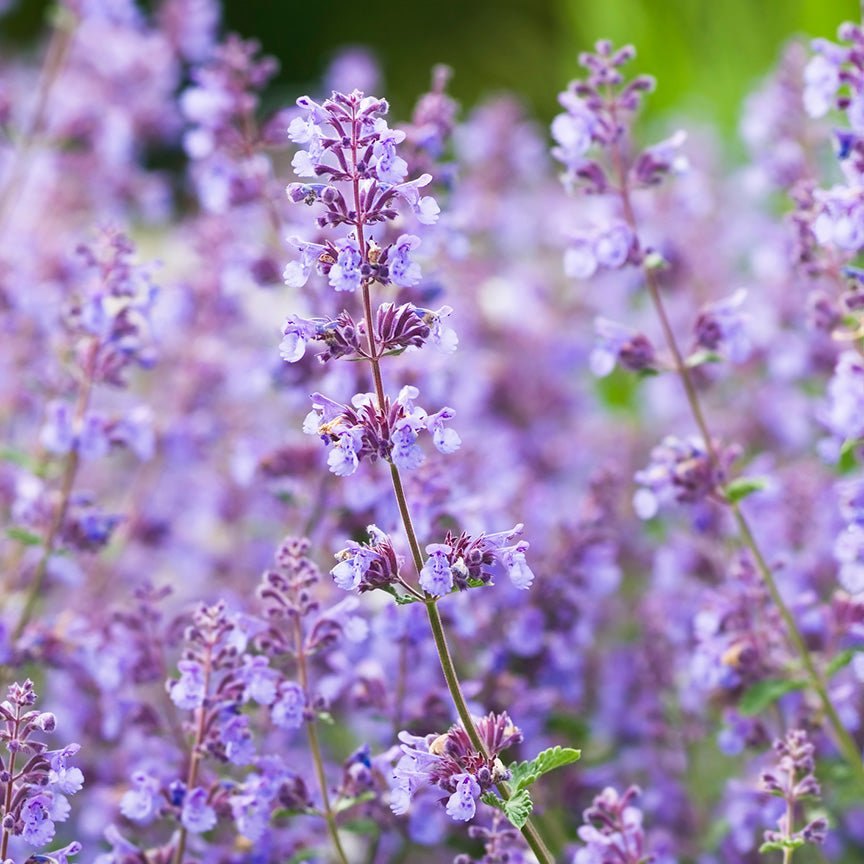
Nepeta cataria
Cây bạc hà mèo · Lamiaceae
Green grass, slightly minty, with a damp, faintly musty note. It is not pleasant in a floral way, but very easy to recognise once smelled.
The characteristic compounds are nepetalactones, a group of iridoids found almost only in the genus Nepeta. They are what make many cats react so strongly to the plant.
Although the Vietnamese name includes the word for mint, catnip contains no menthol and does not smell cold. The name comes from the leaf’s resemblance to mint, not from its chemistry.
- Plant part
- Whole plant
- Vietnamese name
- Cây bạc hà mèo
- Scent family
- Green
- Plant family
- Lamiaceae
- Lots published
- —
 Whole plant
Composition profile
The published composition from the article, read as structure: 2 compounds adding up to about 3 % of the sample. Figures are printed as the source gives them — one sample, not a species average.
| Compound | Level | Class | Note |
|---|---|---|---|
| β-Caryophyllene EU | 1.1–2.7 % | Sesquiterpenes | Base |
| Caryophyllene oxide | 0.12–0.5 % | Oxides | Base |
By chemical class
- Sesquiterpenes2.7 %
- Oxides0.5 %
By note
- Base3.2 %
Group totals use the upper bound of each range and only the compounds the article lists; bars are relative to the identified total.
Put it beside another oil in the Compare tool Which other oils are rich in β-Caryophyllene?
What catnip is
Catnip (Nepeta cataria) is a plant of the mint family, famous for the strong reaction it provokes in many cats. The compound behind that reaction is nepetalactone, an iridoid found almost only in the genus Nepeta. Despite its family, catnip contains no menthol.
Composition: nepetalactone and its isomers
Nepetalactone exists as several isomers, and catnip oils differ mainly in the balance between them.
| Compound | Iran, 3 growth stages (2012) | Chemotype A (2011) | Chemotype B (2011) |
|---|---|---|---|
| Nepetalactone, first isomer* | 55–58% | 91.95% | 16.98% |
| Nepetalactone, second isomer* | 30.06–31.2% | – | 69.83% |
| β-Caryophyllene | 1.1–2.7% | 8.05% | 13.19% |
| Caryophyllene oxide | 0.12–0.5% | – | – |
\* The 2011 study names the two isomers (4aS,7S,7aR) and (4aS,7S,7aS); the 2012 study uses different notation. We keep each study’s own naming and do not convert between them. The Iranian samples were aerial parts from Shiraz, hydrodistilled, taken at the vegetative, budding and full-flowering stages.
The 2011 study divides the oils into two chemotypes: type A dominated by the (4aS,7S,7aR) isomer, type B by the (4aS,7S,7aS) isomer.
A cultivar without nepetalactone
The cultivar citriodora gives quite a different oil. A 1997 study in the Drome region of France found no nepetalactone; instead it had geraniol 25.13–31.00%, nerol 19.95–30.70%, citronellol 11.44–16.73% and geranial 4.93–11.05%, this group making up about 85–95% in total. Its smell is close to lemon and rose, not the grassy smell of ordinary catnip. So a bottle of “catnip” should state the cultivar.
Nepetalactone and insects
The 2011 study found nepetalactone’s mosquito-repellent activity “comparable” to DEET against Anopheles gambiae in laboratory tests. In the USA, a mosquito repellent containing 15% refined Nepeta cataria oil had its label accepted by the Environmental Protection Agency (EPA) in 2009. In the EU, nepetalactone is not approved as a plant-protection active substance under Regulation 1107/2009. This page records these as facts, not as a recommendation to use catnip oil instead of a registered repellent.
Its smell
Nepetalactone gives a green, grassy, slightly damp, slightly musty smell with a faint minty note; caryophyllene adds a spicy woody base. It is not pleasant in a floral way, but it is very recognisable.
Safety
We have not read any IFRA standard or cosmetics regulation specific to catnip oil. Always dilute and test on a small patch of skin before use.
Sources
- Zomorodian K., Saharkhiz M.J., Shariati S. et al. (2012). Chemical Composition and Antimicrobial Activities of Essential Oils from Nepeta cataria L. against Common Causes of Food-Borne Infections. ISRN Pharmaceutics 2012, 591953. doi:10.5402/2012/591953
- Birkett M.A., Hassanali A., Hoglund S. et al. (2011). Repellent activity of catmint, Nepeta cataria, and iridoid nepetalactone isomers against Afro-tropical mosquitoes, ixodid ticks and red poultry mites. Phytochemistry 72(1), 109–114. doi:10.1016/j.phytochem.2010.09.016
- Chalchat J.-C., Lamy J. (1997). Chemical composition of the essential oil isolated from wild catnip Nepeta cataria L. cv. citriodora from the Drome region of France. Journal of Essential Oil Research 9(5), 527–532.
Buy Catnip
Catnip oil: no lot has been brought in yet, so it is not on sale. Message us if you need it.
Further reading
Close to Catnip
Same plant family: Lamiaceae Basil ct linalool · Clary sage · Holy basil (tulsi) · Lavandin · Oregano · Patchouli · Thyme ct linalool · Thyme ct thymol
Also from the whole plant Baeckea · Basil ct linalool · Bee balm · Clove basil · Davana · Thyme ct linalool · Thyme ct thymol · Vietnamese balm
Same method: direct steam distillation Clove basil · East Indian lemongrass · Frankincense · German chamomile · Helichrysum · Kanuka · Niaouli ct 1,8-cineole · Roman chamomile
Quick answers
What does catnip essential oil smell like?
Green grass, slightly minty, with a damp, faintly musty note. It is not pleasant in a floral way, but very easy to recognise once smelled.
What is the botanical name of catnip oil?
The plant is Nepeta cataria, in the Lamiaceae family. In Vietnamese it is called cây bạc hà mèo.
How is catnip oil produced?
From the whole plant of the plant, by direct steam distillation. See the method for what that does to the oil.
What are the main compounds of catnip oil?
From the composition data on this page, the oil is led by β-Caryophyllene and Caryophyllene oxide. Proportions vary with origin, harvest and method; a lot analysis is the only answer for a given bottle.
Last updated