Essential oils · Medicinal family
Niaouli ct 1,8-cineole essential oil
Melaleuca quinquenervia ct. 1,8-cineole
Tràm năm gân · Myrtaceae
Close to cajeput but rounder and less sharp, because besides cineole it carries heavier compounds such as α-terpineol or viridiflorol.
The two are in the same genus and both rich in 1,8-cineole, but in different proportions — enough for the nose to tell them apart, provided it has something to compare. Smell one bottle on its own and it is very hard to say which it is.
That is also why this is a good exercise for beginners: set cajeput and niaouli side by side and smell them in turn three times. The difference only appears when there is a reference, and that lesson applies to every other close pair.
- Plant part
- Leaves
- Chemotype
- ct. 1,8-cineole
- Vietnamese name
- Tràm năm gân
- Scent family
- Medicinal
- Plant family
- Myrtaceae
- Lots published
- —
 Leaves
Composition profile
The published composition from the article, read as structure: 1 compounds adding up to about 70 % of the sample. Figures are printed as the source gives them — one sample, not a species average.
| Compound | Level | Class | Note |
|---|---|---|---|
| 1,8-Cineole | 70 % | Oxides | Top |
By chemical class
- Oxides70.0 %
By note
- Top70.0 %
Group totals use the upper bound of each range and only the compounds the article lists; bars are relative to the identified total.
Put it beside another oil in the Compare tool Which other oils are rich in 1,8-Cineole?
Three paperbarks, three oils
The genus Melaleuca gives three familiar oils, and their names are easily confused:
| Common name | Species | Main compound |
|---|---|---|
| Cajeput | Melaleuca cajuputi | 1,8-Cineole |
| Tea tree | Melaleuca alternifolia | Terpinen-4-ol |
| Niaouli | Melaleuca quinquenervia | Depends on chemotype |
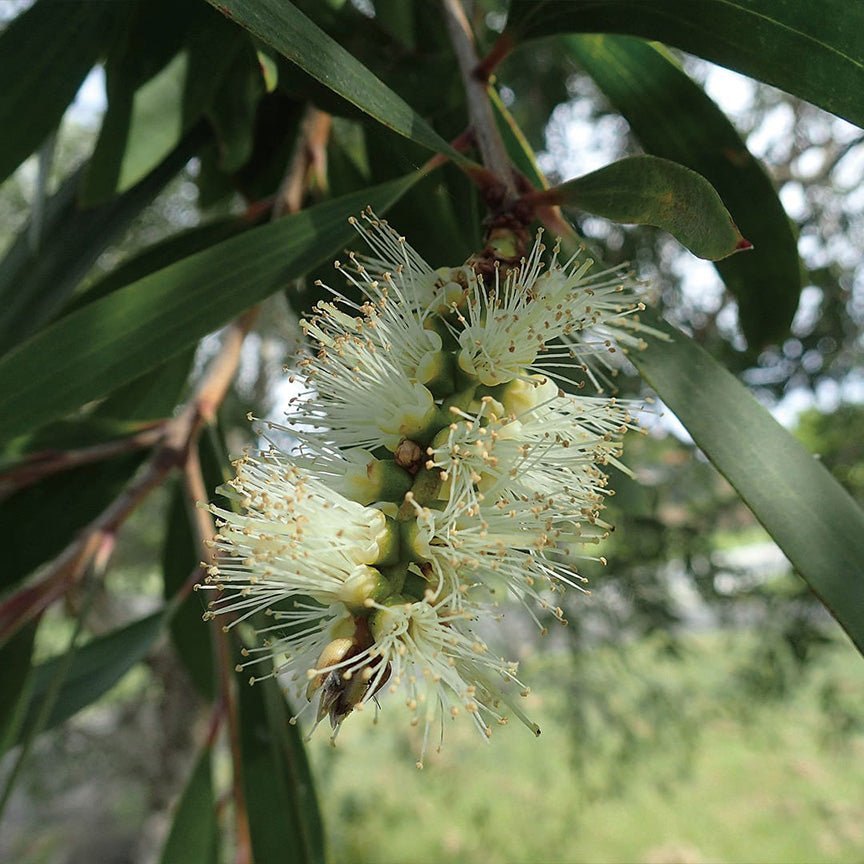
The Vietnamese name, “five-veined paperbark”, translates quinquenervia exactly: according to PROSEA, the leaves have five main parallel veins, rarely three or seven. The tree is native to the coastal region of eastern Australia, southern New Guinea and New Caledonia, and according to PROSEA it has been introduced to Vietnam for provenance trials.
Two very different chemotypes
According to PROSEA, Melaleuca quinquenervia has two main chemotypes: one rich in nerolidol, at about 90%, and one rich in 1,8-cineole (30–70%), sometimes with viridiflorol at 0–60%. The 2025 species profile of the CSIRO Australian Tree Seed Centre, summarising a 2002 study, gives wider ranges:
| Chemotype | Main compounds |
|---|---|
| 1 (“nerolina”) | (E)-Nerolidol 60–95%, linalool trace–40% |
| 2 (“niaouli”) | 1,8-Cineole 10–75%, viridiflorol 13–66%, α-terpineol 0.5–14%, β-caryophyllene 0.5–28% |
According to this profile, the leaves contain 1.0–2.5% essential oil on fresh weight. A 1992 study of 64 oils from 21 trees in Madagascar, over three seasons, recorded two chemotypes: the known 1,8-cineole type and a viridiflorol-rich type (48%).
The nerolidol and cineole forms give two entirely different oils. Commercial niaouli oil, according to PROSEA, is the cineole-rich form. So a label that says “niaouli” without the chemotype is incomplete, and the lot analysis is what confirms it.
A sample grown in Vietnam
A 2024 study in the World Academy of Sciences Journal steam-distilled fresh niaouli leaves collected at Phong Dien (Thua Thien Hue), with a yield of 1.18%, and identified 20 compounds: 1,8-cineole 42.51%, α-terpineol 12.00%, α-cadinol 7.81%, guaiol 6.86%, β-eudesmol 6.53%, γ-eudesmol 3.90% and linalool 3.38%. This sample is of the cineole type but has no viridiflorol, which usually accompanies that type, so it is a rather unusual profile.
New Caledonia and gomen oil
According to PROSEA, niaouli oil is also called gomen oil. The tree is widespread in New Caledonia, especially in the north-west, and the cineole-rich form there is the island’s source of niaouli oil.
PROSEA gives average production of about 20 tonnes a year before the Second World War and in the early 1950s, falling to 2–2.5 tonnes in 1980, 4 tonnes in 1985 and 7–10 tonnes in 1998. Production statistics for this oil, according to PROSEA, are very scarce and incomplete, which makes the origin of any lot on the market all the more worth asking about.
Safe use
Regulation (EU) 2023/1545 has no separate entry for niaouli oil, but the linalool, α-terpineol (under the terpineol entry), β-caryophyllene and limonene in the oil are all on the list of fragrance allergens that must be named on cosmetic labels. Cineole-type oil calls for the same care as other 1,8-cineole-rich oils; the page on children and pregnancy has detailed guidance. Always dilute before use on skin.
Sources
- Doran J.C., Turnbull J.W. Melaleuca quinquenervia (Cav.) S.T. Blake. In PROSEA (Plant Resources of South-East Asia), Pl@ntUse edition. plantuse.plantnet.org
- Doran J., Brophy J., Ahlers R. (2025). Australian essential oil woody-plant species profile: broad-leaved paperbark, Melaleuca quinquenervia. CSIRO Australian Tree Seed Centre. csiro.au
- Ramanoelina P.A.R., Bianchini J.P., Andriantsiferana M., Viano J., Gaydou E.M. (1992). Chemical composition of niaouli essential oils from Madagascar. Journal of Essential Oil Research 4(6), 657–658. (abstract read)
- Chemical compositions and biological properties of the leaf essential oil of three Melaleuca species (2024). World Academy of Sciences Journal 6(6), 67. doi:10.3892/wasj.2024.282
- Regulation (EU) 2023/1545 on the labelling of fragrance allergens.
Buy Niaouli ct 1,8-cineole
Niaouli ct 1,8-cineole oil: no lot has been brought in yet, so it is not on sale. Message us if you need it.
Where you may already have smelled it
According to the analyses cited above, this oil contains up to 70 % 1,8-cineole. It is also the leading compound in the scenes below from the scent dictionary. Smelling one of those scenes again is a way to get to know it without opening a bottle. A shared compound does not mean the oil smells exactly like the scene.
Further reading
Close to Niaouli ct 1,8-cineole
Same plant family: Myrtaceae Clove bud · Eucalyptus dives · Eucalyptus globulus · Green myrtle · Honey myrtle · Lemon eucalyptus · Tea tree
Also from the leaves Cypress · Eucalyptus radiata · Hemlock spruce · Melissa · Perilla · Rosalina · Tea tree · White fir
Same method: direct steam distillation Atlas cedarwood · Carrot seed · Clove basil · Cypress · Elemi · Himalayan cedarwood · Tea tree · Ylang ylang
Quick answers
What does niaouli ct 1,8-cineole essential oil smell like?
Close to cajeput but rounder and less sharp, because besides cineole it carries heavier compounds such as α-terpineol or viridiflorol.
What is the botanical name of niaouli ct 1,8-cineole oil?
The plant is Melaleuca quinquenervia, in the Myrtaceae family; this oil is the 1,8-cineole chemotype. In Vietnamese it is called tràm năm gân.
How is niaouli ct 1,8-cineole oil produced?
From the leaves of the plant, by direct steam distillation. See the method for what that does to the oil.
What are the main compounds of niaouli ct 1,8-cineole oil?
From the composition data on this page, the oil is led by 1,8-Cineole. Proportions vary with origin, harvest and method; a lot analysis is the only answer for a given bottle.
Last updated