Essential oils · Medicinal family
Bay laurel essential oil
Laurus nobilis
Nguyệt quế · Lauraceae
Cool, green and lightly spicy, like the dried bay leaf in a soup pot but much brighter and fresher.
The coolness is 1,8-cineole, the main compound of bay leaf; the warm sweetness is α-terpinyl acetate; the thin spice comes from a little methyl eugenol and eugenol.
A dried kitchen bay leaf has lost most of its fresh top notes. Smelling the oil and then a dried leaf is a quick way to hear what disappears when the leaf is dried.
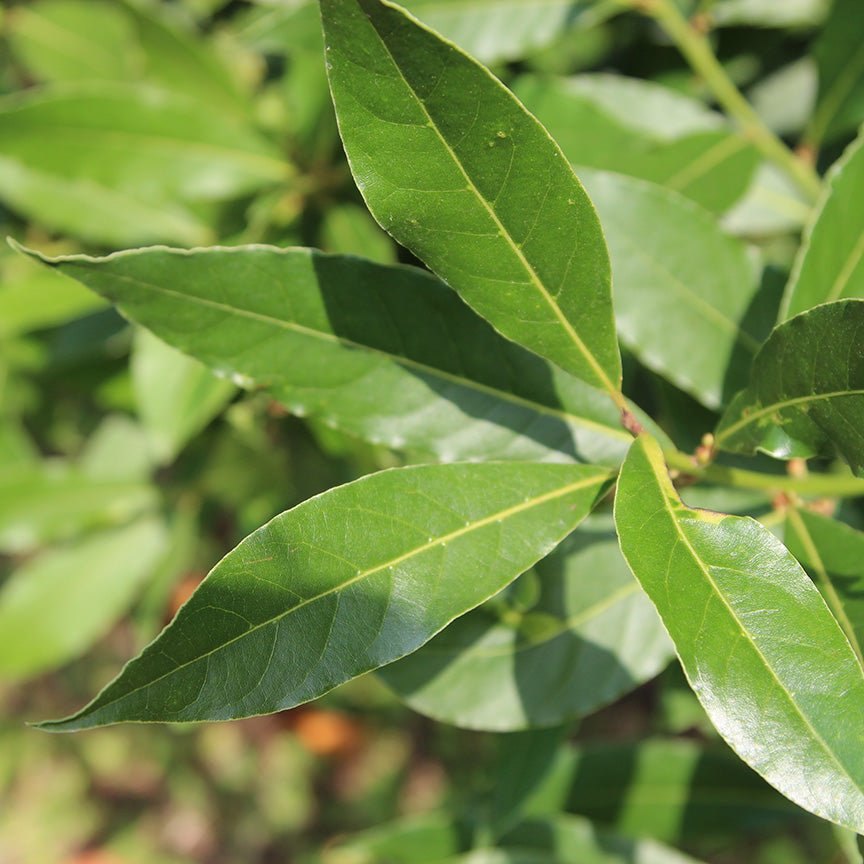
- Plant part
- Leaves
- Vietnamese name
- Nguyệt quế
- Scent family
- Medicinal
- Plant family
- Lauraceae
- Lots published
- —
 Leaves
Composition profile
The published composition from the article, read as structure: 6 compounds adding up to about 100 % of the sample. Figures are printed as the source gives them — one sample, not a species average.
| Compound | Level | Class | Note |
|---|---|---|---|
| 1,8-Cineole | 41–58 % | Oxides | Top |
| α-Terpinyl acetate | 5.5–12.5 % | — | — |
| Sabinene | 4.0–11.5 % | Monoterpenes | Top |
| α-Pinene EU | 4.5–9.0 % | Monoterpenes | Top |
| β-Pinene EU | 2.8–6.0 % | Monoterpenes | Top |
| Linalool EU | 2.0–5.5 % | Alcohols | Middle |
By chemical class
- Oxides58.0 %
- Monoterpenes26.5 %
- Unclassified12.5 %
- Alcohols5.5 %
By note
- Top84.5 %
- Middle5.5 %
- Unclassified12.5 %
Group totals use the upper bound of each range and only the compounds the article lists; bars are relative to the identified total.
Compare with the 2 chemically closest oils Which other oils are rich in 1,8-Cineole?
Laurel leaf and the kitchen bay leaf
Bay laurel (Laurus nobilis) is a shrub or small tree of the Mediterranean. Its dried leaves are the familiar “bay leaves” of European cooking, dropped into soups and wine sauces. It should not be confused with “bay rum” (Pimenta racemosa) from the Caribbean, an entirely different tree.
Commercial leaf oil: the EFSA specification
The European Food Safety Authority’s (EFSA) 2023 assessment of laurel leaf oil as a feed additive, steam-distilled from fresh or dried leaves, sets a specification and analysed 6 batches, some from the Balkans or Turkey:
| Compound | EFSA specification | 6 batches (mean) |
|---|---|---|
| 1,8-Cineole | 41–58% | 47.0% |
| α-Terpinyl acetate | 5.5–12.5% | 11.3% |
| α-Pinene | 4.5–9.0% | 6.69% |
| Sabinene | 4.0–11.5% | 6.55% |
| β-Pinene | 2.8–6.0% | 4.31% |
| Linalool | 2.0–5.5% | 3.61% |
| Methyl eugenol | – | 3.10% |
Methyl eugenol is not in the specification but ranged from 2.34% to 4.00% across the 6 batches; eugenol averaged 0.76%.
Leaf, twig and fruit: three oils
A 2019 study in Molecules distilled oil separately from the leaves, twigs and fruit of wild laurel near Nesebar on Bulgaria’s Black Sea coast. Yields on dry weight were 3.25% for leaves, 0.80% for twigs and 0.78% for fruit:
| Compound | Leaf | Twig | Fruit |
|---|---|---|---|
| 1,8-Cineole | 41.0% | 48.5% | 33.3% |
| α-Terpinyl acetate | 14.4% | 13.1% | 10.3% |
| Sabinene | 8.8% | 3.3% | 6.3% |
| Methyl eugenol | 6.0% | 6.6% | – |
| Linalool | 4.9% | 3.8% | – |
| α-Pinene | 2.6% | – | 11.0% |
A dash means the paper gives no figure for that part. All three are built around 1,8-cineole, but in different proportions: twigs are richest in cineole, and the fruit adds α-pinene and β-elemene (about 7.5%).
Composition changes with origin
A 2017 study in Molecules of dried leaves from Cilento (southern Italy) recorded 1,8-cineole at only 31.9%, with sabinene 12.2%, linalool 10.2% and methyl eugenol 3.3%. That paper also cites 1,8-cineole figures from other studies: Turkey 44.97%, Morocco 52.43%, Tunisia 56.0%, Cyprus 58.59% and Algeria 34.62%. The 2019 study cites an older review giving cineole in leaf oil as 30–70% and linalool as 0.9–26.9%.
Methyl eugenol: what to know
All three sources above record methyl eugenol in the leaf oil, at about 3–6%. EFSA notes that methyl eugenol has been shown to be genotoxic and carcinogenic in rodents. IFRA restricts methyl eugenol very tightly, for example to at most 0.011% in fine fragrance (category 4, Amendment 51). So laurel oil is not one to apply concentrated, and the lot analysis should give a specific methyl eugenol figure.
Safe use
The linalool and pinene in the oil are on the EU list of fragrance allergens that must be labelled, and EFSA classes the oil as an irritant to skin, eyes and respiratory tract for people who handle it. Always dilute before use on skin, and see the page on children and pregnancy.
Sources
- EFSA FEEDAP Panel (2023). Safety and efficacy of a feed additive consisting of an essential oil from the leaves of Laurus nobilis L. (laurel leaf oil) for all animal species (FEFANA asbl). EFSA Journal 21(3), e07875. doi:10.2903/j.efsa.2023.7875
- Fidan H., Stefanova G., Kostova I. et al. (2019). Chemical Composition and Antimicrobial Activity of Laurus nobilis L. Essential Oils from Bulgaria. Molecules 24(4), 804. doi:10.3390/molecules24040804
- Caputo L., Nazzaro F., Souza L.F. et al. (2017). Laurus nobilis: Composition of Essential Oil and Its Biological Activities. Molecules 22(6), 930. doi:10.3390/molecules22060930
- IFRA Standard: Methyl eugenol, Amendment 51 (2023).
- Regulation (EU) 2023/1545 on the labelling of fragrance allergens.
Buy Bay laurel
Bay laurel oil: no lot has been brought in yet, so it is not on sale. Message us if you need it.
Where you may already have smelled it
According to the analyses cited above, this oil contains up to 58 % 1,8-cineole. It is also the leading compound in the scenes below from the scent dictionary. Smelling one of those scenes again is a way to get to know it without opening a bottle. A shared compound does not mean the oil smells exactly like the scene.
Chemically close
The oils whose published composition is closest to this one, compared across every compound we could read. Close in composition does not mean the scent is identical or that one can replace the other.
- Honey myrtle Melaleuca teretifolia shared: 1,8-Cineole, α-Pinene · closeness 0.94 · compare
- Eucalyptus globulus Eucalyptus globulus shared: 1,8-Cineole, α-Pinene · closeness 0.94 · compare
- Rosalina Melaleuca ericifolia shared: 1,8-Cineole, α-Pinene · closeness 0.93 · compare
Further reading
Close to Bay laurel
Same plant family: Lauraceae Camphor ct camphor · Cassia bark · Ceylon cinnamon · Chinese cassia · Indian bay leaf · Ravintsara ct 1,8-cineole
Also from the leaves Geranium · Indian bay leaf · Lemon myrtle · Niaouli ct 1,8-cineole · Pinyon pine · Ravintsara ct 1,8-cineole · Rosalina · Wintergreen
Same method: direct steam distillation Eucalyptus globulus · Fingerroot · Larch / Tamarack · Melissa · Mugwort · Patchouli · Tarragon · Ylang ylang
Quick answers
What does bay laurel essential oil smell like?
Cool, green and lightly spicy, like the dried bay leaf in a soup pot but much brighter and fresher.
What is the botanical name of bay laurel oil?
The plant is Laurus nobilis, in the Lauraceae family. In Vietnamese it is called nguyệt quế.
How is bay laurel oil produced?
From the leaves of the plant, by direct steam distillation. See the method for what that does to the oil.
What are the main compounds of bay laurel oil?
From the composition data on this page, the oil is led by 1,8-Cineole, Sabinene and α-Pinene. Proportions vary with origin, harvest and method; a lot analysis is the only answer for a given bottle.
Last updated