Essential oils · Medicinal family
Japanese mint essential oil
Mentha canadensis
Bạc hà cay Nhật · Lamiaceae
Cold, straight, almost a single note. It is harsher than peppermint and has less of the sweet layer, closer to a mint sweet than to a leaf.
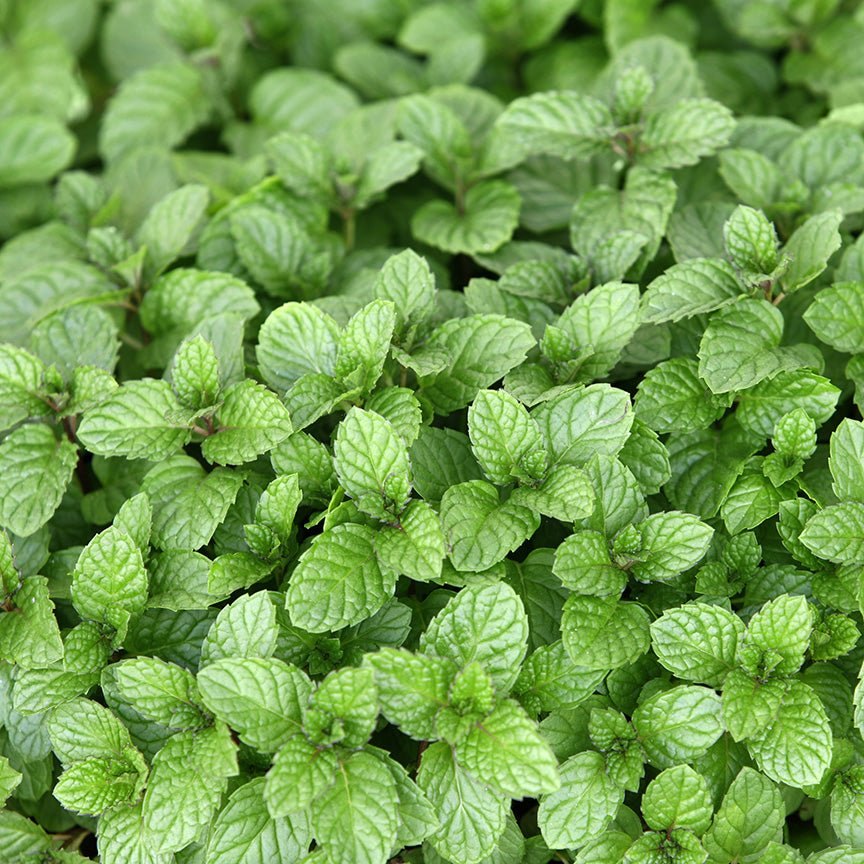
Japanese mint (Mentha canadensis) is a close relative of cornmint and just as rich in menthol. The crude oil is usually chilled to remove some of the crystallised menthol, and the remaining oil is what is sold, so the bottle you smell is already a “depleted” version of the plant.
With this oil, the analysis is the only way to know how much menthol is left. The cornmint page covers dementholising in detail.
- Plant part
- Whole plant
- Vietnamese name
- Bạc hà cay Nhật
- Scent family
- Medicinal
- Plant family
- Lamiaceae
- Lots published
- —
 Whole plant
Composition profile
The published composition from the article, read as structure: 5 compounds adding up to about 89 % of the sample. Figures are printed as the source gives them — one sample, not a species average.
| Compound | Level | Class | Note |
|---|---|---|---|
| Menthol EU | 77.94 % | Alcohols | Middle |
| Isomenthone | 5.24 % | — | — |
| Menthone | 5.00 % | — | — |
| Limonene EU | 0.28 % | Monoterpenes | Top |
| Menthyl acetate | 0.10 % | — | — |
By chemical class
- Alcohols77.9 %
- Unclassified10.3 %
- Monoterpenes0.3 %
By note
- Top0.3 %
- Middle77.9 %
- Unclassified10.3 %
Group totals use the upper bound of each range and only the compounds the article lists; bars are relative to the identified total.
Compare with the 2 chemically closest oils Which other oils are rich in Menthol?
What Japanese mint is
Japanese mint (Mentha canadensis, formerly M. arvensis var. piperascens), is a mint rich in menthol, usually above 60%, and is grown mainly as a source of natural menthol. It belongs to the same group as cornmint grown in Vietnam.
Composition
| Compound | Punjab, India (2018) | Mississippi, USA (2012) | 9 cultivars, Himalaya (2013) |
|---|---|---|---|
| Menthol | 77.94% | 74.3–79.0% | 73.7–85.8% |
| Menthone | 5.00% | 4.3–6.3% | 1.5–11.0% |
| Isomenthone | 5.24% | 4.4–5.7% | 2.1–3.9% |
| Menthyl acetate | 0.10% | – | 0.5–5.3% |
| Limonene | 0.28% | 0.69–1.53% | 1.2–3.3% |
The Mississippi samples show that distillation time also changes the proportions: menthol was 74.3% after 1.25 minutes, 77.2–77.6% after 10–80 minutes and 79.0% after 160 minutes. A dash means the study did not report it.
In Vietnam, two studies of locally grown M. arvensis found lower menthol: 62.8–70.6% in samples from Lam Dong, Ba Ria–Vung Tau and Ho Chi Minh City, and 53.62–62.61% in samples from Thai Binh, Binh Thuan and An Giang, with menthone at about 12–21%. See also the cornmint page.
Whole oil and dementholised oil
There is so much menthol that the oil is chilled so the menthol crystallises and can be removed, and the remaining oil is sold separately. So there are two different oils on the market. The Indian Standard IS 528:1999 distinguishes them clearly:
| Parameter | Type 1: whole oil | Type 2: partly dementholised oil |
|---|---|---|
| Free menthol | min. 60% | min. 40% |
| Ketones (as menthone) | 5–20% | 25–40% |
| Esters (as menthyl acetate) | 3–15% | 3–9% |
The European Pharmacopoeia, as quoted in a 2019 review, sets these figures for dementholised mint oil: menthol 30–50%, menthone 17–35%, isomenthone 5.0–13.0%, limonene 1.5–7.0%.
In other words, dementholised oil has much less menthol and much more menthone than whole oil. When buying, ask which type the bottle is.
Compared with peppermint
According to the same 2019 review, peppermint oil (M. × piperita) usually has 20–60% menthol and 5–35% menthone, plus menthofuran, which appears in the Pharmacopoeia requirements for peppermint oil but not in those for dementholised mint oil. Japanese mint is therefore colder and more “single-note”, while peppermint is more layered and sweeter.
Safety
Menthol-rich oils should not be used near the faces of young children (see children and pregnancy). Always dilute before use on skin.
Sources
- Makkar M.K., Sharma S., Kaur H. (2018). Evaluation of Mentha arvensis essential oil and its major constituents for fungitoxicity. Journal of Food Science and Technology 55(9), 3840–3844. doi:10.1007/s13197-018-3291-y
- Zheljazkov V.D., Astatkie T. (2012). Effect of Distillation Time on Mentha canadensis Essential Oil Yield and Composition. HortScience 47(5), 643–647. doi:10.21273/HORTSCI.47.5.643
- Padalia R.C., Verma R.S., Chauhan A. et al. (2013). Essential oil composition of sixteen elite cultivars of Mentha from western Himalayan region, India. Maejo International Journal of Science and Technology 7(1), 83–93.
- Kalemba D., Synowiec A. (2019). Agrobiological Interactions of Essential Oils of Two Menthol Mints: Mentha piperita and Mentha arvensis. Molecules 25(1), 59. doi:10.3390/molecules25010059
- Indian Standard IS 528:1999. Mentha Oil (Arvensis).
- Investigation and assessment of the quality of Japanese mint essential oil (Mentha arvensis) originated from various geographical regions in Vietnam. Journal of Science and Technology, Nguyen Tat Thanh University. doi:10.55401/v3ac2453
- Evaluation of the chemical components and some bioactive compounds of the peppermint essential oil (Mentha arvensis L.) cultivated in Vietnam (2021). Vietnam Journal of Science and Technology 63(7), 26–30. doi:10.31276/VJST.63(7).26-30
Buy Japanese mint
Japanese mint oil: no lot has been brought in yet, so it is not on sale. Message us if you need it.
Where you may already have smelled it
According to the analyses cited above, this oil contains up to 77.9 % menthol. It is also the leading compound in the scenes below from the scent dictionary. Smelling one of those scenes again is a way to get to know it without opening a bottle. A shared compound does not mean the oil smells exactly like the scene.
- Golden Star balmOpen a tin of Golden Star balm and smell it from a hand’s span away
- Medicated balmOpen a bottle of green dầu gió medicated balm and smell from a hand’s span away
- PeppermintCrush a fresh peppermint leaf and smell it at once
- MouthwashOpen a bottle of mouthwash and smell right at the neck
Chemically close
The oils whose published composition is closest to this one, compared across every compound we could read. Close in composition does not mean the scent is identical or that one can replace the other.
- Cornmint Mentha arvensis shared: Menthol, Menthone · closeness 0.99 · compare
- Peppermint Mentha × piperita shared: Menthol, Isomenthone · closeness 0.87 · compare
Further reading
Close to Japanese mint
Same plant family: Lamiaceae Basil ct linalool · Catnip · Cornmint · Lavandin · Rosemary ct camphor · Spearmint · Spike lavender · Thyme ct linalool
Also from the whole plant Baeckea · Catnip · Cornmint · Holy basil (tulsi) · Hyssop ct 1,8-cineole · Spearmint · Thyme ct linalool · Thyme ct thymol
Same method: direct steam distillation Cornmint · Eucalyptus dives · Holy basil (tulsi) · Lemon eucalyptus · Moroccan blue chamomile · Red myrtle · Spearmint · Thuja
Quick answers
What does Japanese mint essential oil smell like?
Cold, straight, almost a single note. It is harsher than peppermint and has less of the sweet layer, closer to a mint sweet than to a leaf.
What is the botanical name of Japanese mint oil?
The plant is Mentha canadensis, in the Lamiaceae family. In Vietnamese it is called bạc hà cay nhật.
How is Japanese mint oil produced?
From the whole plant of the plant, by direct steam distillation. See the method for what that does to the oil.
Last updated