Fingerroot essential oil
Boesenbergia rotunda
Ngải bún · Zingiberaceae
Camphor, earth, warmth, with a surprisingly thin floral layer underneath. It is closer to galangal than to ginger.
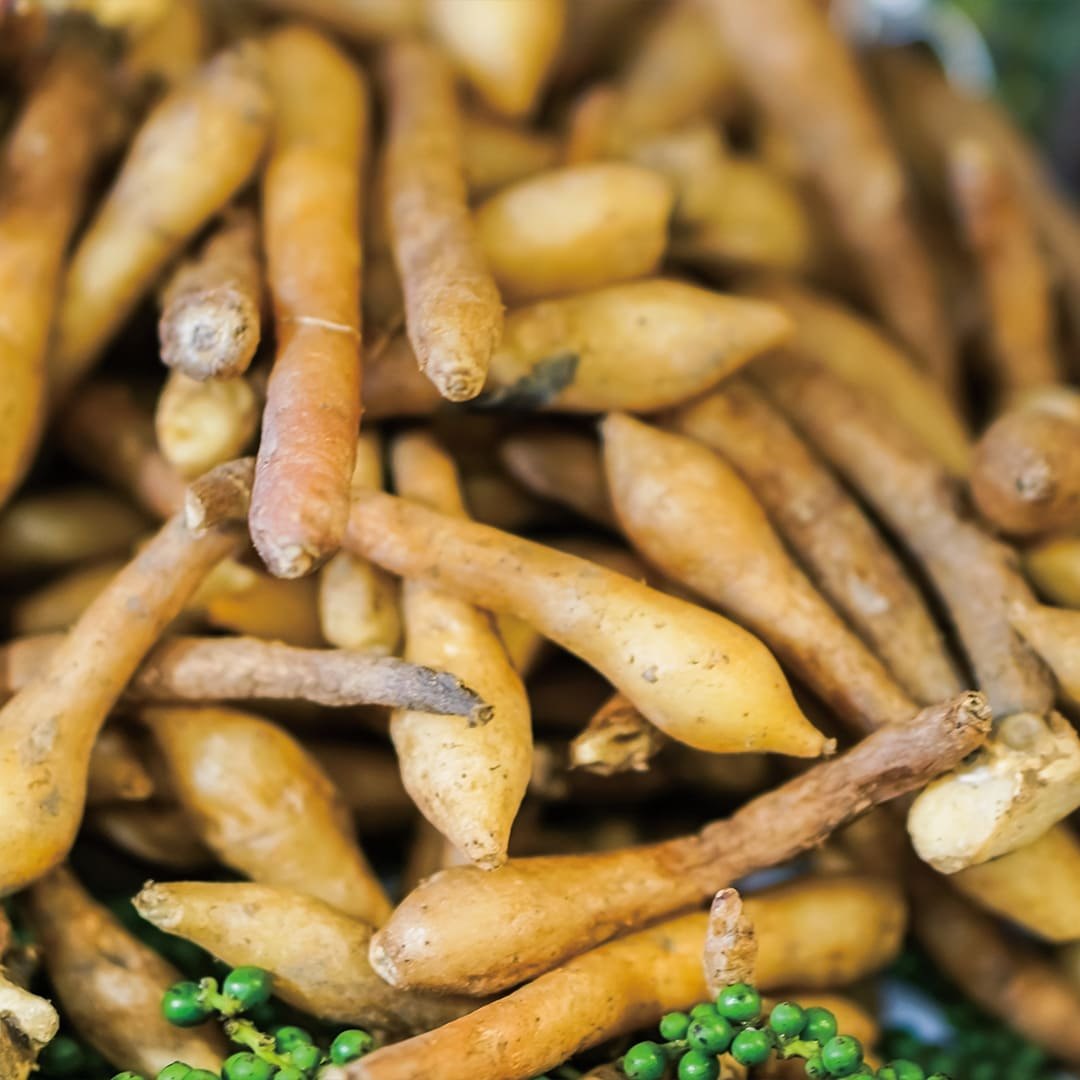
The rhizome grows in clusters like fingers, and in Thailand the roots and rhizomes are used as a spice in a number of dishes. Its oil carries camphor and 1,8-cineole in the opening, while the floral layer behind comes from geraniol, the compound usually found in rose and palmarosa.
In Vietnam, oil has been distilled from fingerroot grown in Dong Thap. The balance of camphor, cineole and geraniol shifts considerably between rhizome and tuberous root, so the label should state the part distilled.
- Plant part
- Rhizome
- Vietnamese name
- Ngải bún
- Scent family
- Spicy
- Plant family
- Zingiberaceae
- Lots published
- —
 Rhizome
Composition profile
The published composition from the article, read as structure: 7 compounds adding up to about 85 % of the sample. Figures are printed as the source gives them — one sample, not a species average.
| Compound | Level | Class | Note |
|---|---|---|---|
| Camphor EU | 28.57 % | Ketones | Middle |
| 1,8-Cineole | 16.00 % | Oxides | Top |
| Geraniol EU | 15.47 % | Alcohols | Base |
| (E)-β-Ocimene | 12.87 % | Monoterpenes | Top |
| Camphene | 6.16 % | Monoterpenes | Top |
| Methyl cinnamate | 4.05 % | Esters | Base |
| Limonene EU | 2.12 % | Monoterpenes | Top |
By chemical class
- Ketones28.6 %
- Monoterpenes21.2 %
- Oxides16.0 %
- Alcohols15.5 %
- Esters4.1 %
By note
- Top37.2 %
- Middle28.6 %
- Base19.5 %
Group totals use the upper bound of each range and only the compounds the article lists; bars are relative to the identified total.
Put it beside another oil in the Compare tool Which other oils are rich in Camphor?
What fingerroot is
Fingerroot (Boesenbergia rotunda) is a member of the ginger family whose roots grow in clusters like fingers. In Thailand, where it is called krachai, the roots and rhizomes are used as a spice in a number of dishes. In Vietnam, oil has been distilled from plants grown in the country.
Composition: oil from Dong Thap
A 2025 study in Plant Science Today hydrodistilled (3 hours) the fresh rhizomes and tuberous roots separately, from fingerroot grown in Dong Thap and collected in April 2023:
| Compound | Rhizome | Tuberous root |
|---|---|---|
| Camphor | 28.57% | 19.88% |
| 1,8-Cineole | 16.00% | 4.25% |
| Geraniol | 15.47% | 16.34% |
| (E)-β-Ocimene | 12.87% | 31.92% |
| Camphene | 6.16% | 5.21% |
| (E)-Methyl cinnamate | 4.05% | 0.50% |
| Limonene | 2.12% | 7.45% |
Oil yield was 0.48% for the rhizome and 0.25% for the tuberous root, on a fresh-weight basis.
The rhizome and the tuberous root give clearly different oils: the root has far less cineole but about two and a half times as much ocimene. A bottle of fingerroot oil should state which part was distilled.
Three krachai types in Thailand
A 2021 study in the Songklanakarin Journal of Science and Technology distilled oil from the rhizomes and roots of three Thai types of fingerroot: Krachai Ban (cultivated, Pathumthani), Krachai Deang (Ratchaburi) and Krachai Pha (wild, Chiang Mai), with yields of 0.18–0.26%. For the rhizome:
| Compound | Ban | Deang | Pha |
|---|---|---|---|
| Camphor | 25.78% | 7.93% | 41.12% |
| 1,8-Cineole | 20.11% | 65.87% | 13.18% |
| Geraniol | 11.83% | 4.49% | 9.32% |
| (Z)-β-Ocimene | 17.26% | – | 16.25% |
| Camphene | 6.88% | – | 6.82% |
A dash means not detected. Krachai Ban is close to the Dong Thap sample: camphor, cineole, geraniol and ocimene, with 5.87% methyl cinnamate. Krachai Deang is a cineole oil, nearly two thirds 1,8-cineole. One more difference: the Thai samples report ocimene as the (Z) form, the Dong Thap sample as the (E) form.
Camphor, cineole and geraniol
Camphor and 1,8-cineole lead in most samples, so the oil leans towards a cool, camphoraceous smell. Geraniol, also abundant in palmarosa, is present at about 3–18% depending on the sample and the part. The two studies show that under the same name, the balance between these compounds shifts clearly with the plant type and the part distilled.
Safety
Oils high in camphor and cineole are not suitable for use near the faces of young children; see children and pregnancy. Camphor and limonene are on the EU list of fragrance allergens that must be declared on cosmetic labels under Regulation 2023/1545, and geraniol is also a substance that must be declared under EU cosmetics rules. Always dilute before use on skin.
Sources
- Chemical composition and anti-Helicobacter pylori activity of essential oils from rhizomes and tuberous roots of Boesenbergia rotunda (L.) Mansf. (2025). Plant Science Today 12(4), 1–11. doi:10.14719/pst.11764
- Theanphong O., Mingvanish W., Jenjittikul T., Rungsihirunrat K. (2021). Genetic variation of Boesenbergia rotunda (L.) Mansf. from Thailand based on essential oil compositions and internal transcribed spacer sequences. Songklanakarin Journal of Science and Technology 43(6), 1620–1627. doi:10.14456/sjst-psu.2021.212
- Regulation (EU) 2023/1545 on the labelling of fragrance allergens.
Buy Fingerroot
Fingerroot oil: no lot has been brought in yet, so it is not on sale. Message us if you need it.
Where you may already have smelled it
According to the analyses cited above, this oil contains up to 28.6 % camphor and up to 20.1 % 1,8-cineole. Both are also the leading compound in the scenes below from the scent dictionary. Smelling one of those scenes again is a way to get to know them without opening a bottle. A shared compound does not mean the oil smells exactly like the scene.
Further reading
Close to Fingerroot
Same plant family: Zingiberaceae Amomum · Cardamom · Galangal · Ginger · Turmeric
Also from the rhizome Galangal · Ginger · Spikenard · Turmeric · Wild ginger
Same method: direct steam distillation Cardamom · Engelmann spruce · Frankincense · Indian patchouli · Mugwort · Tarragon · White pine · Ylang ylang
Quick answers
What does fingerroot essential oil smell like?
Camphor, earth, warmth, with a surprisingly thin floral layer underneath. It is closer to galangal than to ginger.
What is the botanical name of fingerroot oil?
The plant is Boesenbergia rotunda, in the Zingiberaceae family. In Vietnamese it is called ngải bún.
How is fingerroot oil produced?
From the rhizome of the plant, by direct steam distillation. See the method for what that does to the oil.
What are the main compounds of fingerroot oil?
From the composition data on this page, the oil is led by Camphor, 1,8-Cineole and Geraniol. Proportions vary with origin, harvest and method; a lot analysis is the only answer for a given bottle.
Last updated