Vietnamese balm essential oil
Elsholtzia ciliata
Kinh giới · Lamiaceae
Lemon, green, slightly pungent, on a warm herbal base. This is the smell of the plate of fresh herbs served with bún chả, only much stronger.
Vietnamese kinh giới is Elsholtzia ciliata, not the European marjoram or oregano that many sources mistranslate it as. The composition of its oil varies by region: in some places it leans heavily towards the compounds that give a lemon smell, in others towards a ketone peculiar to this genus, with a more pungent smell.
So the description above only holds for the lemony form, the one closest to the bunch of herbs at the market. A lot with a different composition will smell different, and its analysis will say so.
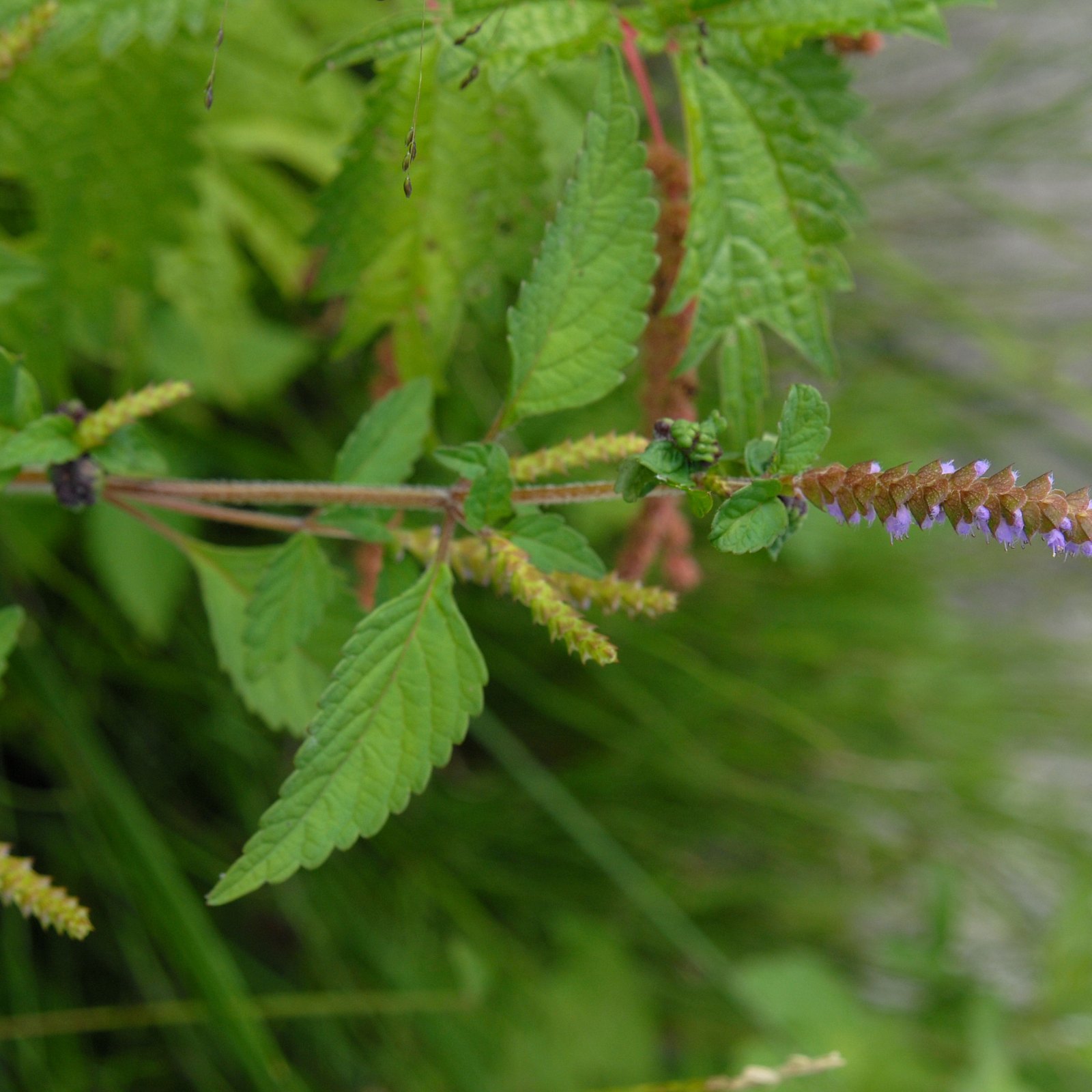
- Plant part
- Whole plant
- Vietnamese name
- Kinh giới
- Scent family
- Green
- Plant family
- Lamiaceae
- Lots published
- —
 Whole plant
Composition profile
The published composition from the article, read as structure: 7 compounds adding up to about 80 % of the sample. Figures are printed as the source gives them — one sample, not a species average.
| Compound | Level | Class | Note |
|---|---|---|---|
| Geranial EU | 23.4 % | Aldehydes | Middle |
| Neral EU | 16.8 % | Aldehydes | Middle |
| (E)-β-Ocimene | 14.0 % | Monoterpenes | Top |
| Linalool EU | 8.3 % | Alcohols | Middle |
| 1-Octen-3-ol | 7.1 % | Alcohols | Top |
| (E)-β-Farnesene | 6.2 % | — | — |
| Limonene EU | 4.1 % | Monoterpenes | Top |
By chemical class
- Aldehydes40.2 %
- Monoterpenes18.1 %
- Alcohols15.4 %
- Unclassified6.2 %
By note
- Top25.2 %
- Middle48.5 %
- Unclassified6.2 %
Group totals use the upper bound of each range and only the compounds the article lists; bars are relative to the identified total.
Compare with the 2 chemically closest oils Which other oils are rich in Geranial?
Vietnamese balm is not European marjoram
The kinh giới served with bun cha and fresh herb plates is Elsholtzia ciliata, a member of the mint family. Many sources translate kinh giới as oregano or marjoram, but those are quite different plants: oregano and sweet marjoram belong to the genus Origanum. The usual English name for the Vietnamese herb is Vietnamese balm. See the Vietnamese balm entry in the scent dictionary.
Vietnamese balm is a citral oil
A 2017 study in Molecules analysed leaf oil from Vietnamese balm grown in Vietnam:
| Compound | Share |
|---|---|
| Geranial | 23.4% |
| Neral | 16.8% |
| (E)-β-Ocimene | 14.0% |
| Linalool | 8.3% |
| 1-Octen-3-ol | 7.1% |
| (E)-β-Farnesene | 6.2% |
| Limonene | 4.1% |
Geranial and neral together are citral, 40.2%, the lemon smell. Ocimene gives a green, slightly sweet note; 1-octen-3-ol is “mushroom alcohol”, the faint damp-earth note underneath. This is the version closest to the bunch of herbs at the market: lemony, green, slightly pungent.
Three kinds of Elsholtzia
The same species gives very different oils depending on where it grows. A 2025 study in Crops summarises:
| Type | Where found | Main compounds |
|---|---|---|
| Citral | Vietnamese samples | Citral 31.3–40.2%, β-ocimene 13.3–21.5% |
| Ketone | Russia, Lithuania | Dehydroelsholtzia ketone 70.1–75.3% |
| Limonene | Bat Xat, Lao Cai | Limonene 71.0%, carvone 15.5% |
The European ketone type smells far more pungent and spicy, with almost no lemon; one dried Lithuanian sample had dehydroelsholtzia ketone at 86.23%. The limonene type from Bat Xat is a new finding of the 2025 study, with carvone giving a spearmint note.
Another Vietnamese study from 2023 found (Z)-β-farnesene the highest at 22.72%, with neral 15.66% and geranial 15.62%. So even within the citral type, the proportions vary.
What this means when buying
The name “Vietnamese balm” on a label is not enough. A bottle imported from Europe may be the ketone type, smelling nothing like the Vietnamese herb. Three things are needed: the scientific name (Elsholtzia ciliata, not Origanum), the growing region, and an analysis showing the chemotype. Citral is on the EU list of cosmetic ingredients that must be labelled above a threshold; the oil should be diluted before use on skin.
Sources
- In Vitro Anti-Leishmanial Activity of Essential Oils Extracted from Vietnamese Plants (2017). Molecules 22(7), 1071. doi:10.3390/molecules22071071
- Chemotypic Diversity, Antimicrobial Activities, and Molecular Docking Analysis of Essential Oils from Four Elsholtzia Species in Northern Vietnam (2025). Crops 6(1), 2. doi:10.3390/crops6010002
- Martisiene I., Zigmantaite V., Pudziuvelyte L. et al. (2023). Elsholtzia ciliata Essential Oil Exhibits a Smooth Muscle Relaxant Effect. Pharmaceuticals 16(10), 1464. doi:10.3390/ph16101464
- Chemical composition of Elsholtzia ciliata (Thunb.) Hyland essential oil in Vietnam with multiple biological utilities: a survey on antioxidant, antimicrobial, anticancer activities (2023). Academia Journal of Biology 45(3), 99–110. doi:10.15625/2615-9023/18230
Buy Vietnamese balm
Vietnamese balm oil: no lot has been brought in yet, so it is not on sale. Message us if you need it.
In the scent dictionary: Vietnamese balm — a description of the smell, the compounds behind it, and how to smell it for yourself.
Where you may already have smelled it
According to the analyses cited above, this oil contains up to 23.4 % geranial. It is also the leading compound in the scenes below from the scent dictionary. Smelling one of those scenes again is a way to get to know it without opening a bottle. A shared compound does not mean the oil smells exactly like the scene.
Chemically close
The oils whose published composition is closest to this one, compared across every compound we could read. Close in composition does not mean the scent is identical or that one can replace the other.
- May chang Litsea cubeba shared: Geranial, Neral · closeness 0.84 · compare
- Lemon myrtle Backhousia citriodora shared: Geranial, Neral · closeness 0.83 · compare
- East Indian lemongrass Cymbopogon flexuosus shared: Geranial, Neral · closeness 0.83 · compare
Further reading
Close to Vietnamese balm
Same plant family: Lamiaceae Bee balm · Hyssop ct 1,8-cineole · Indian patchouli · Lavender · Oregano · Perilla · Spearmint · Sweet marjoram
Also from the whole plant Basil ct linalool · Bergamot mint · Cornmint · Hyssop ct 1,8-cineole · Mugwort · Oregano · Sweet marjoram · Tarragon
Same method: direct steam distillation Amomum · Hyssop ct 1,8-cineole · Kunzea · Lemon verbena · Melissa · Opopanax · Oregano · Sweet marjoram
Quick answers
What does Vietnamese balm essential oil smell like?
Lemon, green, slightly pungent, on a warm herbal base. This is the smell of the plate of fresh herbs served with bún chả, only much stronger.
What is the botanical name of Vietnamese balm oil?
The plant is Elsholtzia ciliata, in the Lamiaceae family. In Vietnamese it is called kinh giới.
How is Vietnamese balm oil produced?
From the whole plant of the plant, by direct steam distillation. See the method for what that does to the oil.
What are the main compounds of Vietnamese balm oil?
From the composition data on this page, the oil is led by Geranial, Neral and (E)-β-Ocimene. Proportions vary with origin, harvest and method; a lot analysis is the only answer for a given bottle.
Last updated